
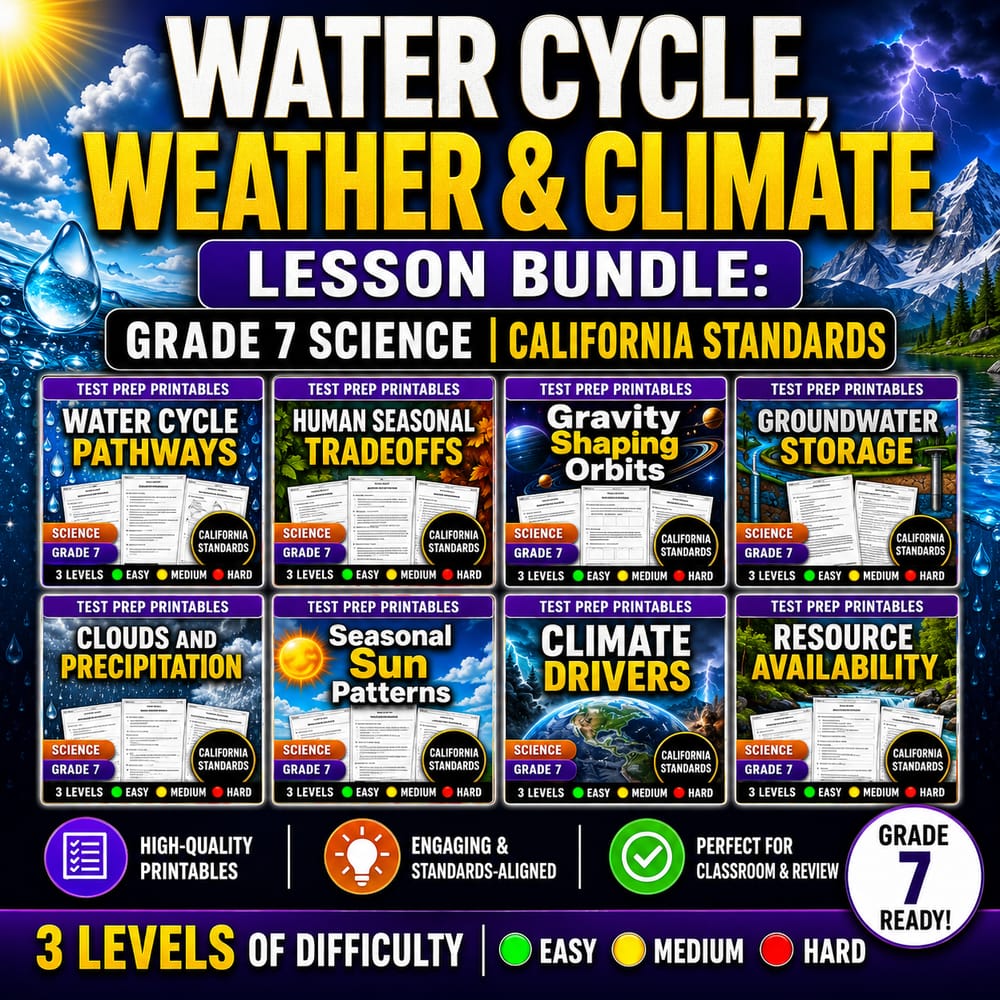
Water Cycle, Weather & Climate Lesson Bundle: Grade 7 Science California Standards
$40.00$50.00Save $10.00
Prism Point Learning
·2 followers·13 sales
SubjectScienceGradeGrade 7
What’s included
10 worksheets · Save $10.00 (20%) · prices shown inside the bundle
 Water Cycle Pathways Worksheet Grade 7 Science | California Standards
- Explain how water moves through the atmosphere, land, and oceans during the water cycle
- Describe how energy from the Sun and gravity drive major water cycle processes
- Connect water cycle pathways to weather, climate, and ecosystems
$4.00$5.00 Human Resource Tradeoffs Worksheet Grade 7 Science | Sustainability & Resources
- Explain how limited resources force communities to balance competing needs and goals
- Identify environmental constraints (land, water, and ecosystem health) that affect human decisions
- Evaluate tradeoffs by considering reliability, cost, human health, and ecological protection
$4.00$5.00 Gravity Shaping Orbits Worksheet Grade 7 Science | Space Science Activity
- Explain how gravity provides the centripetal force that keeps bodies in orbit
- Describe why orbital paths are curved and often elliptical due to changing gravitational direction
- Connect gravity and inertia to predict why objects do not move in straight lines
$4.00$5.00 Groundwater Storage Worksheet Grade 7 Science | Water Resources Activity
- Explain how infiltration and aquifers store groundwater within Earth’s subsurface.
- Describe how gravity and pressure differences influence groundwater movement and baseflow.
- Identify factors that control recharge and how pumping can change groundwater levels and quality.
$4.00$5.00 Clouds and Precipitation Worksheet Grade 7 Science | Weather Systems
- Explain how air cooling and water vapor turning into tiny droplets or ice crystals form clouds.
- Describe how temperature and moisture conditions affect whether clouds produce low clouds, tall storm clouds, or persistent precipitation.
- Connect phase changes and energy transfer to the water cycle and local weather patterns.
$4.00$5.00 Seasonal Sun Patterns Worksheet Grade 7 Science | Earth-Sun System Activity
- Explain how Earth’s axial tilt and orbit change the Sun’s apparent height and daylight length over the year.
- Describe how seasonal patterns differ between the Northern and Southern hemispheres.
- Use evidence-based reasoning to connect solar energy distribution to summer and winter temperatures.
$4.00$5.00 Climate Drivers Worksheet Grade 7 Science | Climate Factors & Earth Systems
- Differentiate weather and climate using time scales and typical patterns.
- Explain how solar energy, atmospheric circulation, and water distribution shape climate.
- Describe how ocean heat storage and release can influence regional climate patterns.
$4.00$5.00 Water Availability and Resources Worksheet Grade 7 Science | California Standards
- Explain how natural processes and human use affect the availability of land, water, and air resources.
- Describe how precipitation patterns and groundwater storage influence access to freshwater.
- Evaluate how droughts, floods, and human demand can change ecosystem stress and resource availability.
$4.00$5.00 Air Masses and Fronts Worksheet Grade 7 Science | Weather & Climate
- Explain how air masses with different temperatures and moisture levels interact to form fronts.
- Describe how air rises, cools, and condenses near a front to increase clouds and precipitation.
- Interpret how wind shifts and temperature changes can signal a front moving through an area.
$4.00$5.00 Designing Water Systems Worksheet Grade 7 Science | Engineering Design
- Evaluate freshwater management options by identifying tradeoffs in cost, reliability, energy use, and environmental impact.
- Explain how design constraints (water quality, infrastructure limits, and altered flow patterns) affect water system decisions.
- Propose improvements that reduce risk from scarcity and pollution while supporting long-term sustainability.
$4.00$5.00
Reviews & Feedback
Loading reviews...
Questions & Answers
Loading questions…
About this bundle
Related categories
Frequently asked questions
Who is Water Cycle, Weather & Climate Lesson Bundle: Grade 7 Science California Standards designed for?
Water Cycle, Weather & Climate Lesson Bundle: Grade 7 Science California Standards is designed for Grade 7 students and Science learners and can be used in classrooms, homeschool, or independent practice.
How do I download Water Cycle, Weather & Climate Lesson Bundle: Grade 7 Science California Standards?
Add it to your cart and complete checkout. After payment, you can download immediately from your account, and you'll also receive a download link by email.
Similar Products

Weather, Water Cycle & Climate Systems Lesson Bundle | Grade 6 Science | NGSS
$24.00$30.00

Grade 6 Science Unit Bundle - Weather, Water Cycle & Climate Systems - NGSS
$14.40$18.00

Grade 6 Science | Weather, Water Cycle & Climate Systems Worksheet Bundle
$9.60$12.00

Grade 3 Science Lesson Group | Weather, Water Cycle, and More
$19.20$24.00

Grade 6 Earth Science Worksheets | Weather, Water & Climate Bundle
$19.20$24.00