
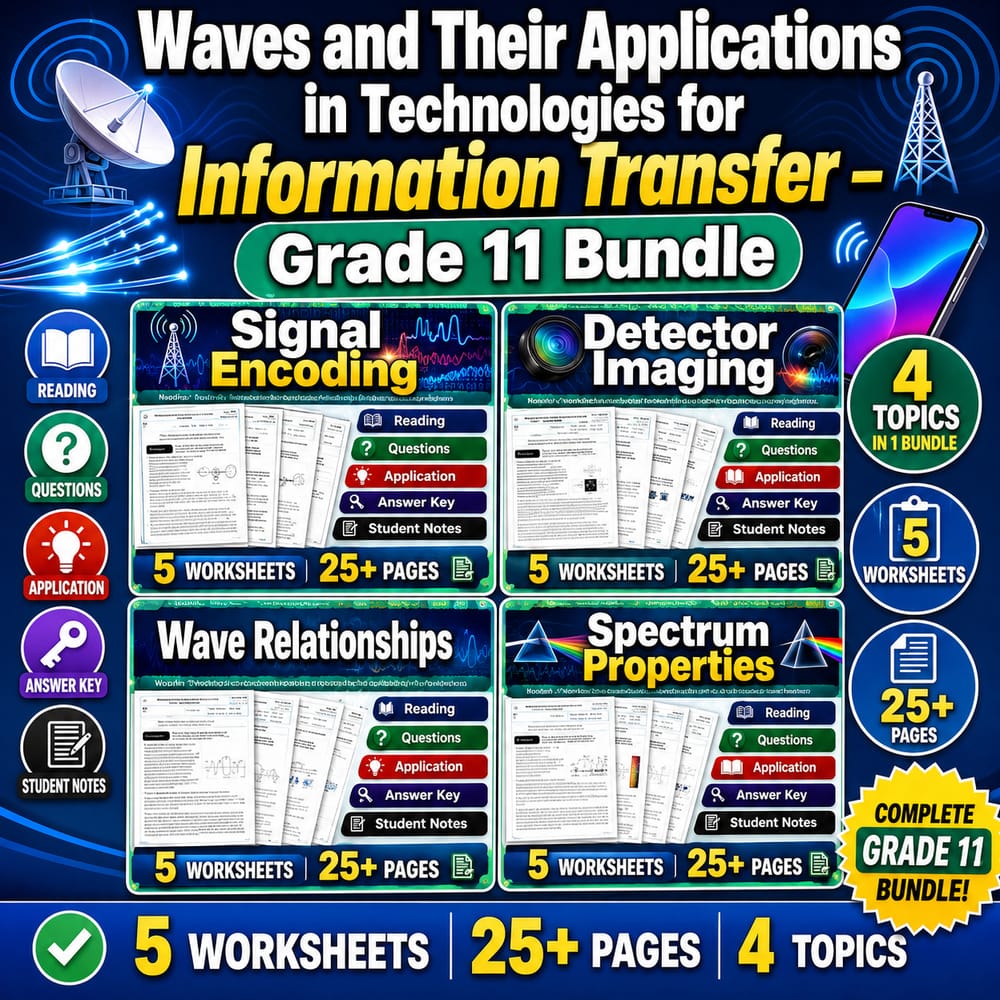
Waves in Info-Transfer Tech Grade 11 Science Lesson Bundle | NGSS
$16.00$20.00Save $4.00
BRIGHT PATH RESOURCES
·3 followers·23 sales
SubjectScienceGradeGrade 11Pages254 Pages
What’s included
4 worksheets · 254 pages · Save $4.00 (20%) · prices shown inside the bundle
 Grade 11 Signal Encoding Daily Reading Worksheet | NGSS Science Activity
- Identify the main idea of a technical text about signal encoding.
- Explain how digital encoding can improve reliability and fidelity compared with analog methods.
- Use evidence from the text to support claims about bandwidth, noise, and signal quality.
$4.00$5.00 Grade 11 Detector Imaging Science Daily Reading Worksheet | NGSS Activity
- Identify the measurement variable in detector imaging claims.
- Explain how a detector’s response is related to the incoming radiation.
- Recognize the role of calibration and uncertainty in interpreting detector data.
$4.00$5.00 Grade 11 Wave Relationships Daily Reading Worksheet | NGSS Science Activity
- Identify key wave properties such as frequency, wavelength, amplitude, and wave speed.
- Interpret symbols used in the wave relationship v = fλ and explain what changes affect propagation.
- Distinguish transverse and longitudinal waves using descriptive features.
$4.00$5.00 Grade 11 Spectrum Properties Science Daily Reading Worksheet | NGSS
- Identify the main idea and key details about how electromagnetic radiation shows wave-like and particle-like behavior
- Explain how interference and diffraction patterns support the wave model of light
$4.00$5.00
Reviews & Feedback
Loading reviews...
Questions & Answers
Loading questions…
About this bundle
Related categories
Frequently asked questions
Who is Waves in Info-Transfer Tech Grade 11 Science Lesson Bundle | NGSS designed for?
Waves in Info-Transfer Tech Grade 11 Science Lesson Bundle | NGSS is designed for Grade 11 students and Science learners and can be used in classrooms, homeschool, or independent practice.
How do I download Waves in Info-Transfer Tech Grade 11 Science Lesson Bundle | NGSS?
Add it to your cart and complete checkout. After payment, you can download immediately from your account, and you'll also receive a download link by email.
Similar Products

Grade 10 Science Waves & Information Transfer NGSS Worksheets Bundle
$9.60$12.00

Grade 9 Waves and Their Applications in Technologies for Information Transfer Lesson Bundle
$16.00$20.00

Grade 4 Science NGSS Waves and Information Transfer Unit Bundle
$7.20$9.00

Grade 10 Science Waves and Their Applications in Technologies Bundle
$7.20$9.00

Waves and Information Transfer Grade 9 Science NGSS Bundle
$9.60$12.00