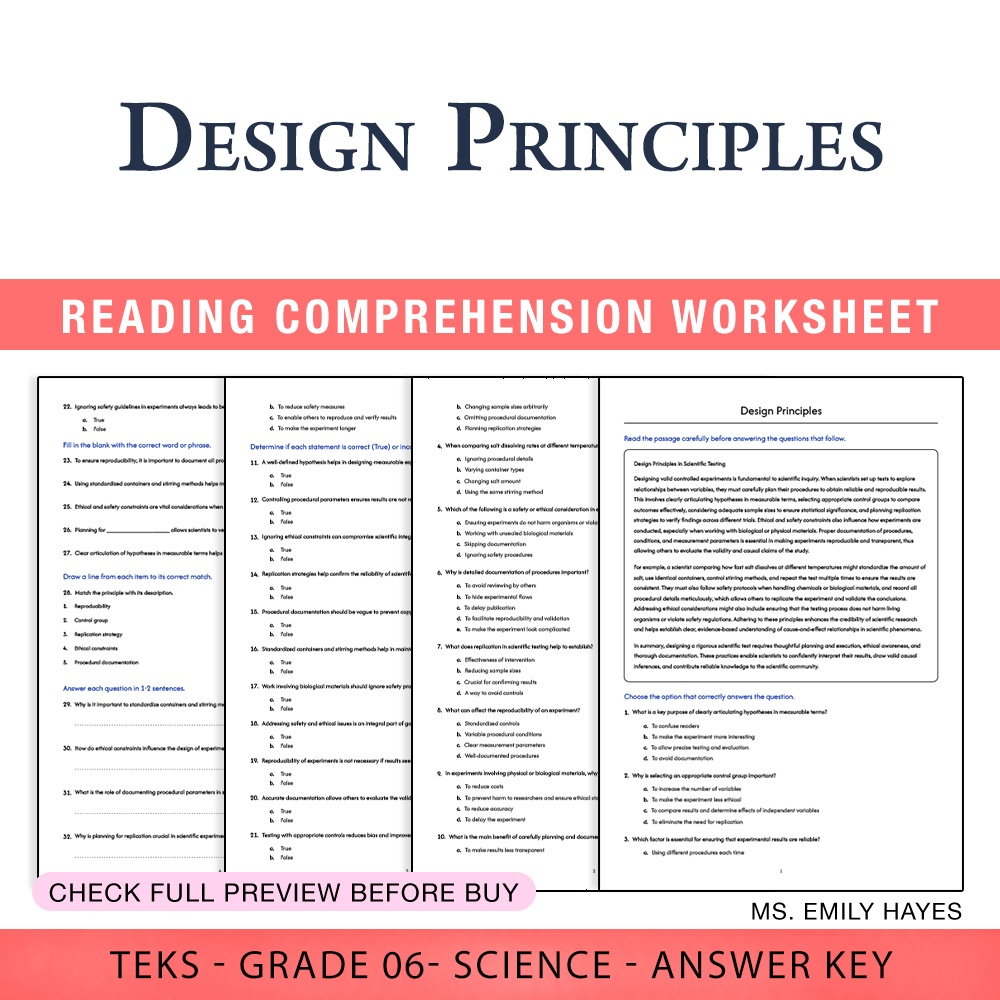
Are you searching for a comprehensive, ready-to-use resource to evaluate your 6th grade students' understanding of essential science design principles? This print-ready worksheet is designed specifically to help teachers address real classroom challenges, such as ensuring students grasp the fundamentals of controlled experiments, hypothesis formulation, and scientific reproducibility. By incorporating diverse question formats—including reading passages, multiple choice, true/false, fill-in-the-blank, matching, and short answer prompts—this worksheet offers a well-rounded approach to assessing critical thinking, comprehension, and practical application skills in science.
Why Teachers Love This ✅ Saves preparation time with carefully crafted, high-quality content tailored for Grade 6 science instruction
✅ Easy to implement with a straightforward, print-and-go PDF format perfect for busy classrooms
✅ Reinforces vital skills like designing valid experiments, controlling variables, and understanding ethical considerations
✅ Fully aligned with TEKS standards, ensuring your lessons meet educational requirements and prepare students effectively
Why Students Succeed With This ✅ Clear, step-by-step instructions that support student understanding and confidence
✅ Engaging questions that connect scientific concepts to real-world scenarios
✅ Scaffolded activities that build mastery in experiment design and data interpretation
✅ Effective for fostering analytical thinking, problem-solving, and scientific literacy in young learners 🚀
What You Get Complete, print-ready PDF worksheet and answer key with rubric designed for in-classroom use:
• A detailed reading passage explaining the importance of design principles
• 10 multiple choice questions that assess understanding of hypothesis formulation and controls
• 12 true/false questions reinforcing key concepts about experiment reproducibility and controls
• 5 fill-in-the-blank exercises to improve procedural documentation skills
• A matching activity linking scientific principles to their descriptions
• 5 short answer prompts encouraging students to explain the significance of standardization and ethical considerations
• 2 essay questions that develop critical thinking around experimental planning and design
Key Learning Objectives Students will master these core skills:
➡️ Understanding the purpose of hypotheses in scientific experiments
➡️ Recognizing the importance of controls and procedural documentation
➡️ Applying standardization techniques to improve test accuracy
➡️ Explaining ethical considerations in biological research
Ideal Usage This worksheet is perfect for classroom practice, homework assignment, or review sessions focused on scientific inquiry and experimental design. Its print-ready PDF format makes it simple to incorporate into daily lessons, science stations, or small-group activities. Use it as a standalone assessment or as part of a broader unit on scientific methods. It's especially effective for fostering student independence, encouraging deeper understanding, and developing long-term analytical skills.
Reach your students' full potential with this engaging, standards-aligned resource that builds fundamental skills in
science experimentation. Prepare your class for success with materials that are quick to implement and designed to inspire curiosity and precision in scientific investigations! 🚀