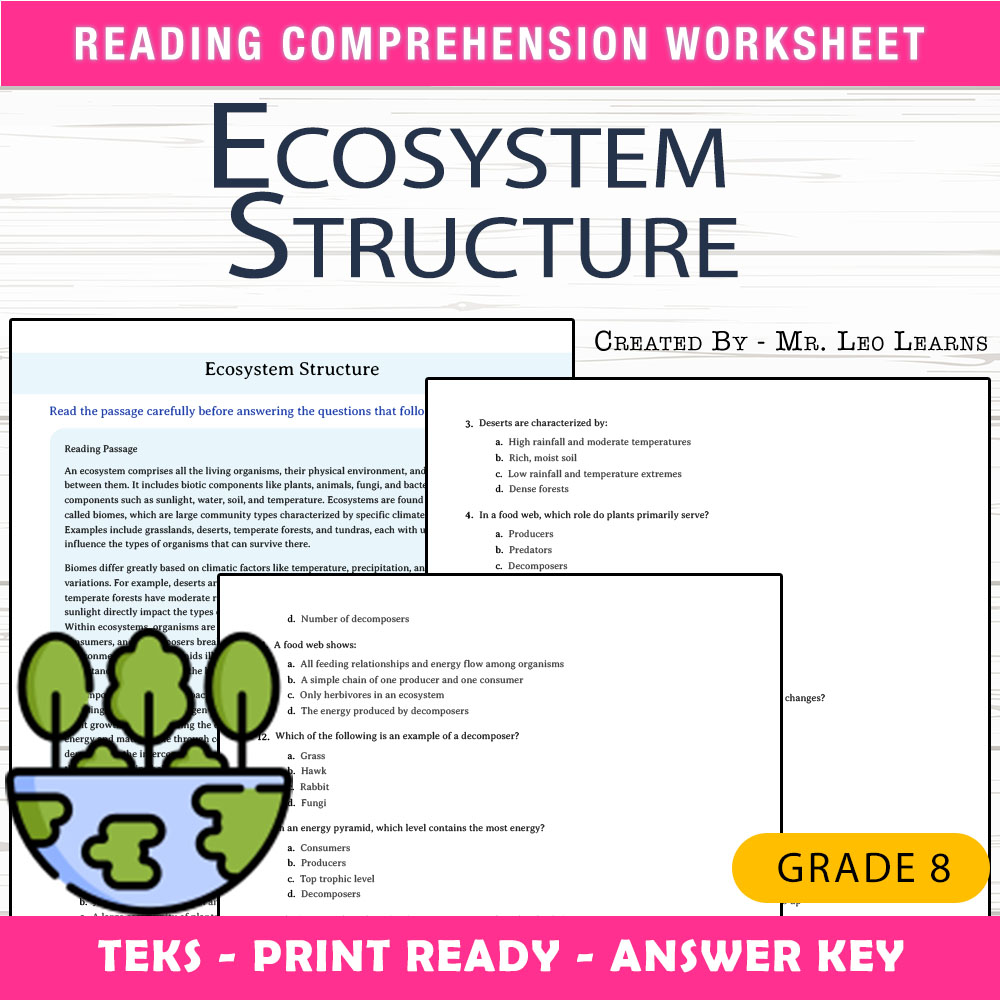
In the busy classroom, teachers often observe students struggling to grasp the complexity of ecosystems—how living organisms interact with their physical environment—and understanding the key components that make up these vital systems. This worksheet provides a straightforward, print-and-go resource designed to simplify this challenging topic. By breaking down the concepts into a clear reading passage and focused multiple-choice questions, it offers students a structured way to engage with the core ideas of ecosystem structure, making abstract ideas more tangible and accessible.
What This Resource Helps Students Do
This worksheet supports students in developing a deeper understanding of ecosystems by guiding them through reading comprehension and critical thinking about both biotic and abiotic components. It encourages independent review, allowing students to reinforce their knowledge of how living organisms, physical elements, and their interactions form a functioning ecosystem. The multiple-choice questions are designed to build clarity, helping students differentiate between key concepts like producers, consumers, and abiotic factors like sunlight and water. Through these activities, they strengthen their ability to analyze and categorize environmental features accurately, cultivating confidence in science vocabulary and concepts.
Inside the PDF
• A reading passage explaining what an ecosystem comprises, including examples and key ideas
• 25 multiple-choice questions that reinforce comprehension and assess understanding
• A print-ready format that requires no preparation or printing adjustments
• An answer key with rubric for quick grading and feedback
• Layout designed for ease of photocopying and classroom distribution
How It Improves Learning
This worksheet promotes learning through structured activities that clarify what an ecosystem is and the roles of its components. The reading passage provides context and foundational knowledge, making it easier for students to grasp complex ideas. The multiple-choice questions evaluate understanding and push students to think critically about concepts like abiotic versus biotic factors, enabling teachers to identify areas needing reinforcement. Using this resource, students move from initial confusion to a confident understanding of ecosystem functions, supporting both independent learning and classroom discussion. It serves as a reliable tool for review, assessment, or reinforcement of key science standards.
Core Skills Students Will Develop
- ➡️ Understanding ecosystem components
- ➡️ Distinguishing between biotic and abiotic factors
- ➡️ Analyzing interactions within ecosystems
- ➡️ Applying scientific vocabulary accurately
Ways Teachers Use This Worksheet
This worksheet is versatile and easy to incorporate into various classroom activities. It can be used as classwork during lessons on ecosystems, as homework to reinforce lesson content, or as an assessment tool to check understanding after instruction. Teachers often deploy it for small-group practice or station rotations, and it works well for students who finish early or need extra review. Its straightforward format allows for quick implementation, making it an effective resource for supporting student learning at different levels of mastery while maintaining consistency and structure in science instruction.
Why This PDF Saves Time
Designed with practicality in mind, this printable worksheet requires no additional prep work. Teachers can easily photocopy and distribute it for immediate use. The PDF format ensures that layout and design remain consistent, eliminating the need for formatting adjustments. The included answer key with rubric provides a quick, reliable way to evaluate student responses without additional grading resources, helping teachers save valuable preparation time and maintain focus on instruction.
Ultimately, this ecosystem structure worksheet is a ready-to-use classroom tool that streamlines lesson planning and fosters student success. Its clear, engaging format helps students develop essential science skills confidently and independently. With minimal setup required, it’s a dependable resource to support meaningful learning in the science classroom. 🌱