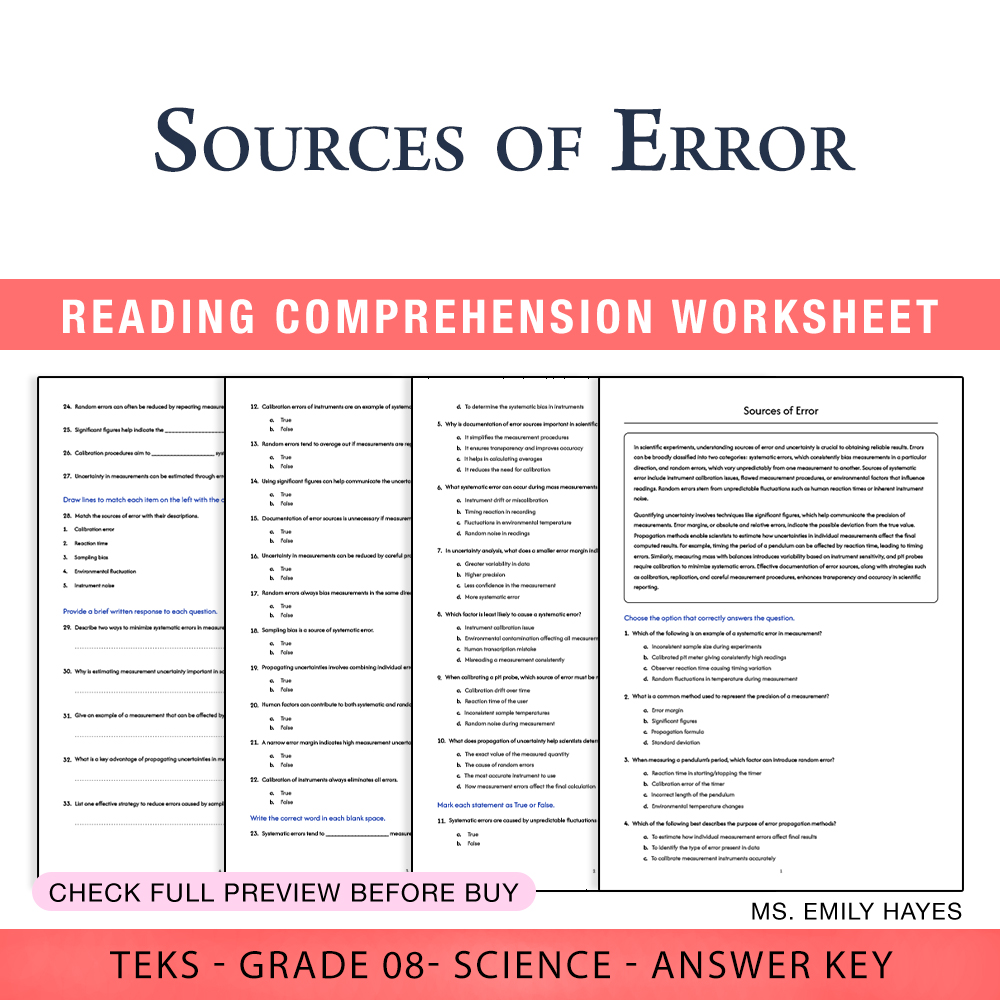
Are you seeking an effective way to help your Grade 8 students master the critical concepts of sources of error and measurement uncertainty in scientific experiments? This comprehensive, print-ready worksheet addresses a common classroom challenge: understanding and identifying errors that impact data accuracy. Built to foster students' analytical skills and deepen their grasp of experimental reliability, this resource offers practical exercises aligned with TEKS standards. Designed for immediate classroom implementation, it saves teachers valuable prep time while promoting active student engagement through varied question formats.
Why Teachers Love This ✅ Saves preparation time with ready-to-use PDF worksheet and answer key
✅ Fully printable and classroom-ready—easy to implement with minimal setup
✅ Focuses on essential science skills like identifying systematic vs. random errors
✅ Incorporates real-world scenarios to make abstract concepts relatable and memorable
Why Students Succeed With This ✅ Clear, concise instructions guide students through complex concepts
✅ Builds critical thinking by analyzing sources of error in various contexts
✅ Developed to reinforce understanding via diverse question types: multiple choice, true/false, short answer, and matching
✅ Encourages active learning and confidence in experimental procedures
What You Get Complete, print-ready PDF materials include:
• A comprehensive reading passage explaining sources of error in experiments
• 10 multiple-choice questions to reinforce identification of measurement errors
• 12 true/false questions to test conceptual understanding
• 5 fill-in-the-blank exercises to enhance vocabulary and comprehension
• A matching activity linking sources of error with descriptions
• 5 short-answer questions to develop explanation skills
• 2 in-depth essay prompts that promote critical thinking about errors and experimental accuracy
• An answer key with detailed rubrics for objective assessment
Key Learning Objectives Students will master these core skills:
➡️ Identify different types of measurement errors such as systematic and random errors
➡️ Explain how calibration and environmental factors contribute to measurement uncertainty
➡️ Describe methods to minimize sources of error in scientific experiments
➡️ Analyze real-world experimental scenarios to detect sources of measurement inaccuracies
Ideal Usage This worksheet is perfect for reinforcing science concepts during class practice, homework assignments, or review sessions. Its print-ready format allows seamless integration into lessons on experimental accuracy, scientific measurement, or the scientific method. Use it to facilitate whole-class discussions, group activities, or individual work. Its variety of question formats encourages active student participation and deepens understanding of the importance of identifying and reducing errors to improve data reliability. Suitable for in-person teaching, science labs, or review days, this resource supports your instructional goals effectively.
Equip your students with the skills needed to excel in scientific measurement and foster critical thinking about experimental data. Download this worksheet today to ensure your class is prepared to analyze and interpret data confidently, setting a strong foundation for future science success! 🚀