
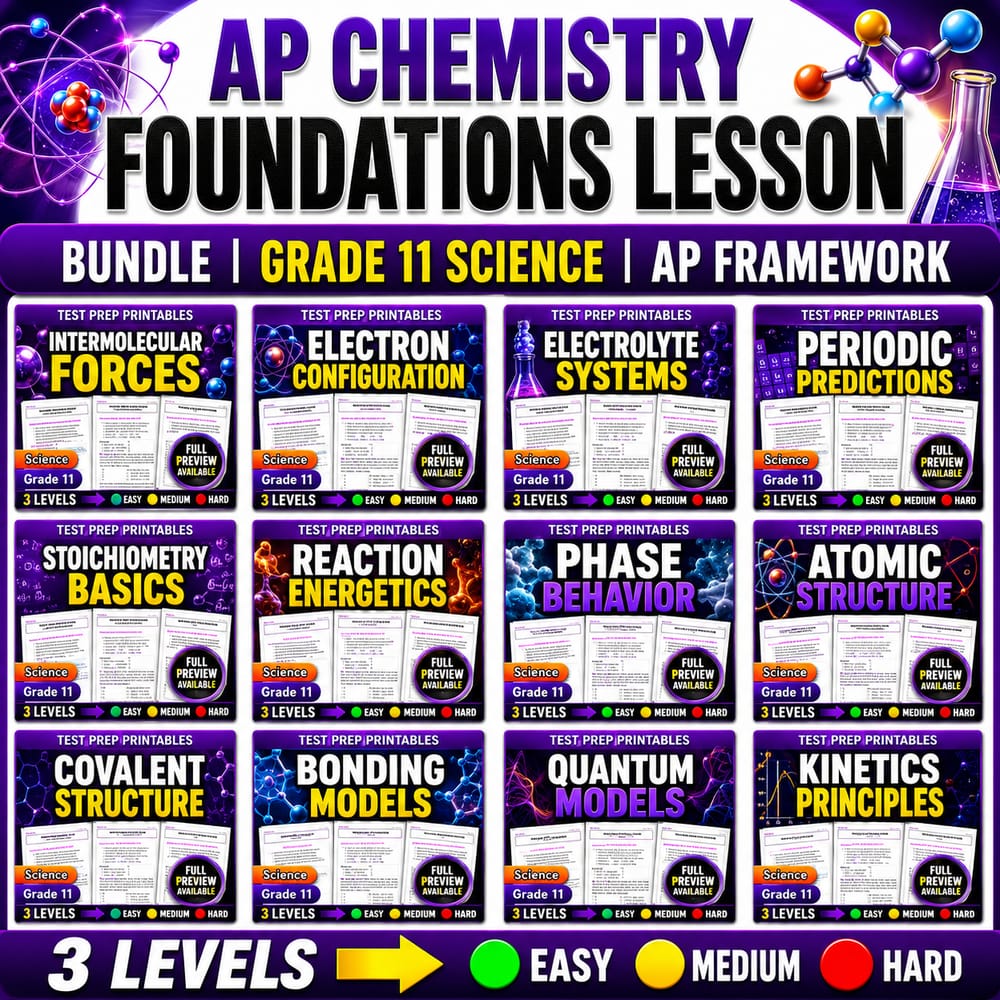


AP Chemistry Foundations Lesson Bundle | Grade 11 Science | AP Framework
$68.00$85.00Save $17.00
Prism Point Learning
·2 followers·13 sales
SubjectScienceGradeGrade 11
What’s included
12 worksheets · Save $17.00 (20%) · prices shown inside the bundle
 Intermolecular Forces Worksheet | Grade 11 AP Chemistry Activities
- Characterize dispersion, dipole–dipole, and hydrogen-bonding interactions and relate them to phase behavior.
- Explain how molecular polarity and intermolecular attractions influence boiling point, vapor pressure, and solubility.
- Use potential-energy ideas and property trends to connect microscopic forces to macroscopic observations like cohesive versus adhesive behavior.
$4.00$5.00 Electron Configuration Worksheet | Grade 11 AP Chemistry Science Practice
- Apply the Aufbau, Pauli exclusion, and Hund’s rules to write correct electron configurations for atoms and ions.
- Connect valence electron patterns to common oxidation states and periodic trends.
- Explain how orbital shapes and nodal structure relate to electron probability and energy concepts.
$4.00$5.00 Equilibrium Systems Worksheet | Grade 11 AP Chemistry Science Practice
- Use reaction quotient Q and compare it to the equilibrium constant K to predict the direction of shift in both homogeneous and heterogeneous systems.
- Calculate equilibrium concentrations or partial pressures using Kc and Kp expressions, including the role of stoichiometric coefficients.
- Explain Le Châtelier’s principle for concentration, pressure, and temperature perturbations and connect it to thermodynamic tendencies.
$24.00$30.00 Periodic Predictions Worksheet | Grade 11 AP Chemistry Science Practice
- Explain how effective nuclear charge helps predict trends in atomic radius, ionization energy, electron affinity, and electronegativity.
- Use periodic trends to predict the likely ionic charges and simple compound formation for main-group elements.
- Compare relative reactivity across periods and groups using electron structure and periodic patterns.
$4.00$5.00 Stoichiometry Basics Worksheet | Grade 11 AP Chemistry Practice
- Use mole ratios from balanced chemical equations to convert between moles, mass, and particle counts.
- Apply molar mass to calculate the amount of reactants and products in quantitative reactions.
- Determine the limiting reagent and calculate percent yield from given experimental data.
$4.00$5.00 Reaction Energetics Worksheet | Grade 11 AP Chemistry Science Practice
- Explain how enthalpy changes relate to energy flow in endothermic and exothermic reactions.
- Use calorimetry reasoning to interpret measured heat and temperature change.
- Apply Hess’s law and formation enthalpies to determine overall reaction enthalpy.
$4.00$5.00 Phase Behavior Worksheet | Grade 11 AP Science Practice
- Interpret qualitative phase diagrams and relate them to intermolecular forces and molecular structure.
- Use vapor pressure curves to explain vapor–liquid equilibria and how temperature changes boiling and freezing points.
- Predict colligative-property trends (boiling point elevation, freezing-point depression, and osmotic behavior) in idealized and non-ideal cases.
$4.00$5.00 Atomic Structure Worksheet | Grade 11 AP Science Activities & Review
- Explain the roles of protons, neutrons, and electrons in determining atomic identity and behavior
- Use emission spectra and mass spectrometry evidence to support discrete energy levels and isotopic composition
- Calculate average atomic mass from isotopic abundances and interpret basic ion formation patterns
$4.00$5.00 Covalent Structure Worksheet | Grade 11 AP Chemistry Science Activities
- Use Lewis structures and VSEPR models to predict bond angles and molecular shapes.
- Explain how hybridization and orbital overlap relate to bonding geometry and bond order.
- Use resonance and molecular orbital ideas to account for polarity and spectroscopic/reactivity trends.
$4.00$5.00 Bonding Models Worksheet | Grade 11 AP Chemistry Practice Activities
- Distinguish ionic, covalent, and metallic bonding using electronegativity difference and formal charge ideas.
- Use potential-energy diagrams and electron-sharing/electron-transfer concepts to justify bond strength trends.
- Relate lattice considerations to lattice energy, melting point, and conductivity predictions.
$4.00$5.00
Reviews & Feedback
Loading reviews...
Questions & Answers
Loading questions…
About this bundle
Related categories
Frequently asked questions
Who is AP Chemistry Foundations Lesson Bundle | Grade 11 Science | AP Framework designed for?
AP Chemistry Foundations Lesson Bundle | Grade 11 Science | AP Framework is designed for Grade 11 students and Science learners and can be used in classrooms, homeschool, or independent practice.
How do I download AP Chemistry Foundations Lesson Bundle | Grade 11 Science | AP Framework?
Add it to your cart and complete checkout. After payment, you can download immediately from your account, and you'll also receive a download link by email.
Similar Products

Chemistry Foundations Lesson Bundle | Grade 12 Science AP
$48.00$60.00

Grade 10 Science Chemistry Foundations Lesson Bundle for AP Curriculum
$31.20$39.00

Grade 12 Chemistry Foundations Lesson Bundle – AP Science Activities
$28.80$36.00

Grade 12 Chemistry Foundations Science Lesson Bundle for Advanced Placement (AP)
$41.60$52.00

Grade 10 Chemistry Foundations Science Lesson Bundle: AP Worksheet Set
$48.00$60.00