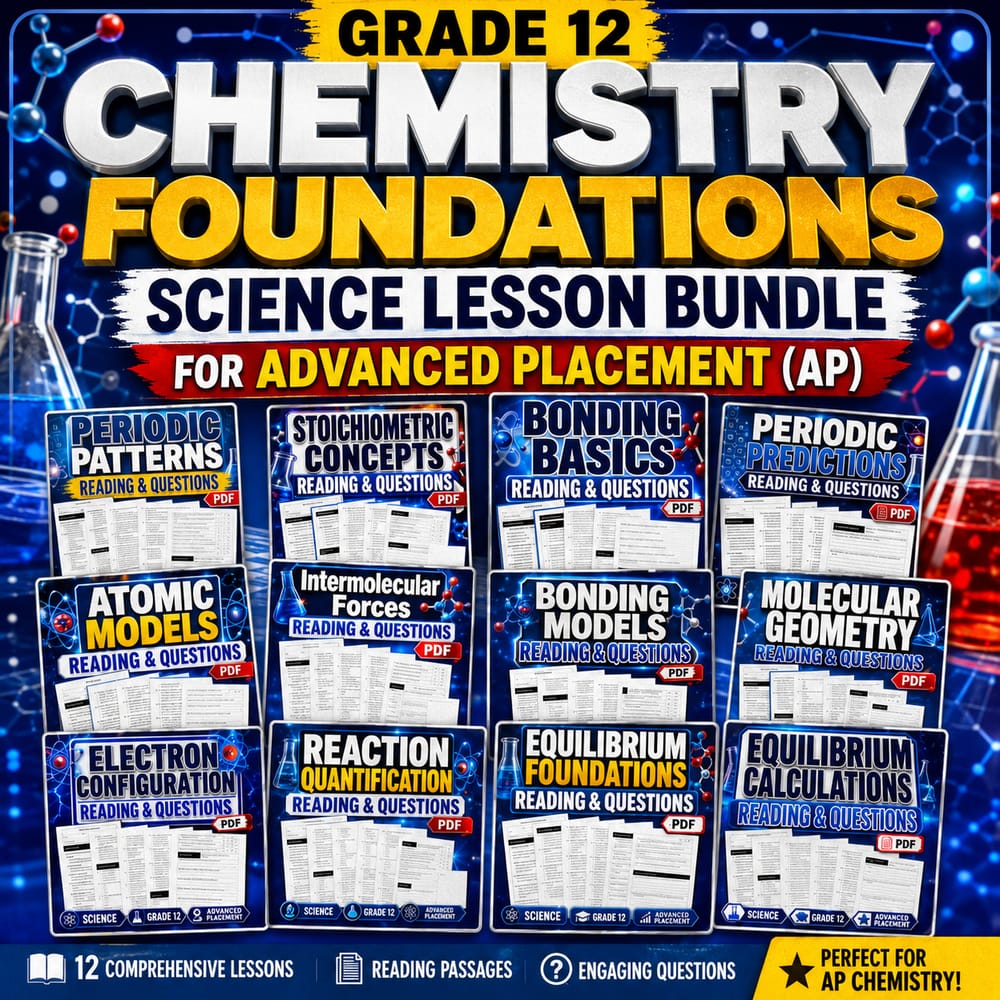
Grade 12 Chemistry Foundations Science Lesson Bundle for Advanced Placement (AP) — bundle cover
Grade 12 Chemistry Foundations Science Lesson Bundle for Advanced Placement (AP) — included worksheet 1
Grade 12 Chemistry Foundations Science Lesson Bundle for Advanced Placement (AP) — included worksheet 2
Grade 12 Chemistry Foundations Science Lesson Bundle for Advanced Placement (AP) — included worksheet 3
Grade 12 Chemistry Foundations Science Lesson Bundle for Advanced Placement (AP) — included worksheet 4
Grade 12 Chemistry Foundations Science Lesson Bundle for Advanced Placement (AP) — included worksheet 5
Grade 12 Chemistry Foundations Science Lesson Bundle for Advanced Placement (AP) — included worksheet 6
Grade 12 Chemistry Foundations Science Lesson Bundle for Advanced Placement (AP) — included worksheet 7
Grade 12 Chemistry Foundations Science Lesson Bundle for Advanced Placement (AP) — included worksheet 8
Grade 12 Chemistry Foundations Science Lesson Bundle for Advanced Placement (AP) — included worksheet 9
Grade 12 Chemistry Foundations Science Lesson Bundle for Advanced Placement (AP) — included worksheet 10
Grade 12 Chemistry Foundations Science Lesson Bundle for Advanced Placement (AP) — included worksheet 11
Grade 12 Chemistry Foundations Science Lesson Bundle for Advanced Placement (AP) — included worksheet 12
Grade 12 Chemistry Foundations Science Lesson Bundle for Advanced Placement (AP) — included worksheet 13
Grade 12 Science worksheet — Grade 12 Chemistry Foundations Science Lesson Bundle for Advanced Placement (AP)

Description

Overview


Grade 12 Chemistry Foundations supports your Science classroom with AP-aligned practice across key chemistry concepts and problem-solving routines. This lesson bundle uses 12 focused worksheets to help students connect quantitative thinking to evidence-based explanations in preparation for Advanced Placement (AP). 🧪

What’s Included


  • ✅ Grade 12 Science Worksheet | Stoichiometric Concepts AP Standard (PDF) – Use mole ratios and unit analysis to interpret chemical quantities with AP-style clarity.
  • ✅ Grade 12 Science – Reaction Quantification Worksheet (AP) | PDF – Practice calculating amounts involved in reactions and checking reasonableness.
  • ✅ Grade 12 Science Worksheet | Periodic Predictions (AP) Standards Aligned (PDF) – Predict properties from trends to strengthen conceptual understanding before calculations.
  • ✅ Grade 12 Science | Periodic Trends Worksheet (AP Standard) (PDF) – Analyze trend behavior across periods and groups using particle-level reasoning.
  • ✅ Grade 12 Science | Molecular Geometry Worksheet (AP Standards) (PDF) – Determine molecular shape and polarity from electron-pair models.
  • ✅ Grade 12 Science | Intermolecular Forces Worksheet (AP Standards) (PDF) – Compare forces and connect structure to observable properties and behaviors.
  • ✅ Grade 12 Science | Equilibrium Foundations Worksheet (AP Standards) (PDF) – Build the conceptual basis for dynamic equilibrium and how systems respond.
  • ✅ Grade 12 Science Equilibrium Calculations Worksheet (AP) PDF – Apply equilibrium expressions to solve for reaction changes and concentrations.
  • ✅ Grade 12 - Electron Configuration Worksheet (AP Standards) (PDF) – Write electron configurations and use orbital ideas to connect energy levels to behavior.
  • ✅ Grade 12 Science | Bonding Models Worksheet (AP Standard) (PDF) – Connect bonding models to structure, electron transfer/sharing, and stability.
  • ✅ Grade 12 Science – Bonding Basics Worksheet (AP Standards) (PDF) – Practice identifying bond types and interpreting diagrams with evidence-based reasoning.
  • ✅ Grade 12 Science | Atomic Models Worksheet (AP Standards) (PDF) – Compare atomic models and use particle concepts to support explanations.

Skills & Standards


This Chemistry Foundations lesson bundle aligns with the expectations of Advanced Placement (AP) by emphasizing crosscutting concepts such as structure and function and models that explain phenomena. Students work through disciplinary core ideas related to the structure and properties of matter, chemical reactions, and equilibrium. Each worksheet includes opportunities for modeling (atom and particle representations), analytical reasoning (organizing data, applying relationships, and justifying steps), and evidence-based explanations (supporting conclusions with chemistry reasoning rather than memorization).

Perfect For


  • Teachers seeking structured instruction
  • Sub plans
  • Homework or review
  • Intervention or centers
  • Assessment preparation

How to Use


Use the 12 worksheets as a multi-day sequence: start with atomic and electron configuration foundations, move into periodic predictions and trends, then transition to bonding, molecular geometry, intermolecular forces, and finish with equilibrium foundations and calculations. For pacing, consider 2 days per major topic (or 3 shorter periods for calculation-heavy sets) and add quick checks like a 5-minute warm-up problem and an exit ticket that asks students to explain their approach in words. Assign one worksheet as practice and pair the next with targeted reteaching, then use the final pages as focused review before evaluations.

Closing


Download this Grade 12 Chemistry Foundations lesson bundle to streamline AP Chemistry preparation with clear, practice-ready worksheets.

Grade 12 Chemistry Foundations Science Lesson Bundle for Advanced Placement (AP)

$41.60$52.00Save $10.40
Evergreen Desk Education
·2 followers·17 sales
SubjectScienceGradeGrade 12Pages221 Pages

What’s included

13 worksheets · 221 pages · Save $10.40 (20%) · prices shown inside the bundle

  1. Grade 12 Science | Periodic Trends Worksheet (AP Standard) (PDF)
    Grade 12 Science | Periodic Trends Worksheet (AP Standard) (PDF)

    Grade 12 · Science · 17 Pages

    • Explain how effective nuclear charge influences atomic radius, ionization energy, and electronegativity across a period and down a group.
    • Predict trends in metallic character and reactivity using periodic positions and electronic structure ideas.
    • Interpret tabular and graphical information to infer likely chemical behavior of elements.
    $3.20$4.00
  2. Grade 12 Science Worksheet | Stoichiometric Concepts AP Standard (PDF)
    Grade 12 Science Worksheet | Stoichiometric Concepts AP Standard (PDF)

    Grade 12 · Science · 18 Pages

    • Use mole concepts and molar mass to convert between mass, moles, and particle counts.
    • Apply balanced chemical equations to determine mole ratios and predict product amounts.
    • Determine the limiting reactant, theoretical yield, and percent yield from given data.
    $3.20$4.00
  3. Grade 12 Science – Bonding Basics Worksheet (AP Standards) (PDF)
    Grade 12 Science – Bonding Basics Worksheet (AP Standards) (PDF)

    Grade 12 · Science · 16 Pages

    • Distinguish ionic, covalent, and metallic bonding by electron transfer, sharing, and charge-delocalization models.
    • Use Lewis structures and formal charge to evaluate bonding possibilities and predict likely molecular structures.
    • Explain how bond type affects bulk properties such as conductivity, melting point, and solubility.
    $3.20$4.00
  4. Grade 12 Science | Periodic Predictions Worksheet (AP Standards) (Practice Set)
    Grade 12 Science | Periodic Predictions Worksheet (AP Standards) (Practice Set)

    Grade 12 · Science · 18 Pages

    • Explain how effective nuclear charge and electron shielding drive periodic trends in ionization energy, electron affinity, and atomic radius.
    • Use subshell filling and penetration to rationalize anomalies in predicted periodic behavior.
    • Interpret quantitative and graphical comparisons to justify classifications and reactivity patterns.
    $3.20$4.00
  5. Grade 12 Science Worksheet | Periodic Predictions (AP) Standards Aligned (PDF)
    Grade 12 Science Worksheet | Periodic Predictions (AP) Standards Aligned (PDF)

    Grade 12 · Science · 17 Pages

    • Use effective nuclear charge, shielding, and subshell filling to predict trends and anomalies in ionization energy, electron affinity, and atomic radius.
    • Interpret quantitative comparisons and simple graphical relationships across periods and down groups to justify periodic patterns.
    • Connect periodic trends to element classification, reactivity series behavior, and the selection of representative elements for modeling.
    $3.20$4.00
  6. Grade 12 Science | Atomic Models Worksheet (AP Standards) (PDF)
    Grade 12 Science | Atomic Models Worksheet (AP Standards) (PDF)

    Grade 12 · Science · 16 Pages

    • Explain how historical atomic models evolved toward quantum descriptions of the electron and nucleus.
    • Use spectral lines and scattering evidence to justify discrete (quantized) energy levels.
    • Relate quantum numbers and orbital shapes to electron arrangements and chemical behavior.
    $3.20$4.00
  7. Grade 12 Science | Intermolecular Forces Worksheet (AP Standards) (PDF)
    Grade 12 Science | Intermolecular Forces Worksheet (AP Standards) (PDF)

    Grade 12 · Science · 18 Pages

    • Distinguish dispersion forces, dipole–dipole interactions, and hydrogen bonding and relate each to molecular structure
    • Explain how intermolecular force strength affects boiling point, vapor pressure, viscosity, and solubility
    • Use diagrams and thermodynamic reasoning to predict how changes in size, shape, and polarity change macroscopic behavior
    $3.20$4.00
  8. Grade 12 Science | Bonding Models Worksheet (AP Standard) (PDF)
    Grade 12 Science | Bonding Models Worksheet (AP Standard) (PDF)

    Grade 12 · Science · 16 Pages

    • Explain how molecular orbital theory extends valence-bond ideas for diatomic molecules and predicts bonding order.
    • Compare localized versus delocalized bonding models and connect each model to delocalization and observed properties.
    • Use energy-level diagrams and symmetry ideas to predict electronic transitions and magnetic behavior.
    $3.20$4.00
  9. Grade 12 Science | Molecular Geometry Worksheet (AP Standards) (PDF)
    Grade 12 Science | Molecular Geometry Worksheet (AP Standards) (PDF)

    Grade 12 · Science · 18 Pages

    • Use VSEPR and hybridization concepts to predict molecular shapes and approximate bond angles from electron-pair arrangements.
    • Relate molecular geometry and symmetry to bond polarity, overall dipole moment, and macroscopic properties.
    • Explain how resonance and multiple bonds affect electron distribution and the resulting 3D molecular structure.
    $3.20$4.00
  10. Grade 12 Science - Electron Configuration Worksheet (AP Standards) (PDF)
    Grade 12 Science - Electron Configuration Worksheet (AP Standards) (PDF)

    Grade 12 · Science · 16 Pages

    • Assign electron configurations using the orbital filling order and quantum energy-level ideas
    • Apply Hund’s rule and the Pauli exclusion principle to determine orbital occupancy correctly
    • Explain common transition-element exceptions and justify them using energy-level and stability arguments
    $3.20$4.00

Reviews & Feedback

Loading reviews...

Questions & Answers

Loading questions…

About this bundle

Related categories

Frequently asked questions

Who is Grade 12 Chemistry Foundations Science Lesson Bundle for Advanced Placement (AP) designed for?
Grade 12 Chemistry Foundations Science Lesson Bundle for Advanced Placement (AP) is designed for Grade 12 students and Science learners and can be used in classrooms, homeschool, or independent practice.
How do I download Grade 12 Chemistry Foundations Science Lesson Bundle for Advanced Placement (AP)?
Add it to your cart and complete checkout. After payment, you can download immediately from your account, and you'll also receive a download link by email.