
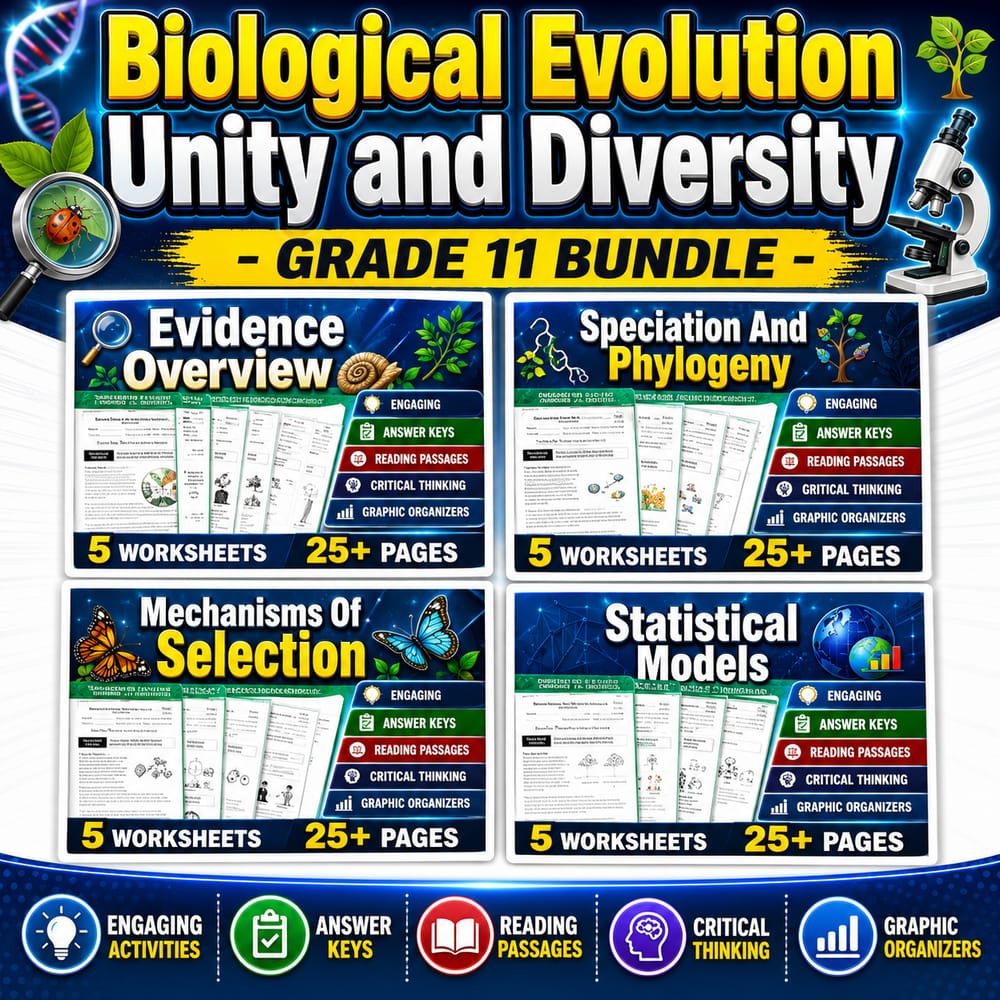
Biological Evolution Unity & Diversity Grade 11 Science Lesson Bundle | NGSS
$16.00$20.00Save $4.00
BRIGHT PATH RESOURCES
·3 followers·23 sales
SubjectScienceGradeGrade 11
What’s included
4 worksheets · Save $4.00 (20%) · prices shown inside the bundle
 Grade 11 Science Daily Reading: Evidence Overview | NGSS Biology Worksheet
- State the main claim about how multiple evidence lines support biological evolution.
- Identify key supporting details from different evidence types.
- Explain how independent datasets can converge on the same evolutionary explanation.
$4.00$5.00 Grade 11 Science Daily Reading: Speciation and Phylogeny | NGSS Biology Worksheet
- Identify key ideas about how geographic isolation and reproductive barriers can lead to speciation.
- Explain how phylogenetic trees reflect shared ancestry and branching patterns.
- Use vocabulary related to diversification to answer comprehension and reasoning questions.
$4.00$5.00 Grade 11 Science Daily Reading: Mechanisms of Selection | NGSS Biology Worksheet
- Summarize the three key steps of natural selection.
- Explain how heritable variation and environmental pressures can change trait frequencies over generations.
- Define fitness in the context of differential survival and reproduction.
$4.00$5.00 Grade 11 Science Daily Reading: Statistical Models | NGSS Science Worksheet
- Identify the purpose of a null model in evolutionary genetics.
- State key Hardy–Weinberg assumptions for expected allele and genotype frequencies.
- Explain how sampling error can create apparent departures from expectations.
$4.00$5.00
Reviews & Feedback
Loading reviews...
Questions & Answers
Loading questions…
About this bundle
Related categories
Frequently asked questions
Who is Biological Evolution Unity & Diversity Grade 11 Science Lesson Bundle | NGSS designed for?
Biological Evolution Unity & Diversity Grade 11 Science Lesson Bundle | NGSS is designed for Grade 11 students and Science learners and can be used in classrooms, homeschool, or independent practice.
How do I download Biological Evolution Unity & Diversity Grade 11 Science Lesson Bundle | NGSS?
Add it to your cart and complete checkout. After payment, you can download immediately from your account, and you'll also receive a download link by email.
Similar Products

Biological Evolution & Unity and Diversity | Grade 6 Science NGSS
$14.40$18.00

Biological Evolution: Unity and Diversity Lesson Bundle | Grade 10 Science | NGSS
$20.00$25.00

Grade 8 Biological Evolution: Unity and Diversity Science Lesson Bundle NGSS
$12.80$16.00

Biological Evolution: Unity and Diversity Lesson Bundle Grade 8 Science | NGSS
$12.80$16.00

Grade 11 Biological Evolution Unity and Diversity Science Lesson Bundle (NGSS)
$9.60$12.00