
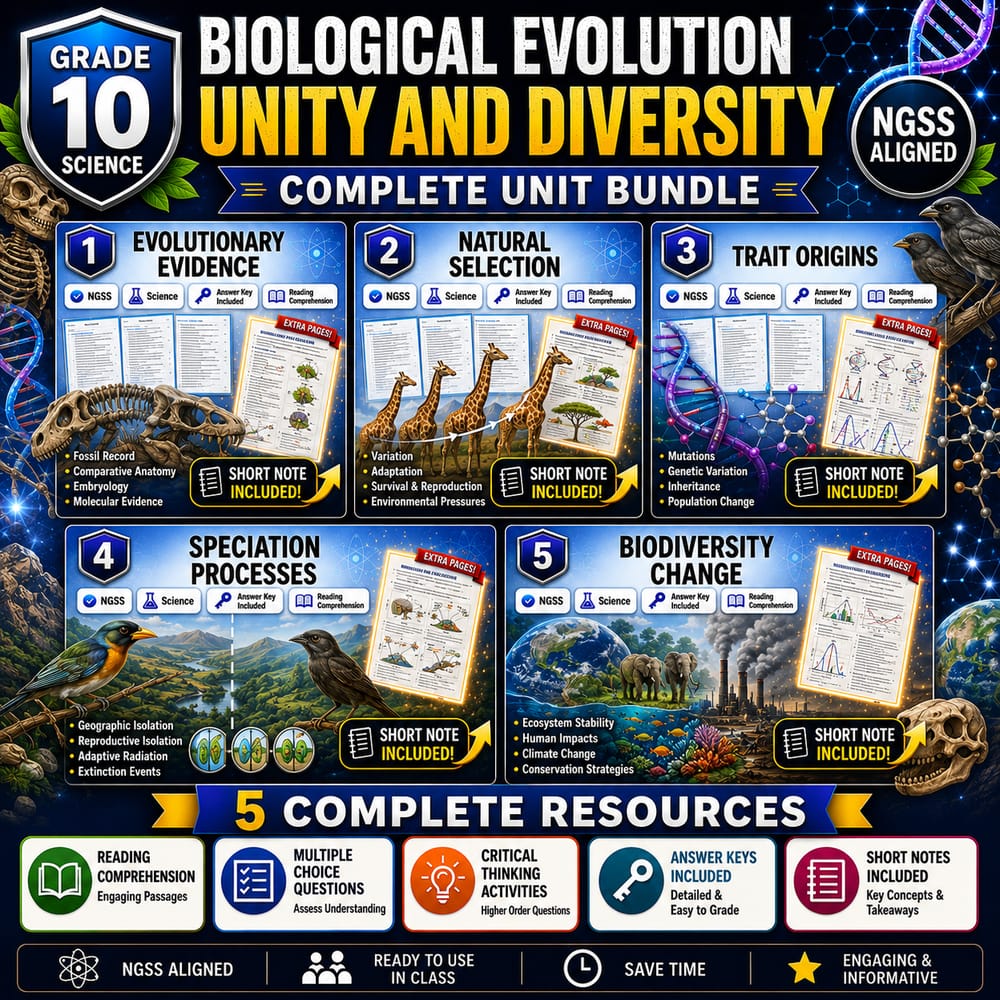
Biological Evolution: Unity and Diversity Lesson Bundle | Grade 10 Science | NGSS
$20.00$25.00Save $5.00
MTS Resources
New·0 followers·0 sales
SubjectScienceGradeGrade 10Pages66 Pages
What’s included
5 worksheets · 66 pages · Save $5.00 (20%) · prices shown inside the bundle
 Speciation Processes worksheet | Assessment Grade 10 Science printable PDF
- Explain how reproductive isolation arises through allopatric, sympatric, polyploidy, and behavioral mechanisms
- Use evidence from phylogeny and reproductive barriers to describe how new species form over time
- Compare ecological divergence and geographic separation as drivers of lineage splitting
$4.00$5.00 Biodiversity Change Worksheet | Science Assessment Grade 10 NGSS Printable PDF
- Explain how human activities and environmental change can reduce biodiversity through multiple mechanisms such as habitat fragmentation, invasive species, and climate shifts.
- Interpret how fossil evidence, phylogenetic analysis, and population monitoring can show patterns of species loss and recovery potential.
- Evaluate causal links among factors that reduce genetic diversity and ecological resilience, and propose conservation strategies based on evidence.
$4.00$5.00 Selective Mechanisms Worksheet | Grade 10 Science printable PDF NGSS
- Explain how heritable variation and environmental pressures drive natural selection in populations
- Interpret how differential survival and reproduction change allele frequencies over generations
- Use fitness and selection coefficient ideas to connect phenotypic change to population genetics dynamics
$4.00$5.00 Evolutionary Evidence Worksheet | Grade 10 Science printable PDF NGSS
- Explain how multiple independent lines of evidence support common ancestry and descent with modification.
- Describe how the fossil record, radiometric dating, comparative anatomy, embryology, molecular sequences, and biogeography contribute to evolutionary conclusions.
- Use examples to connect evidence types to patterns of divergence and relatedness across organisms.
$4.00$5.00 Trait Origins Worksheet | Grade 10 Science printable PDF | assessment
- Explain how mutations, recombination, gene flow, and chromosomal changes can create heritable trait variation through allele frequency changes.
- Connect population-level processes (genetic drift and nonrandom mating) to shifts in trait distributions across generations.
- Use cause-and-effect reasoning to relate molecular/genetic mechanisms to phenotypic outcomes.
$4.00$5.00
Reviews & Feedback
Loading reviews...
Questions & Answers
Loading questions…
About this bundle
Related categories
Frequently asked questions
Who is Biological Evolution: Unity and Diversity Lesson Bundle | Grade 10 Science | NGSS designed for?
Biological Evolution: Unity and Diversity Lesson Bundle | Grade 10 Science | NGSS is designed for Grade 10 students and Science learners and can be used in classrooms, homeschool, or independent practice.
How do I download Biological Evolution: Unity and Diversity Lesson Bundle | Grade 10 Science | NGSS?
Add it to your cart and complete checkout. After payment, you can download immediately from your account, and you'll also receive a download link by email.
Similar Products

Biological Evolution & Unity and Diversity | Grade 6 Science NGSS
$14.40$18.00

Biological Evolution Unity & Diversity Grade 11 Science Lesson Bundle | NGSS
$16.00$20.00

Grade 8 Biological Evolution: Unity and Diversity Science Lesson Bundle NGSS
$12.80$16.00

Biological Evolution: Unity and Diversity Lesson Bundle Grade 8 Science | NGSS
$12.80$16.00

Grade 11 Biological Evolution Unity and Diversity Science Lesson Bundle (NGSS)
$9.60$12.00