
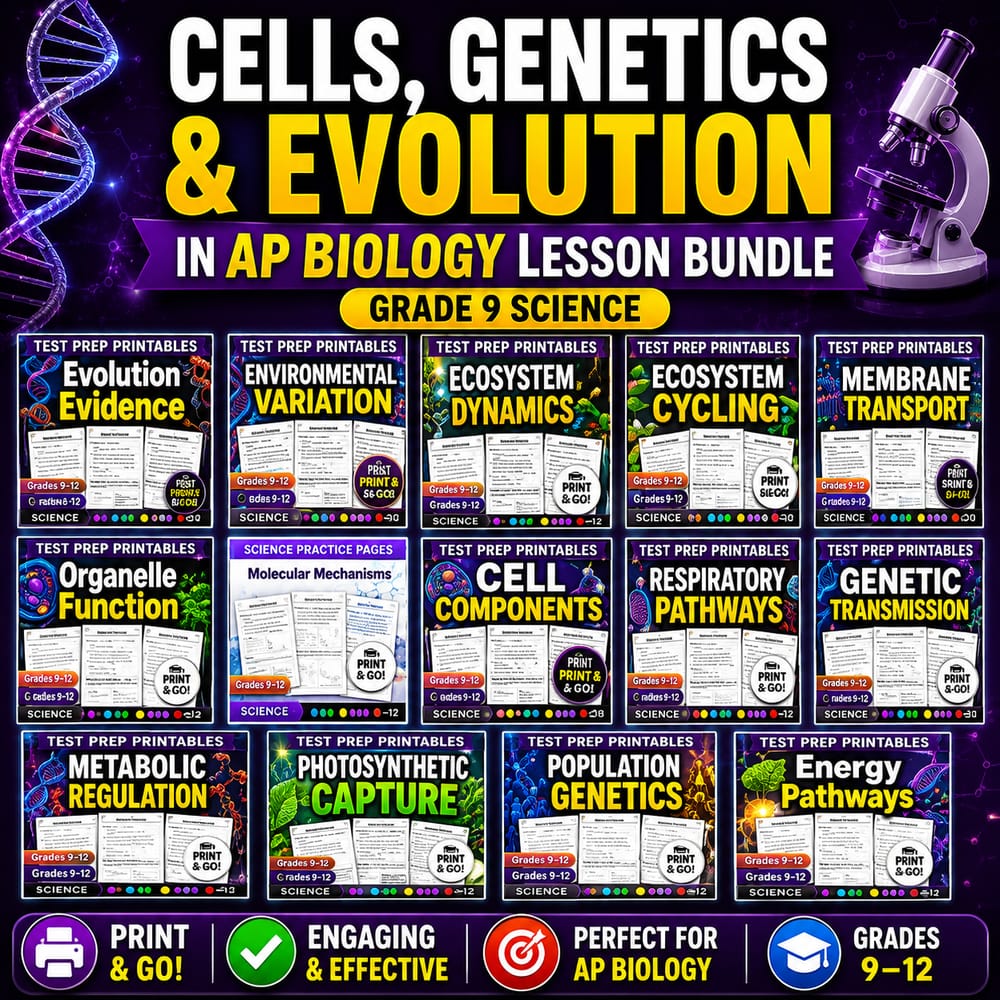


Cells, Genetics & Evolution in AP Biology Lesson Bundle | Grade 9 Science
$56.00$70.00Save $14.00
Prism Point Learning
·2 followers·13 sales
SubjectScienceGradeGrade 9
What’s included
14 worksheets · Save $14.00 (20%) · prices shown inside the bundle
 Evolution Evidence Worksheet | Grade 9 AP Science Evolution Activity
- Interpret multiple lines of evidence for descent with modification, including fossils, comparative anatomy, biogeographic patterns, and molecular phylogenies.
- Explain how mutation, natural selection, genetic drift, and gene flow can change allele frequencies over short and long timescales.
- Use simple models or scenarios to predict how populations respond to changing environmental pressures.
$4.00$5.00 Developmental Variation Worksheet for Grade 9 Science | AP Biology Practice
- Explain how changes in developmental timing and gene regulation can create phenotypic diversity.
- Describe how regulatory networks and epigenetic modulation influence trait expression during development.
- Use developmental evidence to interpret developmental bias and convergent evolution in evolutionary outcomes.
$4.00$5.00 Ecosystem Dynamics Worksheet Grade 9 Science | AP Ecology Practice
- Explain how trophic interactions and feedback loops influence ecosystem responses to disturbances.
- Use simple quantitative reasoning to describe population and nutrient dynamics in ecosystem models.
- Evaluate resilience, regime shifts, and thresholds when multiple stressors act together.
$4.00$5.00 Ecosystem Cycling Worksheet Grade 9 Science | AP Ecology Practice
- Explain how carbon and nitrogen cycle through organisms and abiotic components in an ecosystem.
- Describe how trophic transfer and stoichiometric constraints influence biomass distribution and population dynamics.
- Predict how perturbations like nutrient enrichment, habitat alteration, and invasive species can change ecosystem function.
$4.00$5.00 Membrane Transport Worksheet Activities | Grade 9 AP Science Practice
- Explain how passive diffusion, facilitated transport, and active transport move substances across cell membranes.
- Use concentration gradients and membrane permeability to predict net movement direction and rate.
- Describe how membrane composition and transport proteins help maintain electrochemical gradients and osmotic balance.
$4.00$5.00 Organelle Function Worksheet Pack | Grade 9 AP Biology Science Activities
- Explain how major cell organelles support metabolic pathways and cellular maintenance
- Connect internal membrane structures (cristae, thylakoid stacks, folded membranes) to the organelles’ key functions
- Interpret how compartmentation helps reactions happen efficiently by optimizing reaction rates and coordinating anabolic and catabolic processes
$4.00$5.00 Molecular Inheritance Worksheet for Grade 9 Science | AP Biology Practice
- Explain how DNA sequence information flows to phenotype through replication, transcription, RNA processing, and translation.
- Predict how point mutations and regulatory changes can alter gene expression and protein function.
- Compare the likely effects of coding-region vs regulatory-region mutations in single-gene and polygenic contexts.
$4.00$5.00 Cell Components Worksheet for Grade 9 Science | AP Biology Practice
- Identify major cell components (membranes, organelles, cytoskeleton) and describe their core functions
- Explain how compartmentalization supports specialized metabolism inside cells
- Relate membrane and organelle structure to selective transport and diffusion rates
$4.00$5.00 Respiratory Pathways Worksheet for Grade 9 AP Science Biology Activities
- Explain how glycolysis, the citric acid (TCA) cycle, and electron transport work together to produce ATP.
- Compare aerobic and anaerobic outcomes using redox balance and pathway stoichiometries.
- Predict how substrate availability and enzyme regulation affect pathway flux and cellular ATP yield.
$4.00$5.00 Genetic Transmission Worksheet | Mendelian Genetics Grade 9 AP Science
- Explain how chromosomal behavior during meiosis connects to Mendelian inheritance patterns.
- Predict genotypic and phenotypic ratios using Punnett frameworks and probability.
- Interpret deviations from simple dominance, including incomplete dominance, codominance, and linkage.
$4.00$5.00
Reviews & Feedback
Loading reviews...
Questions & Answers
Loading questions…
About this bundle
Related categories
Frequently asked questions
Who is Cells, Genetics & Evolution in AP Biology Lesson Bundle | Grade 9 Science designed for?
Cells, Genetics & Evolution in AP Biology Lesson Bundle | Grade 9 Science is designed for Grade 9 students and Science learners and can be used in classrooms, homeschool, or independent practice.
How do I download Cells, Genetics & Evolution in AP Biology Lesson Bundle | Grade 9 Science?
Add it to your cart and complete checkout. After payment, you can download immediately from your account, and you'll also receive a download link by email.
Similar Products

Grade 11 Science Biology Cells, Genetics & Evolution Lesson Bundle | BC
$60.00$75.00

Grade 10 Genetics, Evolution, and Cell Science Lesson Bundle: General
$32.00$40.00

Grade 10 Science Worksheet Bundle | Genetics, Cell Biology & Ecosystems (TEKS Aligned)
$126.00$180.00

Grade 10 Science Worksheet Bundle – Genetics, Cell Biology & Ecology (PDF)
$84.00$120.00

Grade 10 Science UNIT Worksheet Bundle – Genetics, Ecosystems & Cell Biology
$17.60$22.00