
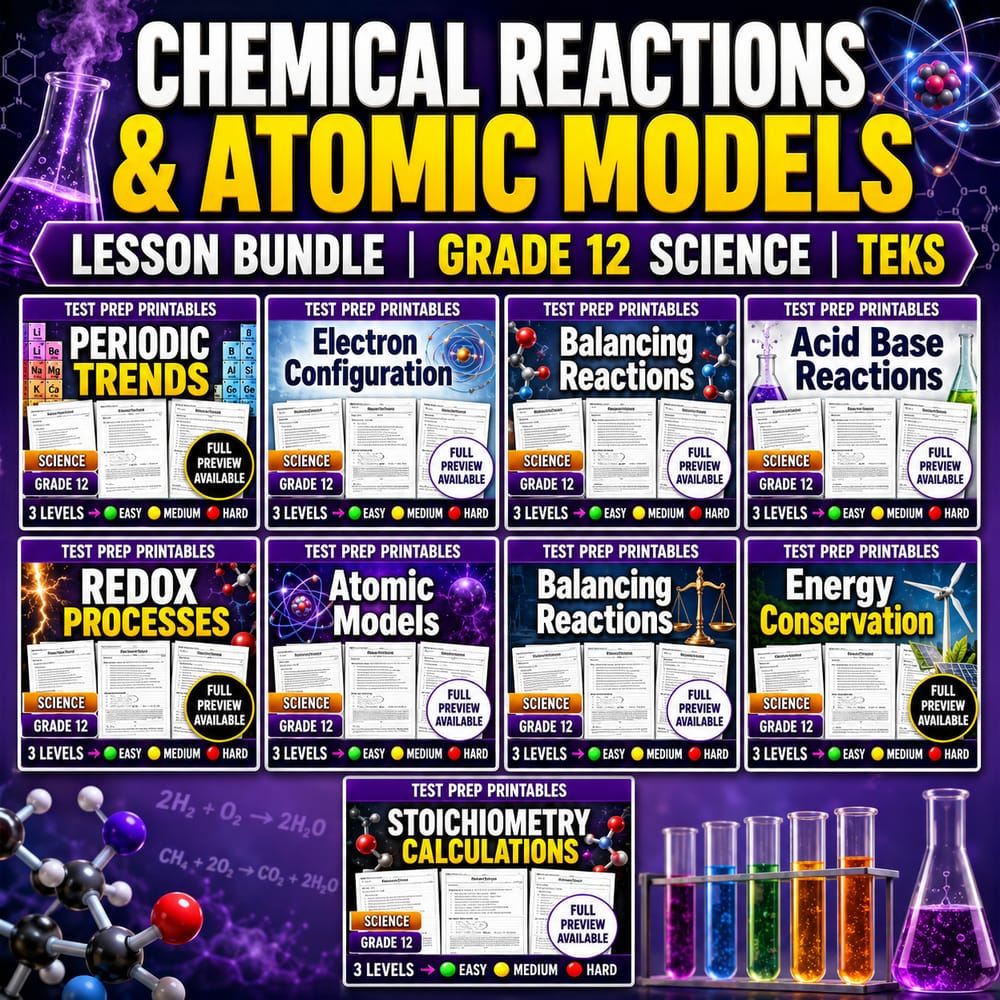
Chemical Reactions & Atomic Models Lesson Bundle | Grade 12 Science | TEKS
$40.00$50.00Save $10.00
Prism Point Learning
·2 followers·13 sales
SubjectScienceGradeGrade 12
What’s included
10 worksheets · Save $10.00 (20%) · prices shown inside the bundle
 Periodic Trends Worksheet | Grade 12 Science Activities
- Explain how effective nuclear charge and shielding influence periodic trends across periods and down groups.
- Interpret and predict patterns for atomic radius, ionization energy, electron affinity, electronegativity, and metallic character.
- Use reasoning based on electron configuration to compare representative elements (alkali metals, transition metals, halogens).
$4.00$5.00 Electron Configuration Worksheet | Grade 12 Science Activities
- Use quantum numbers (n, ℓ, mℓ, ms) to describe electrons in atoms
- Apply the Aufbau principle, Pauli exclusion principle, and Hund’s rule to build electron configurations and orbital diagrams
- Explain how photoelectron spectroscopy supports electronic structure trends and interpret anomalous electron configurations
$4.00$5.00 Bonding Structures Worksheet | Grade 12 Science Practice TEKS
- Classify ionic, covalent, and metallic bonding using electrostatic interactions, polarity, and bond order ideas.
- Use Lewis structures and formal charge reasoning to predict molecular shapes and polarity with VSEPR.
- Relate bonding models to macroscopic properties such as melting point, conductivity, and solubility.
$4.00$5.00 Acid Base Reactions Worksheet | Grade 12 Science Practice
- Compare the Arrhenius, Brønsted–Lowry, and Lewis definitions of acids and bases using correct examples.
- Use conjugate acid–base pairs to explain changes in pH and relate pH to pOH.
- Interpret titration curves and equivalence points and connect them to reaction stoichiometry and equilibria.
$4.00$5.00 Redox Processes Worksheet | Grade 12 Science Practice
- Determine oxidation numbers and identify oxidation and reduction in chemical reactions.
- Balance redox equations in acidic and basic media using oxidation numbers or half-reactions.
- Calculate galvanic cell EMF using standard reduction potentials and apply Faraday’s laws to electrochemical quantities.
$4.00$5.00 Atomic Models Worksheet | Grade 12 Science Practice
- Explain how experimental evidence led to changes in atomic models from Dalton to Rutherford to Bohr.
- Relate cathode ray observations and gold foil scattering to the existence and location of subatomic particles.
- Connect discrete spectral lines to quantized energy levels and infer implications for electron structure.
$4.00$5.00 Energy Conservation Worksheet | Grade 12 Science Activities
- Apply the first and second laws of thermodynamics to interpret internal energy, enthalpy, entropy, and Gibbs free energy in chemical systems.
- Predict reaction spontaneity and the direction of approach to equilibrium using temperature-dependent free energy changes.
- Connect free-energy changes to equilibrium constants and interpret how coupling reactions can conserve energy.
$4.00$5.00 Thermochemistry Worksheet | Grade 12 Science Activities
- Use enthalpy, heat flow, and calorimetry data to determine enthalpy changes for reactions.
- Apply standard enthalpies of formation and Hess’s law to calculate enthalpy changes for multi-step reactions.
- Classify reactions as exothermic or endothermic and relate the sign of ΔH to energy bookkeeping and reaction spontaneity.
$4.00$5.00 Balancing Reactions Worksheet | Grade 12 Science Practice
- Use chemical equations to represent chemical change and balance them using the law of conservation of mass
- Identify and classify common reaction types (synthesis, decomposition, single and double replacement, combustion)
- Apply stoichiometric coefficients and mole ratios to make quantitative relationships between reactants and products
$4.00$5.00 Stoichiometry Calculations Worksheet Grade 12 Science Practice
- Use mole concept and molar mass to convert between mass, moles, and particle counts in stoichiometry problems.
- Determine limiting reagent, theoretical yield, and percent yield from balanced chemical equations and given quantities.
- Apply gas stoichiometry using the ideal gas law and balanced-equation mole ratios to relate gas volumes and moles.
$4.00$5.00
Reviews & Feedback
Loading reviews...
Questions & Answers
Loading questions…
About this bundle
Related categories
Frequently asked questions
Who is Chemical Reactions & Atomic Models Lesson Bundle | Grade 12 Science | TEKS designed for?
Chemical Reactions & Atomic Models Lesson Bundle | Grade 12 Science | TEKS is designed for Grade 12 students and Science learners and can be used in classrooms, homeschool, or independent practice.
How do I download Chemical Reactions & Atomic Models Lesson Bundle | Grade 12 Science | TEKS?
Add it to your cart and complete checkout. After payment, you can download immediately from your account, and you'll also receive a download link by email.
Similar Products

Phase Changes, Chemical Reactions & Atomic Structure Lesson Bundle | Grade 9 Science | Alberta
$36.00$45.00

Particle Models and Chemical Reactions Grade 6 Science Lesson Bundle | NGSS
$20.00$25.00

Chemical Reactions, Biodiversity & Atomic Structure Lesson Bundle | Grade 10 Science NGSS
$19.60$28.00

Grade 9 Alberta Science Chemical Changes & Atomic Models Bundle
$16.00$20.00

Atomic Structure & Chemical Reactions Lesson Bundle | Grade 9 Science | NGSS
$28.00$35.00