
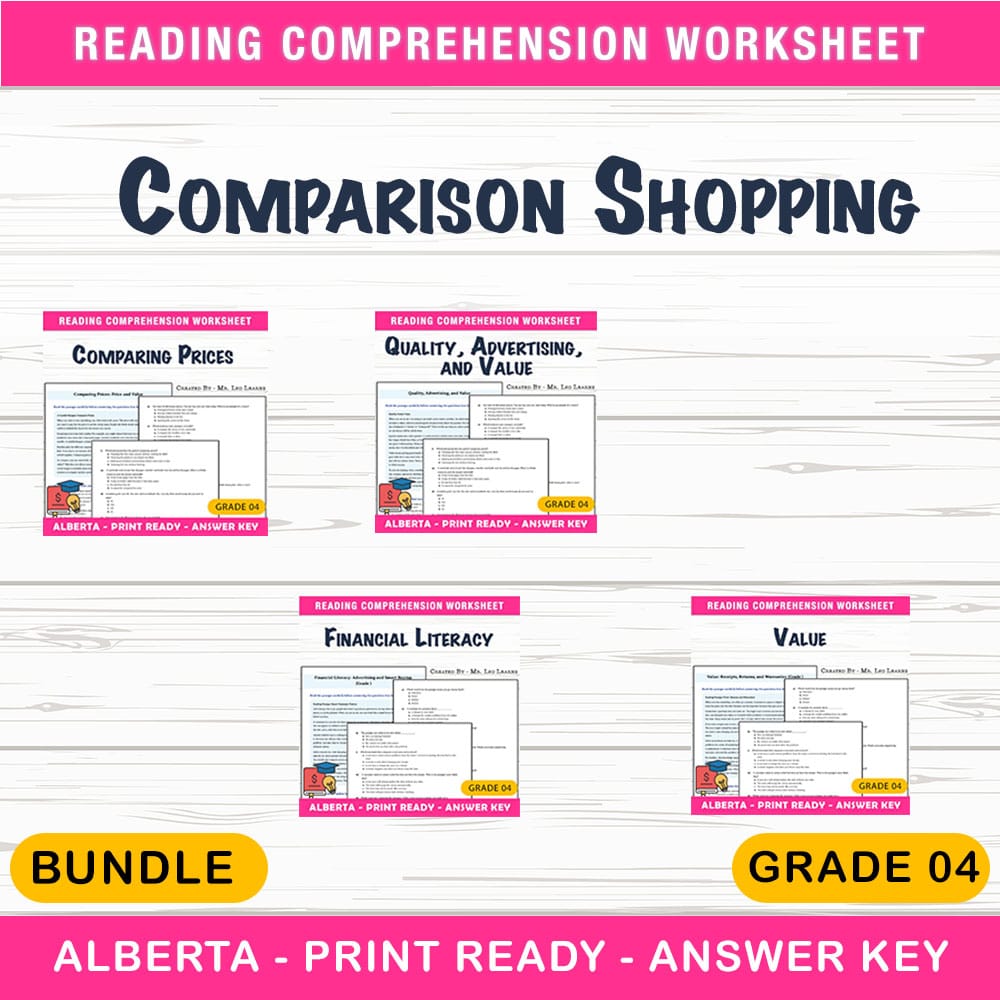
Comparison Shopping Lesson Bundle | Grade 4 Financial Literacy | Alberta
$9.60$12.00Save $2.40
The Resource Hub
·2 followers·9 sales
GradeGrade 4Pages32 Pages
What’s included
4 worksheets · 32 pages · Save $2.40 (20%) · prices shown inside the bundle
 Grade 4 Financial Literacy Comparing Prices Worksheet | Alberta Price & Value
- Identify what the word price means in a shopping situation.
- Compare prices to decide which choice has better value.
- Use cost, value, and choice vocabulary to explain buying decisions.
$2.40$3.00 Grade 4 Financial Literacy Receipts, Returns & Warranties Worksheet | Alberta
- Explain how a receipt can serve as proof for a return.
- Describe the difference between a return, a refund, and a warranty.
- Identify how keeping receipts helps protect money in simple budgets.
$2.40$3.00 Grade 4 Financial Literacy Advertising & Smart Buying Worksheet | Alberta
- Define key vocabulary (online, review, safe, buyer, consumer) and use each word in a sentence.
- Identify how advertising can influence what a consumer wants to buy.
- Apply strategies for safe online and store purchases, including checking reviews and product details.
$2.40$3.00 Grade 4 Financial Literacy Advertising & Value Worksheet | Alberta Consumer Skills
- Define key financial literacy terms: advertising, claim, quality, value, and product.
- Identify how advertising messages may be claims about a product.
- Choose examples of value using quality, not just price.
$2.40$3.00
Reviews & Feedback
Loading reviews...
Questions & Answers
Loading questions…
About this bundle
Related categories
Frequently asked questions
Who is Comparison Shopping Lesson Bundle | Grade 4 Financial Literacy | Alberta designed for?
Comparison Shopping Lesson Bundle | Grade 4 Financial Literacy | Alberta is designed for Grade 4 students and can be used in classrooms, homeschool, or independent practice.
How do I download Comparison Shopping Lesson Bundle | Grade 4 Financial Literacy | Alberta?
Add it to your cart and complete checkout. After payment, you can download immediately from your account, and you'll also receive a download link by email.
Similar Products

Grade 10 ELA Full-Year Reading & Writing Worksheets Bundle
$140.00$200.00

Grade 10 ELA Language & Conventions Worksheets Bundle
$28.00$35.00

Grade 10 ELA Writing Process & Coherence Worksheets Bundle
$40.00$50.00

Grade 10 ELA Media Literacy Worksheets Bundle | Alberta
$20.00$25.00

Grade 5 Maths Task Cards Full Year Bundle | 684 Cards, 57 Resources
$163.80$234.00