
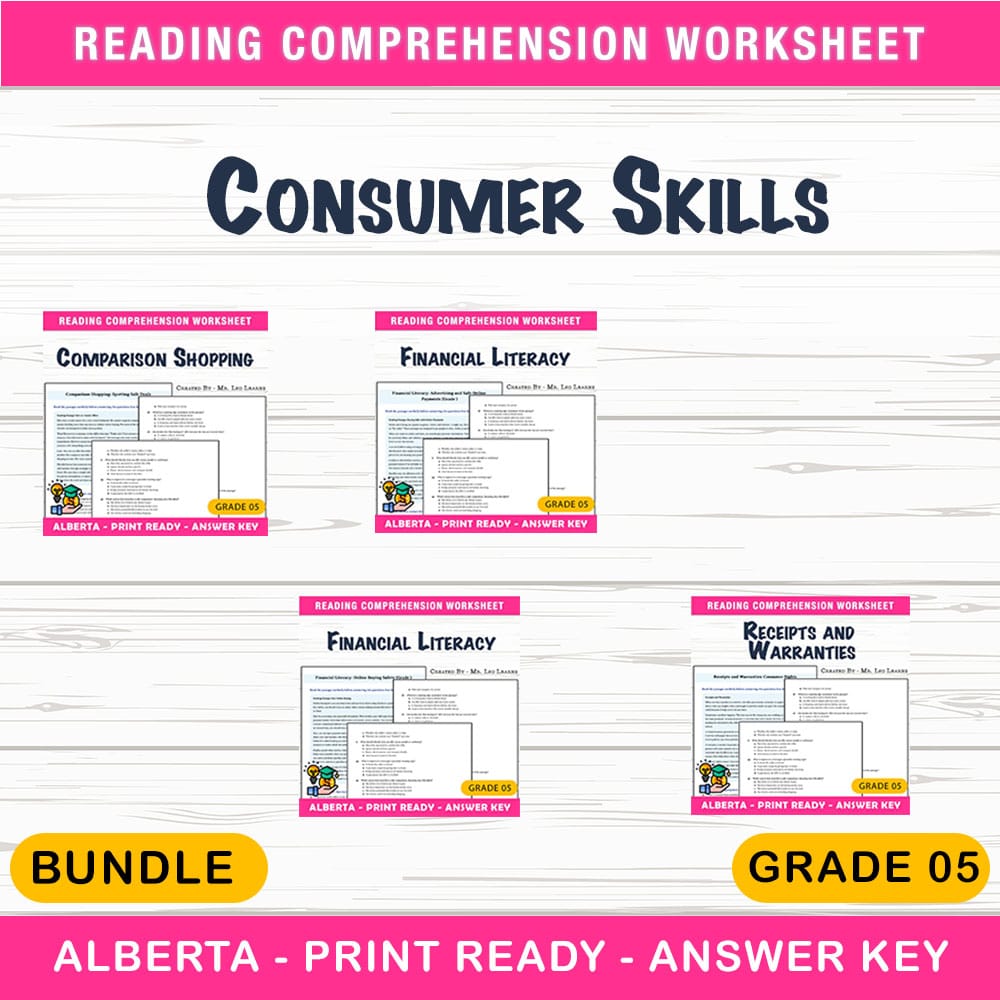
Consumer Skills Worksheets Bundle | Grade 5 Financial Literacy | Alberta
$8.40$12.00Save $3.60
The Resource Hub
·2 followers·9 sales
GradeGrade 5Pages32 Pages
What’s included
4 worksheets · 32 pages · Save $3.60 (30%) · prices shown inside the bundle
 Grade 5 Advertising & Safe Online Payments Worksheet | Financial Literacy
- Identify common advertising words and claims in online offers for purchases.
- Explain how to recognize safer payment habits when buying online.
- Use key vocabulary (online, payment, secure, password, privacy) to describe good choices.
$2.10$3.00 Grade 5 Online Buying Safety Worksheet | Financial Literacy Digital Shopping
- Identify safe habits for paying online using a bank or payment card
- Recognize why protecting personal information helps keep money safe
- Use the idea of recording purchases to help track spending
$2.10$3.00 Grade 5 Receipts & Warranties Worksheet | Consumer Rights Financial Literacy
- Identify how a receipt helps a consumer prove a purchase.
- Explain the difference between a return and a refund.
- Recognize what a warranty is and how it protects a buyer.
$2.10$3.00 Grade 5 Comparison Shopping Worksheet | Spotting Safe Deals Financial Literacy
- Explain how comparison shopping helps people choose the best value by checking price, quality, and delivery details.
- Identify warning signs of scams and fake offers, including urgent messages, suspicious links, and offers that seem too good to be true.
- Use financial vocabulary (scam, fraud, trick, warning, fake) to describe unsafe purchasing situations.
$2.10$3.00
Reviews & Feedback
Loading reviews...
Questions & Answers
Loading questions…
About this bundle
Related categories
Frequently asked questions
Who is Consumer Skills Worksheets Bundle | Grade 5 Financial Literacy | Alberta designed for?
Consumer Skills Worksheets Bundle | Grade 5 Financial Literacy | Alberta is designed for Grade 5 students and can be used in classrooms, homeschool, or independent practice.
How do I download Consumer Skills Worksheets Bundle | Grade 5 Financial Literacy | Alberta?
Add it to your cart and complete checkout. After payment, you can download immediately from your account, and you'll also receive a download link by email.
