
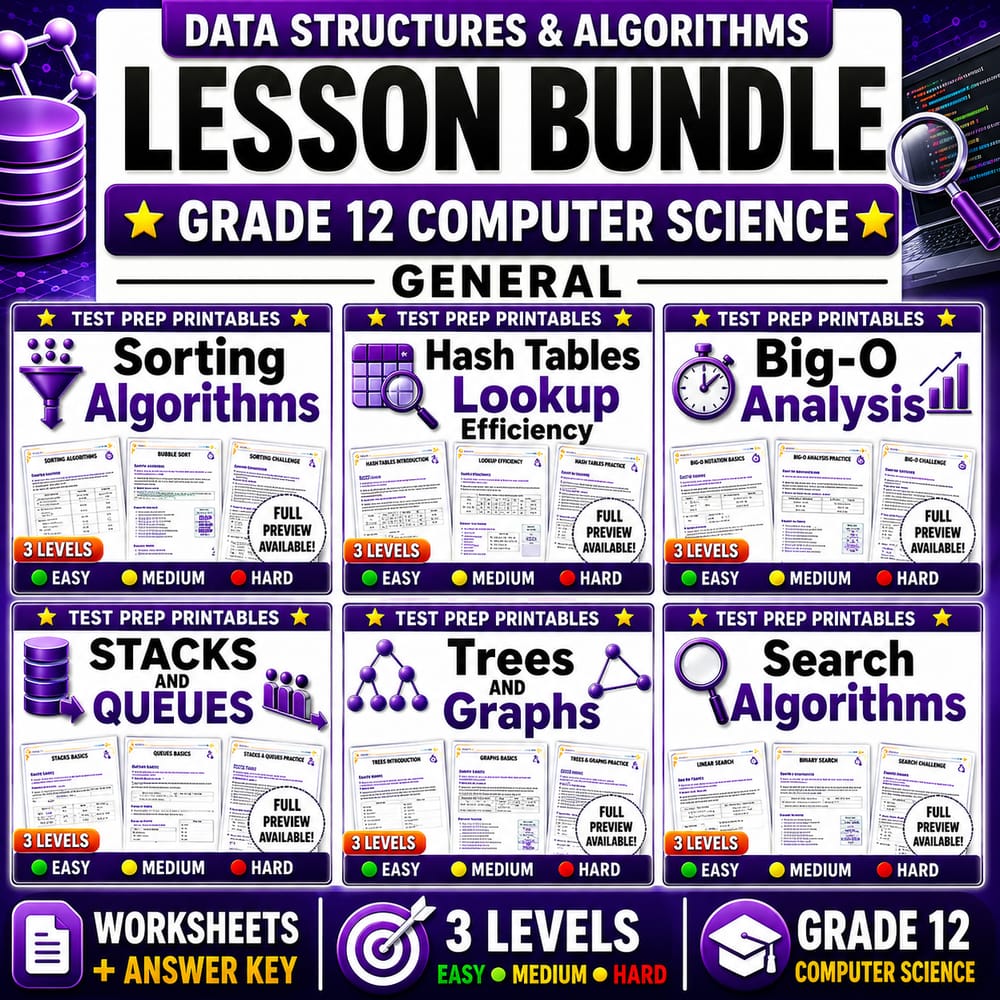
Data Structures & Algorithms Lesson Bundle | Grade 12 Computer Science | General
$24.00$30.00Save $6.00
Prism Point Learning
·2 followers·13 sales
SubjectComputer ScienceGradeGrade 12Pages183 Pages
What’s included
6 worksheets · 183 pages · Save $6.00 (20%) · prices shown inside the bundle
 Sorting Algorithms Worksheet | Grade 12 Computer Science Practice
- Trace how bubble sort, selection sort, and insertion sort progress through passes.
- Compare swap behavior and time complexity characteristics of common sorting algorithms.
- Predict the intermediate and final order of elements after specific passes.
$4.00$5.00 Hash Tables and Lookup Efficiency Worksheet Grade 12 Computer Science
- Explain how hash functions and keys enable fast lookup in hash tables
- Analyze how collisions and load factor affect lookup performance
- Compare hash-table search efficiency with other lookup methods
$4.00$5.00 Big-O Analysis Comparing Growth Rates Worksheet | Grade 12 Computer Science
- Explain what Big-O notation means for time and space growth as input size increases.
- Classify common code patterns by their Big-O time complexity (e.g., O(1), O(n), O(n²)).
- Justify which algorithm scales better using growth-rate reasoning.
$4.00$5.00 Stacks and Queues LIFO vs FIFO Worksheet | Grade 12 Computer Science
- Distinguish stack behavior (LIFO) from queue behavior (FIFO) and predict outcomes of operations.
- Apply push, pop, enqueue, and dequeue to real scheduling and program execution scenarios.
- Evaluate statements about stacks and queues for correctness and identify common misconceptions.
$4.00$5.00 Trees and Graphs Traversals Worksheet | Grade 12 Computer Science
- Explain how trees represent hierarchical relationships and how graphs represent network connections
- Use traversal ideas to describe how nodes can be visited in a tree or graph
- Determine path relationships and interpret common graph terms such as vertices, edges, and degree
$4.00$5.00 Search Algorithms Worksheet Grade 12 Computer Science Activities
- Compare linear search and binary search in terms of required data conditions and time efficiency
- Trace the steps of a search algorithm and interpret the number of comparisons
- Select the best search method for a given data scenario and justify the choice
$4.00$5.00
Reviews & Feedback
Loading reviews...
Questions & Answers
Loading questions…
About this bundle
Related categories
Frequently asked questions
Who is Data Structures & Algorithms Lesson Bundle | Grade 12 Computer Science | General designed for?
Data Structures & Algorithms Lesson Bundle | Grade 12 Computer Science | General is designed for Grade 12 students and Computer Science learners and can be used in classrooms, homeschool, or independent practice.
How do I download Data Structures & Algorithms Lesson Bundle | Grade 12 Computer Science | General?
Add it to your cart and complete checkout. After payment, you can download immediately from your account, and you'll also receive a download link by email.
Similar Products

Grade 3 Data Literacy in Computer Science Lesson Bundle | General
$14.40$18.00

Data Structures & Algorithms Lesson Bundle | Grade 11 CS | General
$24.00$30.00

Relational Databases & Data Analytics Lesson Bundle | Grade 12 CS | General
$24.00$30.00

Reliable Data, Databases & Visualization Lesson Bundle | Grade 10 Computer Science | General
$24.00$30.00

Grade 8 Data Analysis & Ethics Lesson Bundle | Computer Science | General
$24.00$30.00