
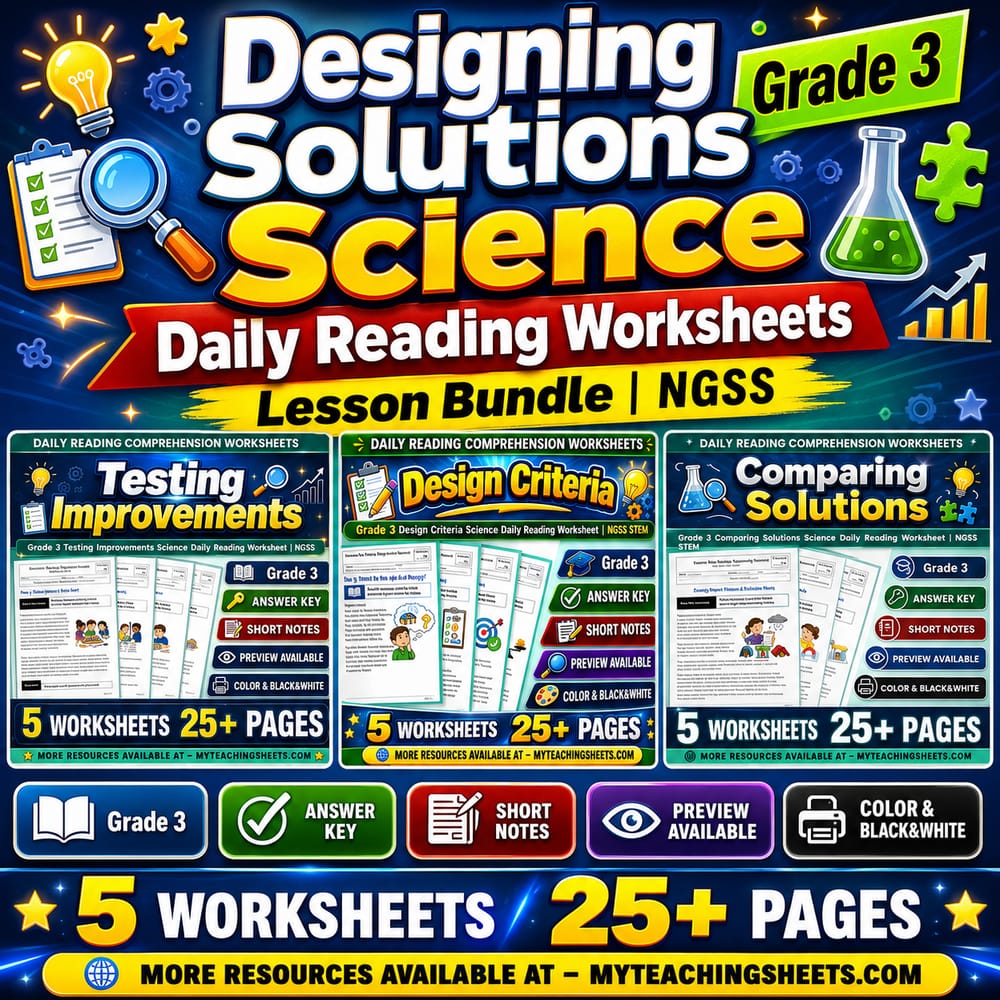
Designing Solutions Grade 3 Science Daily Reading Worksheets Lesson Bundle| NGSS
$12.00$15.00Save $3.00
BRIGHT PATH RESOURCES
·3 followers·23 sales
SubjectScienceGradeGrade 3
What’s included
3 worksheets · Save $3.00 (20%) · prices shown inside the bundle
 Grade 3 Testing Improvements Science Daily Reading Worksheet | NGSS STEM
- Identify the controlled variables in a fair test.
- Explain why keeping conditions the same helps results make sense.
- Connect test results to design improvements.
$4.00$5.00 Grade 3 Design Criteria Science Daily Reading Worksheet | NGSS STEM Activity
- Identify the desired function of a design problem.
- Name measurable success measures for a design.
- Recognize constraints that can limit a solution.
$4.00$5.00 Grade 3 Comparing Solutions Science Daily Reading Worksheet | NGSS STEM
- Identify criteria in a problem.
- Compare solution ideas using evidence from simple models.
- Use measurements and observations to explain trade-offs.
$4.00$5.00
Reviews & Feedback
Loading reviews...
Questions & Answers
Loading questions…
About this bundle
Related categories
Frequently asked questions
Who is Designing Solutions Grade 3 Science Daily Reading Worksheets Lesson Bundle| NGSS designed for?
Designing Solutions Grade 3 Science Daily Reading Worksheets Lesson Bundle| NGSS is designed for Grade 3 students and Science learners and can be used in classrooms, homeschool, or independent practice.
How do I download Designing Solutions Grade 3 Science Daily Reading Worksheets Lesson Bundle| NGSS?
Add it to your cart and complete checkout. After payment, you can download immediately from your account, and you'll also receive a download link by email.
Similar Products

Engineering Design Grade 7 Science Daily Reading Worksheets Lesson Bundle | TEKS
$32.00$40.00

Engineering Design Grade 11 Science Daily Reading Worksheets Bundle | NGss
$16.00$20.00

Grade 10 Science Trade-Off Design Daily Reading Worksheet Lesson Bundle-General
$19.20$24.00

Engineering Design Foundations Grade 10 Science Daily Reading Bundle | NGSS
$16.00$20.00

Engineering Design Grade 9 Science Daily Reading Worksheets Lesson Bundle | NGSS
$12.80$16.00