
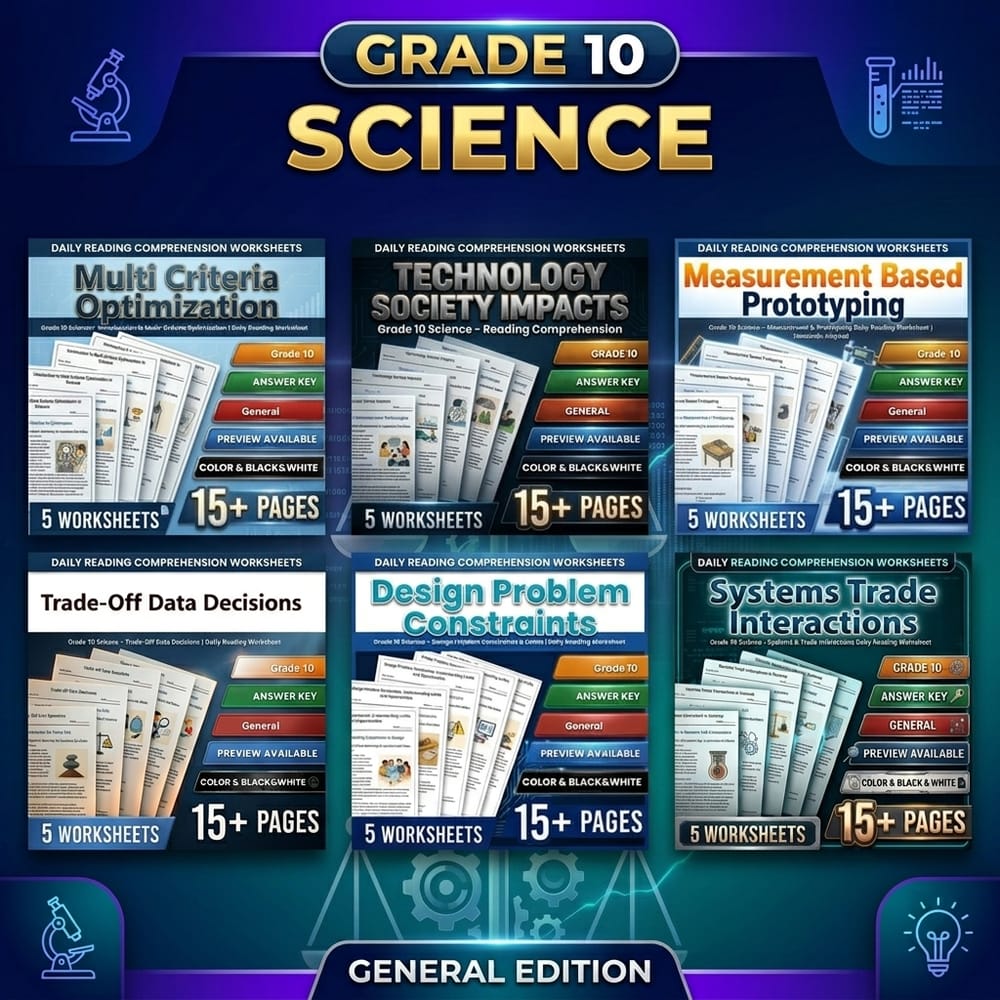
Grade 10 Science Trade-Off Design Daily Reading Worksheet Lesson Bundle-General
$19.20$24.00Save $4.80
Bright Mind Resources
New·1 followers·12 sales
SubjectScienceGradeGrade 10
What’s included
6 worksheets · Save $4.80 (20%) · prices shown inside the bundle
 Grade 10 Science – Multi-Criteria Optimization | Daily Reading Worksheet
- Understand the concept of multi-criteria optimization
- Learn how to prioritize multiple goals in design
- Recognize the importance of constraints and measurement trends
$3.20$4.00 Grade 10 Science – Technology & Society Impacts | Daily Reading Worksheet
- Understand how communication technologies influence society
- Analyze cause-and-effect relationships in technological development
- Evaluate the benefits and risks of new communication tools
$3.20$4.00 Grade 10 Science – Measurement & Prototyping Worksheet | Standards-Aligned
- Understand the importance of measurement in evaluating prototypes
- Identify key types of measurements used in prototyping
- Recognize how measurements influence design improvements
$3.20$4.00 Grade 10 Science – Trade-Off Data Decisions | Daily Reading Worksheet
- Understand the concept of trade-offs in scientific decision-making.
- Identify examples of trade-offs in data and design.
- Analyze how trade-offs affect scientific and engineering choices.
$3.20$4.00 Grade 10 Science – Design Problem Constraints & Limits | Daily Reading Worksheet
- Identify different types of constraints in a design process
- Explain how constraints influence design choices
- Connect specific constraints to feasible solutions
$3.20$4.00 Grade 10 Science – Systems & Trade Interactions Daily Reading Worksheet
- Understand the concept of systems and their components.
- Identify different parts of a system and explain their functions.
- Recognize how changes in one component affect other parts of the system.
$3.20$4.00
Reviews & Feedback
Loading reviews...
Questions & Answers
Loading questions…
About this bundle
Related categories
Frequently asked questions
Who is Grade 10 Science Trade-Off Design Daily Reading Worksheet Lesson Bundle-General designed for?
Grade 10 Science Trade-Off Design Daily Reading Worksheet Lesson Bundle-General is designed for Grade 10 students and Science learners and can be used in classrooms, homeschool, or independent practice.
How do I download Grade 10 Science Trade-Off Design Daily Reading Worksheet Lesson Bundle-General?
Add it to your cart and complete checkout. After payment, you can download immediately from your account, and you'll also receive a download link by email.
Similar Products

Design Tradeoffs Grade 8 Science Daily Reading Worksheets Lesson Bundle | NGSS
$20.00$25.00

Tech Tradeoffs Grade 8 Science Daily Reading Worksheets Lesson Bundle | General
$19.20$24.00

Grade 8 Tradeoff Analysis Science Daily Reading Worksheets Lesson Bundle | NGSS
$16.00$20.00

Grade 10 NGSS Science: Models, Systems, and Trade-Off Design Lesson Bundle
$16.00$20.00

Grade 10 Engineering Design Trade-Offs Science Lesson Bundle: General
$19.20$24.00