
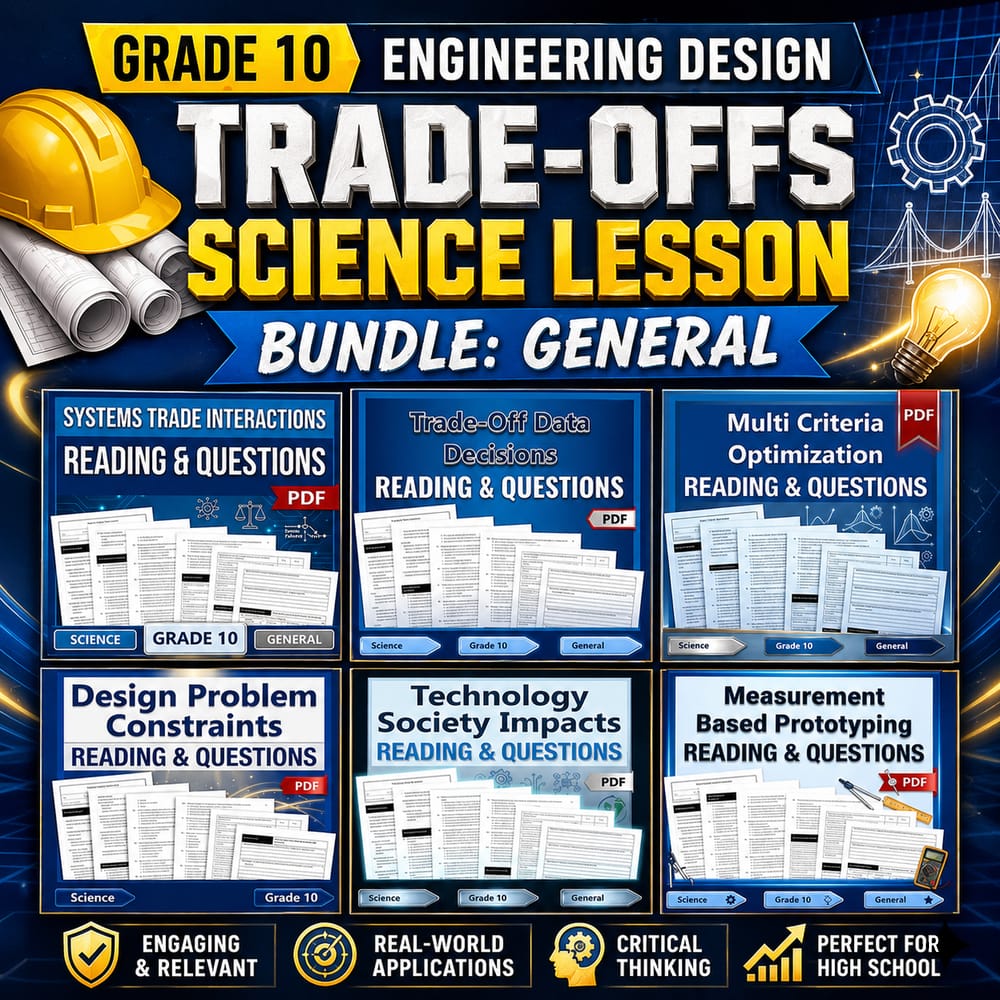
Grade 10 Engineering Design Trade-Offs Science Lesson Bundle: General
$19.20$24.00Save $4.80
Evergreen Desk Education
·2 followers·17 sales
SubjectScienceGradeGrade 10
What’s included
6 worksheets · Save $4.80 (20%) · prices shown inside the bundle
 Grade 10 Science | Systems Trade Interactions Worksheet (PDF)
- Explain how a design can be modeled as a system with interacting components and dependencies.
- Identify trade-offs that arise from system interactions, constraints, and feedback.
- Use cause-and-effect reasoning to predict how changes in one component affect other outcomes.
$3.20$4.00 Grade 10 Science | Trade-Off Data Decisions Worksheet (PDF)
- Explain how measurable criteria can be used to compare alternative solutions.
- Identify common trade-offs (performance vs. cost, durability vs. weight) in real design decisions.
- Justify a chosen option by connecting evidence to criteria and acknowledging limitations.
$3.20$4.00 Grade 10 Science Worksheet | Multi Criteria Optimization (PDF)
- Explain how data and constraints are used to optimize a design toward target outcomes.
- Compare trade-offs when multiple criteria (goals) matter at the same time.
- Use evidence from parameter changes to justify which design improvements are meaningful.
$3.20$4.00 Grade 10 Science | Design Problem Constraints Worksheet (PDF)
- Explain how constraints (time, cost, safety, energy use, and materials) shape the range of acceptable engineering design solutions
- Justify design choices by linking each major decision to a specific constraint and describing trade-offs
- Evaluate whether a proposed solution is feasible by checking evidence, calculations, and safety considerations
$3.20$4.00 Grade 10 Science | Impacts of Technology Society Worksheet (PDF)
- Explain how technology and engineering can reshape communication, work, travel, and access to services.
- Analyze how design choices create different benefits and risks in specific social contexts.
- Connect environmental impacts of technology to resource use, emissions, waste, and ecosystem effects.
$3.20$4.00 Grade 10 Science | Measurement-Based Prototyping Worksheet (PDF)
- Explain how measurements connect design features to performance outcomes in prototypes.
- Identify sources of variation and limitations that affect the reliability of conclusions.
- Use measurement results to compare performance across conditions and decide whether goals are met.
$3.20$4.00
Reviews & Feedback
Loading reviews...
Questions & Answers
Loading questions…
About this bundle
Related categories
Frequently asked questions
Who is Grade 10 Engineering Design Trade-Offs Science Lesson Bundle: General designed for?
Grade 10 Engineering Design Trade-Offs Science Lesson Bundle: General is designed for Grade 10 students and Science learners and can be used in classrooms, homeschool, or independent practice.
How do I download Grade 10 Engineering Design Trade-Offs Science Lesson Bundle: General?
Add it to your cart and complete checkout. After payment, you can download immediately from your account, and you'll also receive a download link by email.
Similar Products

Grade 10 Engineering Design Worksheets Bundle | Science Trade-Offs
$14.40$18.00

Grade 11 System Design & Trade-offs Science Lesson Bundle | General
$19.20$24.00

Grade 10 Engineering Design Trade-Offs Science Lesson Bundle: General Framework
$24.00$30.00

Grade 8 Engineering Design Testing Tradeoffs Science Lesson Bundle - General Framework
$24.00$30.00

Grade 7 Science Structural Engineering Design & Materials Lesson Bundle |Ontario
$48.00$60.00