
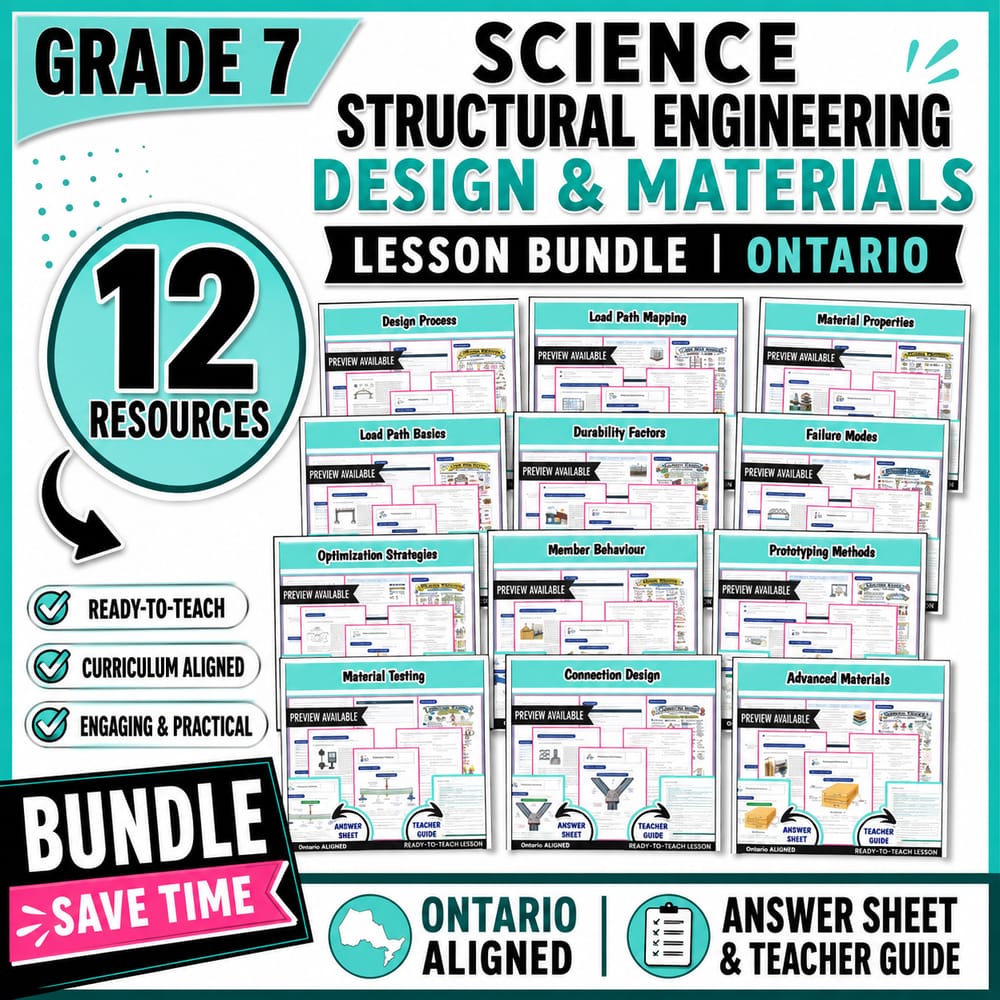


Grade 7 Science Structural Engineering Design & Materials Lesson Bundle |Ontario
$48.00$60.00Save $12.00
Chalk and Compass
·5 followers·13 sales
SubjectScienceGradeGrade 7
What’s included
12 worksheets · Save $12.00 (20%) · prices shown inside the bundle
 Grade 7 Design Process Worksheet | Engineering Design Cycle Ontario
- Explain the design process from requirements and constraints to concept generation and solution selection.
- Describe how performance objectives (like load capacity, stiffness, and serviceability) guide engineering decisions.
- Use criteria and trade-off reasoning (including decision matrices and sketches) to compare design alternatives.
$4.00$5.00 Load Path Mapping Worksheet Grade 7 Science | Ontario Engineering Forces
- Describe how engineers map primary and secondary load paths in buildings and bridges to transfer gravity, lateral, and dynamic forces safely to foundations.
- Explain how openings, re-entrant corners, and irregular geometry can redistribute loads and change stiffness and internal force locations.
- Justify the importance of redundancy and alternative load paths to reduce the risk of collapse.
$4.00$5.00 Grade 7 Material Properties Worksheet | Ontario Science Activity
- Define and compare key material properties (density, tensile/compressive strength, stiffness, ductility, toughness, and thermal expansion).
- Explain how material properties affect structural behavior such as deformation, cracking, and failure modes.
- Relate property selection to loading conditions and structural performance using wood, steel, and reinforced concrete examples.
$4.00$5.00 Load Path Basics Worksheet Grade 7 Science Structures & Forces
- Identify the main structural components in a load path (slabs/decks, beams, columns, trusses, and foundations).
- Distinguish dead loads and live loads and predict how they transfer through a simple structure.
- Recognize where tension, compression, and shear typically occur in common structural members and at connections.
$4.00$5.00 Durability Factors Worksheet Grade 7 Science | Ontario STEM
- Explain how corrosion, rot and moisture uptake, freeze–thaw cycling, and UV degradation reduce material durability over time
- Describe protective measures (coatings, cathodic protection, concrete cover) that slow or prevent environmental damage
- Relate expected lifespan to service environment and maintenance/inspection routines for bridge decks and exterior roofing
$4.00$5.00 Failure Modes Worksheet Grade 7 Science Engineering Design Ontario
- Explain how common structural failure modes (buckling, fatigue, shear/bending fracture, and connection/foundation failure) relate to geometry, material, and loading.
- Describe the limit states design philosophy and how safety factors reduce the risk of structural failure.
- Use redundancy and proper detailing to reduce the chance of progressive collapse.
$4.00$5.00 Grade 7 Optimization Strategies Worksheet | Engineering Design & Science
- Explain how iterative refinement and quantitative comparison improve structural designs while balancing weight, cost, and performance.
- Distinguish topology optimization from form optimization and describe how performance-based criteria guide design choices.
- Describe how life-cycle assessment, constructability constraints, and building codes with safety margins affect feasible optimization results.
$4.00$5.00 Grade 7 Member Behaviour Worksheet | Forces, Loads & Structural Response
- Describe how structural members respond to applied loads through bending, shear, axial force, and torsion
- Connect bending moment and shear force to deflection and serviceability in beams and cantilevers
- Contrast bending-dominated members with axial-dominated members such as columns and truss bars
$4.00$5.00 Prototyping Methods Worksheet Grade 7 Science Engineering Design Ontario
- Compare scaled physical models, digital finite-element models, and laboratory load rigs for testing strength, stiffness, and failure modes.
- Explain how strain gauges and displacement transducers are used to measure structural response during prototyping.
- Describe limitations of scaling, including effects of material heterogeneity and joint behavior.
$4.00$5.00 Grade 7 Material Testing Worksheet | Ontario Science + Doodle Note
- Explain how tensile, compression, and bending tests help determine material properties used in design.
- Describe non-destructive testing methods (ultrasonic testing and hardness measurements) and what information they provide.
- Interpret how safety factors and design codes account for material variability and anisotropy.
$4.00$5.00
Reviews & Feedback
Loading reviews...
Questions & Answers
Loading questions…
About this bundle
Related categories
Frequently asked questions
Who is Grade 7 Science Structural Engineering Design & Materials Lesson Bundle |Ontario designed for?
Grade 7 Science Structural Engineering Design & Materials Lesson Bundle |Ontario is designed for Grade 7 students and Science learners and can be used in classrooms, homeschool, or independent practice.
How do I download Grade 7 Science Structural Engineering Design & Materials Lesson Bundle |Ontario?
Add it to your cart and complete checkout. After payment, you can download immediately from your account, and you'll also receive a download link by email.
Similar Products

Grade 7 Science Unit Bundle – Structural Engineering & Material Testing
$26.40$33.00

Grade 3 Science Lesson Bundle | Structural Systems & Strong Structures | Ontario
$16.80$21.00

Grade 3 Science Basic Structures & Materials Worksheet Bundle | Ontario
$16.80$21.00

Grade 7 Science Unit | Structural Engineering & Material Testing Worksheets Bundle
$19.20$24.00

Grade 7 Science Lesson Bundle: Engineering & Structural Materials Ontario
$28.80$36.00