
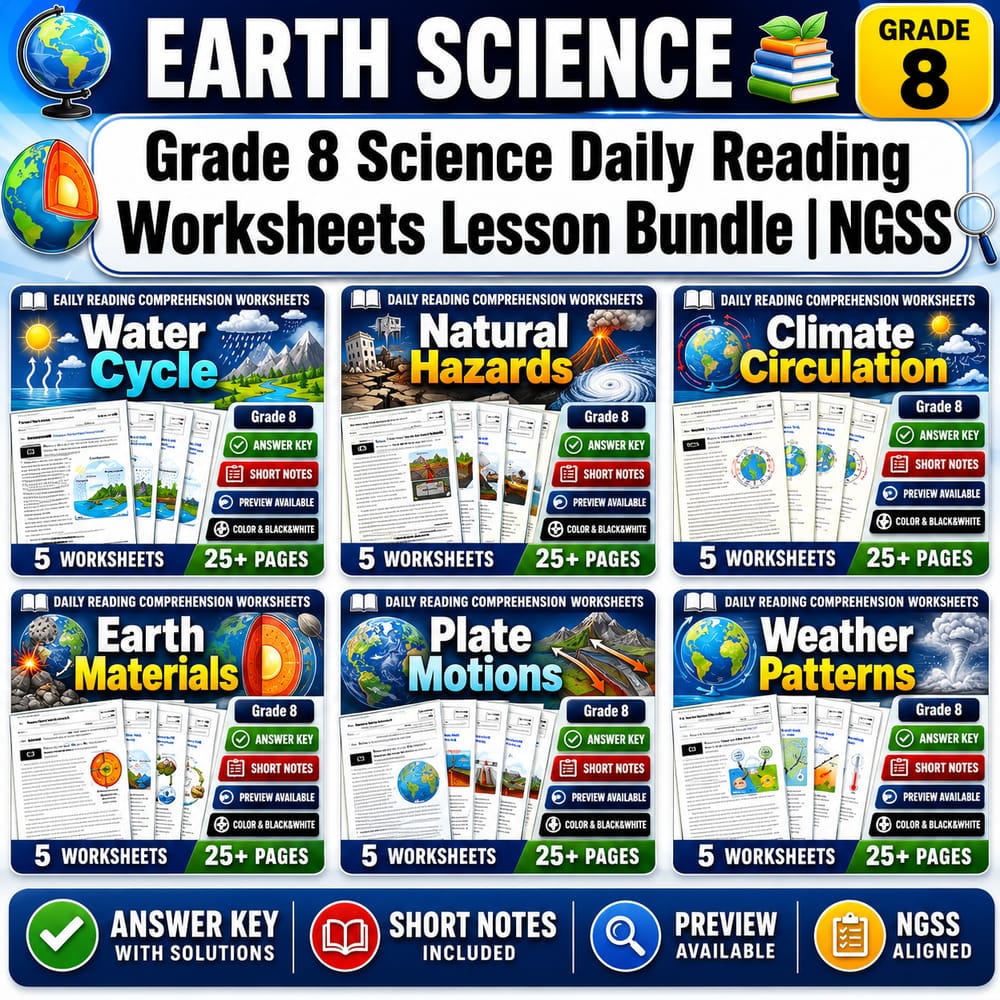
Earth Science Grade 8 Science Daily Reading Worksheets Lesson Bundle | NGSS
$24.00$30.00Save $6.00
BRIGHT PATH RESOURCES
·3 followers·23 sales
SubjectScienceGradeGrade 8
What’s included
6 worksheets · Save $6.00 (20%) · prices shown inside the bundle
 Grade 8 Water Cycle NGSS Science Worksheet | Earth Science Activity
- Identify and describe the main stages of the water cycle.
- Understand the processes of evaporation, condensation, precipitation, infiltration, runoff, and groundwater flow.
- Recognize the connection between the water cycle and land surface weathering processes.
$4.00$5.00 Grade 8 Natural Hazards & Earthquake Data Analysis NGSS Science Worksheet
- Interpret seismic catalogs to understand earthquake patterns
- Calculate and analyze earthquake recurrence intervals
- Identify spatial distribution of earthquakes using fault maps
$4.00$5.00 Grade 8 Climate Circulation NGSS Science Worksheet | Earth Science Activity
- Identify main atmospheric and oceanic circulation cells
- Understand the roles of Hadley, Ferrel, and polar cells
- Explain how Coriolis effect influences wind patterns
$4.00$5.00 Grade 8 Earth Materials The Rock Cycle NGSS Science Worksheet Activity
- Understand the stages of the rock cycle and how different rocks transform from one type to another.
- Recognize the role of Earth's internal heat and surface processes in shaping Earth's materials.
- Identify key processes such as melting, crystallization, uplift, weathering, transport, and deposition.
$4.00$5.00 Grade 8 Plate Motions and Landforms NGSS Science Worksheet Activity
- Understand key concepts related to Science
- Apply knowledge through practice questions
- Demonstrate comprehension of the material
$4.00$5.00 Grade 8 Weather Patterns Air Masses NGSS Science Worksheet Activity
- Identify different types of air masses and describe their characteristics
- Understand how air masses influence weather conditions like wind, temperature, humidity, and precipitation
- Analyze observational data related to surface pressure maps, temperature gradients, radiosonde profiles, and Doppler radar
$4.00$5.00
Reviews & Feedback
Loading reviews...
Questions & Answers
Loading questions…
About this bundle
Related categories
Frequently asked questions
Who is Earth Science Grade 8 Science Daily Reading Worksheets Lesson Bundle | NGSS designed for?
Earth Science Grade 8 Science Daily Reading Worksheets Lesson Bundle | NGSS is designed for Grade 8 students and Science learners and can be used in classrooms, homeschool, or independent practice.
How do I download Earth Science Grade 8 Science Daily Reading Worksheets Lesson Bundle | NGSS?
Add it to your cart and complete checkout. After payment, you can download immediately from your account, and you'll also receive a download link by email.
Similar Products

Earth and Human Activity Grade 11 Science Daily Reading Worksheets Bundle | NGSS
$24.00$30.00

Earth's Place in the Universe Grade 11 Science Daily Reading Bundle | NGSS
$8.00$10.00

Grade 7 Earth Science Daily Reading Worksheets Lesson Bundle | Florida NGSSS
$32.00$40.00

Earth Systems Grade 10 Science Daily Reading Worksheets Lesson Bundle | NGSS
$28.00$35.00

Grade 8 Earth Science Daily Reading Worksheets Lesson Bundle | Florida NGSSS
$32.00$40.00