
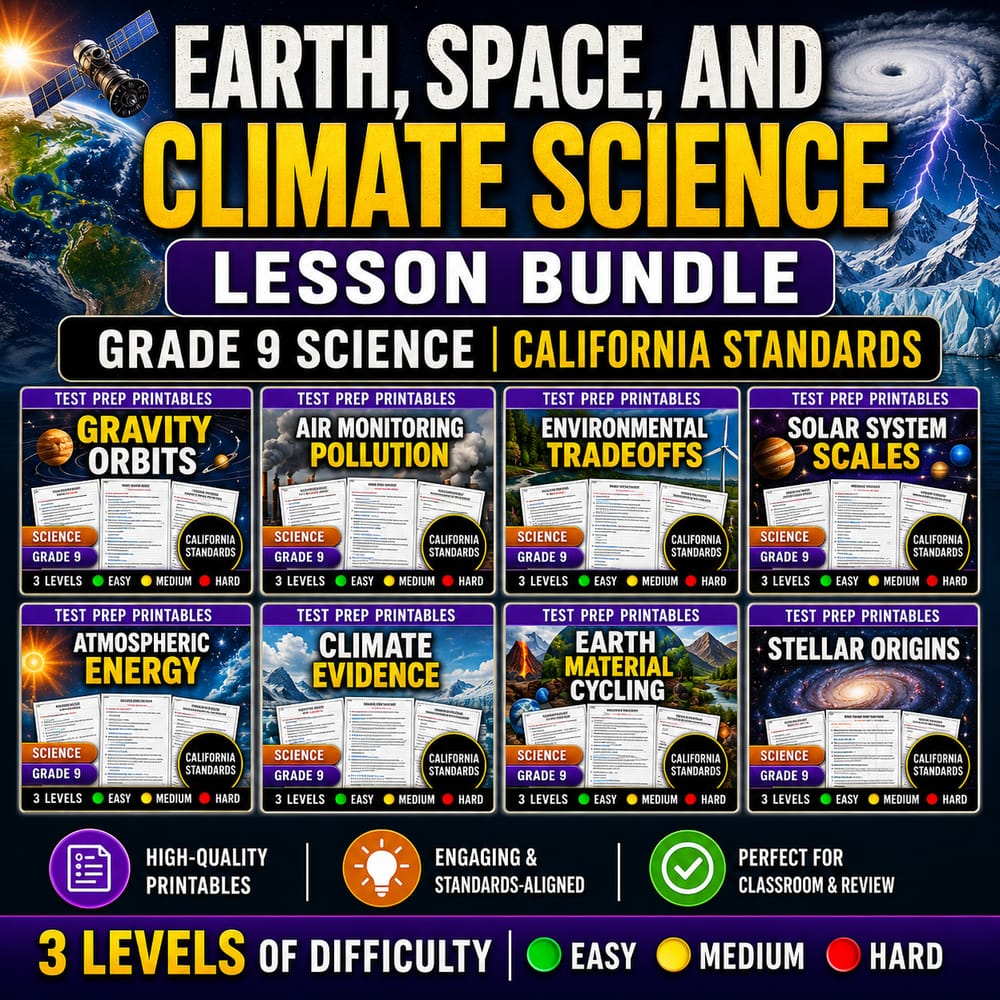
Earth, Space, and Climate Science Lesson Bundle | Grade 9 | California Standards
$40.00$50.00Save $10.00
Prism Point Learning
·2 followers·13 sales
SubjectScienceGradeGrade 9
What’s included
10 worksheets · Save $10.00 (20%) · prices shown inside the bundle
 Gravity and Orbits Worksheet | Grade 9 Space Science Practice Activity
- Explain how gravitational force depends on mass and distance.
- Describe how orbital speed and distance work together to create stable orbits.
- Use observed orbital patterns to support claims about predictable motion in space.
$4.00$5.00 Monitoring Pollution Worksheet | Grade 9 Environmental Science Practice
- Explain how monitoring air and water quality provides evidence of pollution changes over time.
- Describe how chemical indicators, flow conditions, and spatial patterns help identify pollution sources and pathways.
- Evaluate strategies that prevent or reduce emissions to minimize downstream environmental harm.
$4.00$5.00 Environmental Tradeoffs Worksheet | Grade 9 Environmental Science Practice
- Explain how human actions can change air, water, and land systems and create tradeoffs.
- Evaluate environmental solutions by considering mechanisms of harm, benefits, side effects, and feasibility.
- Use scientific reasoning to predict how environmental changes can propagate through ecosystems, including uncertainty.
$4.00$5.00 Solar System Scales Worksheet | Grade 9 Astronomy Distance & Size Activity
- Explain how relative scale and perspective help describe distances and sizes in the solar system.
- Relate apparent sky motion and brightness to real orbital motion and distances.
- Use reasoning about scale to compare observations across planets.
$4.00$5.00 Atmospheric Energy Worksheet for Grade 9 Science Practice & Review
- Explain how unequal solar heating creates temperature and air pressure differences that drive atmospheric circulation
- Describe how energy transfers between Earth’s surface and the atmosphere influence humidity, clouds, and precipitation
- Use cause-and-effect reasoning to connect weather patterns to temperature, humidity, and energy balance
$4.00$5.00 Climate Evidence Worksheet | Grade 9 Climate Change Science Activities
- Distinguish weather from climate using evidence and timescales
- Explain how greenhouse gases and feedbacks can influence long-term temperature
- Describe how natural records (ice cores and ocean sediments) provide climate evidence
$4.00$5.00 Earth Material Cycling Worksheet | Grade 9 Earth Science Review Activities
- Explain how matter cycles through Earth systems using reservoirs and processes such as evaporation, condensation, and precipitation
- Describe how carbon and nutrients move among the atmosphere, oceans, organisms, and rocks over time
- Use evidence and simple models to predict how changes in material cycles can affect surface conditions and climate
$4.00$5.00 Stellar Origins Worksheet | Grade 9 Space Science, Stars & Element Formation
- Explain how nuclear fusion in stars can create new elements over a star’s lifetime.
- Describe how explosive events in space spread matter that later forms new stars, planets, and atmospheres.
- Connect stellar life cycles to the elements found on Earth and the timing of chemical enrichment in the universe.
$4.00$5.00 Climate Modeling Worksheet | Grade 9 Climate Science Activities
- Explain how climate models represent Earth’s energy balance and atmospheric circulation
- Describe how different greenhouse gas emission scenarios lead to different climate projections
- Evaluate feedbacks and uncertainty when comparing model results with evidence
$4.00$5.00 Resources and Landforms Worksheet | Grade 9 Earth Science Practice
- Explain how tectonic activity, weathering, erosion, and sedimentation create and reshape landforms
- Describe how Earth processes affect where valuable resources form and how stable land can be over time
- Connect geologic timescales to changes in soil, river deposits, and groundwater systems
$4.00$5.00
Reviews & Feedback
Loading reviews...
Questions & Answers
Loading questions…
About this bundle
Related categories
Frequently asked questions
Who is Earth, Space, and Climate Science Lesson Bundle | Grade 9 | California Standards designed for?
Earth, Space, and Climate Science Lesson Bundle | Grade 9 | California Standards is designed for Grade 9 students and Science learners and can be used in classrooms, homeschool, or independent practice.
How do I download Earth, Space, and Climate Science Lesson Bundle | Grade 9 | California Standards?
Add it to your cart and complete checkout. After payment, you can download immediately from your account, and you'll also receive a download link by email.
Similar Products

Grade 12 Earth, Space & Fusion Science Lesson Bundle | California Standards
$28.00$35.00

Grade 12 Science Lesson Bundle: Space, Earth Systems, and Climate (General)
$16.00$20.00

Grade 7 Weather, Climate, and Earth Processes Science Lesson Bundle
$40.00$50.00

Grade 9 Earth Science Worksheets Bundle: Climate, Cycles & Space
$16.80$21.00

Grade 6 Science Earth Systems & Climate Lesson Bundle | NGSS
$24.00$30.00