
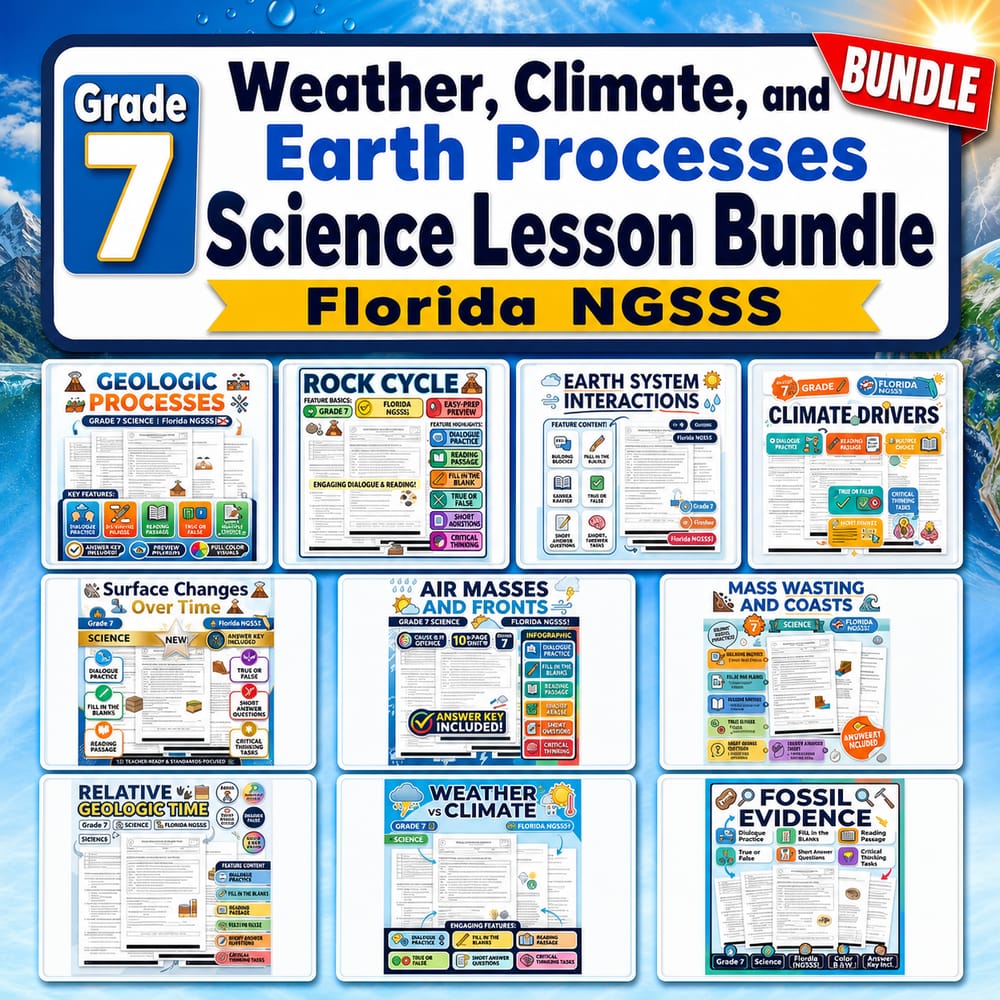
Grade 7 Weather, Climate, and Earth Processes Science Lesson Bundle
$40.00$50.00Save $10.00
J.S Sheets
New·3 followers·24 sales
SubjectScienceGradeGrade 7Pages100 Pages
What’s included
10 worksheets · 100 pages · Save $10.00 (20%) · prices shown inside the bundle
 Geologic Processes Grade 7 Science Worksheet | Standards-Aligned Practice
- Explain how tectonic activity can form mountain ranges and basins.
- Describe weathering, erosion, and deposition and how they change rocks and landforms.
- Identify how sediments move and where they accumulate in real-world landscapes.
$4.00$5.00 Science Worksheet The Rock Cycle Grade 7 | Standards-Aligned Practice PDF
- Explain how igneous, sedimentary, and metamorphic rocks form in the rock cycle.
- Describe the roles of heat, pressure, weathering, and mineral cementation in rock transformations.
- Use rock-cycle ideas to make connections between surface and subsurface Earth processes.
$4.00$5.00 Earth System Interactions Worksheet Grade 7 Science
- Explain how the geosphere, hydrosphere, atmosphere, and biosphere exchange matter and energy
- Describe cause-and-effect relationships between Earth systems (e.g., erosion affecting waterways and habitats)
- Use evidence from observations to support an explanation of Earth system interactions over time
$4.00$5.00 Science Climate Drivers Worksheet | Florida NGSSS Grade 7 Science
- Explain how latitude changes the angle of incoming sunlight and affects temperature patterns
- Describe how elevation and landforms can influence temperature and precipitation
- Connect distance from water and ocean currents to regional climate differences
$4.00$5.00 Surface Changes Over Time Worksheet Grade 7 Science | NGSSS Aligned
- Explain how heavy rainfall, runoff, and flooding can rapidly change Earth’s surface by eroding banks and depositing sediment
- Describe how storms, including coastal storms, reshape dunes and beaches
- Compare gradual processes (weathering, erosion, deposition) with sudden processes (earthquakes and volcanic activity)
$4.00$5.00 Science Worksheet Air Masses and Fronts Grade 7 | Standards-Aligned Practice
- Explain what an air mass is and how its temperature and moisture affect weather
- Describe how fronts form when different air masses meet
- Compare cold fronts and warm fronts in terms of lifting, clouds, and precipitation
$4.00$5.00 Mass Wasting and Coasts Surface Impacts Worksheet | NGSSS Grade 7 Science
- Explain how gravity and water-driven forces contribute to mass wasting and coastal erosion
- Describe how saturation from prolonged rain can trigger landslides
- Identify how waves and storm surge reshape beaches, dunes, and shorelines over time
$4.00$5.00 Science Worksheet: Relative Geologic Time | NGSSS Grade 7 Science
- Use the principles of superposition and cross-cutting relationships to place geologic events in order.
- Explain how geologists infer relative ages of rock layers and features without exact numeric dates.
- Identify which rock relationships indicate older versus younger formations in a geologic history.
$4.00$5.00 Weather vs. Climate Worksheet for Grade 7 Science | NGSSS Standards Aligned
- Differentiate between weather and climate using timescales
- Identify key weather variables (temperature, precipitation, humidity, wind)
- Explain how climate depends on long-term patterns and geography
$4.00$5.00 Science Fossil Evidence Worksheet | Standards-Aligned Grade 7 Assessment
- Explain how fossils form and describe what kinds of evidence fossils can preserve.
- Use fossil assemblages to infer past environments and conditions.
- Describe how fossils help scientists compare and match layers in Earth’s history.
$4.00$5.00
Reviews & Feedback
Loading reviews...
Questions & Answers
Loading questions…
About this bundle
Related categories
Frequently asked questions
Who is Grade 7 Weather, Climate, and Earth Processes Science Lesson Bundle designed for?
Grade 7 Weather, Climate, and Earth Processes Science Lesson Bundle is designed for Grade 7 students and Science learners and can be used in classrooms, homeschool, or independent practice.
How do I download Grade 7 Weather, Climate, and Earth Processes Science Lesson Bundle?
Add it to your cart and complete checkout. After payment, you can download immediately from your account, and you'll also receive a download link by email.
Similar Products

Grade 7 Earth Science Worksheets Bundle | Weather, Climate & Earth Systems
$16.80$21.00

Grade 9 Earth, Weather & Climate Systems Lesson Bundle | Florida ngsss
$36.00$45.00

Grade 10 Weather & Climate Science Lesson Bundle - General Framework
$25.60$32.00

Grade 8 Weather and Climate Science Lesson Bundle: General Framework
$19.20$24.00

Grade 9 Earth Systems Weather & Climate Science Lesson Bundle: Florida NGSSS
$36.00$45.00