
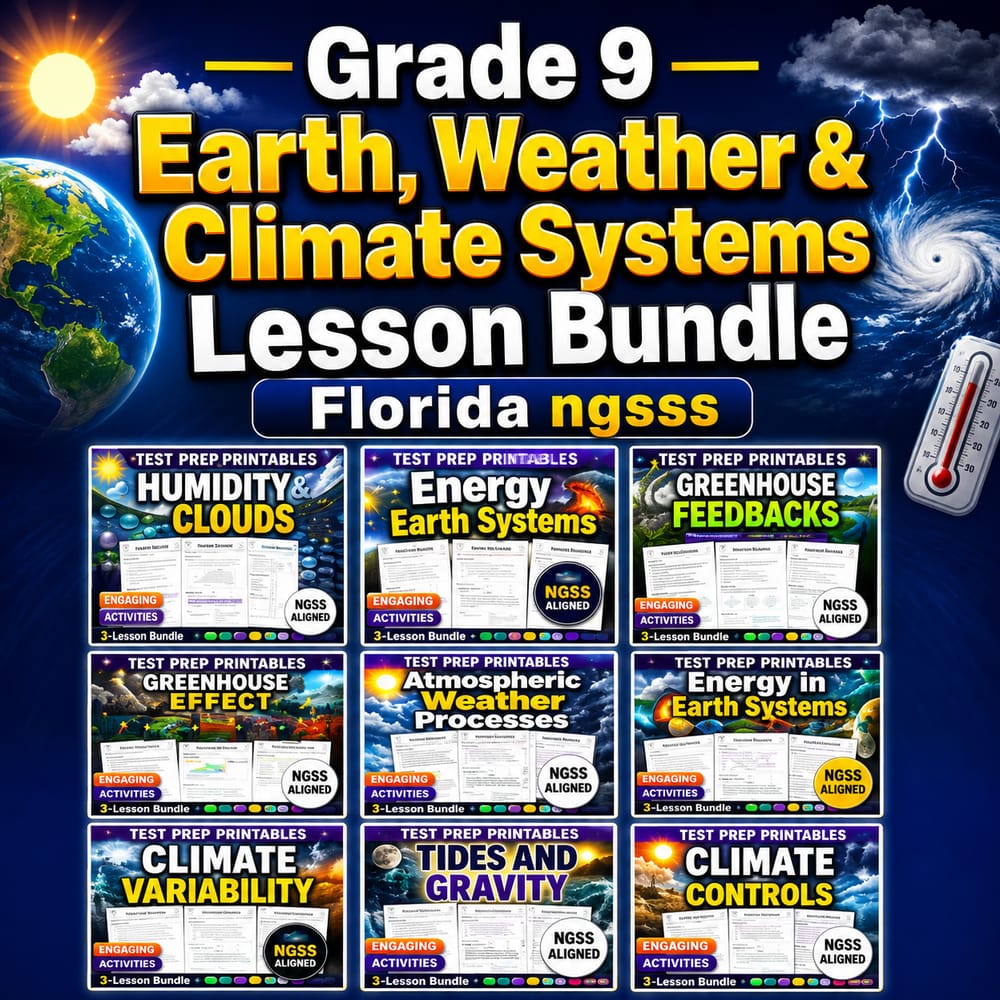
Grade 9 Earth, Weather & Climate Systems Lesson Bundle | Florida ngsss
$36.00$45.00Save $9.00
Prism Point Learning
·2 followers·14 sales
SubjectScienceGradeGrade 9
What’s included
9 worksheets · Save $9.00 (20%) · prices shown inside the bundle
 Humidity and Clouds Worksheet Grade 9 Science Activity | Weather NGSSS
- Explain how air cooling and condensation lead to cloud formation
- Use relative humidity to describe how close air is to saturation
- Connect atmospheric stability and vertical motion to different cloud types and precipitation
$4.00$5.00 Earth Seasons Causes Worksheet Grade 9 Science Activity | NGSSS
- Explain how Earth’s axial tilt and orbit around the Sun produce predictable seasonal changes.
- Describe how changes in sunlight angle and day length affect solar energy received and temperature patterns.
- Connect Earth–Sun geometry to seasonal weather and long-term environmental conditions.
$4.00$5.00 Greenhouse Feedbacks Worksheet Grade 9 Science Activity | NGSSS
- Explain how greenhouse gas changes can create positive and negative feedbacks in Earth’s climate system.
- Describe how water vapor, ice/snow reflectivity (albedo), clouds, and atmospheric circulation can affect energy balance.
- Use evidence-based reasoning to judge statements about greenhouse feedback mechanisms.
$4.00$5.00 Greenhouse Effect Worksheet Grade 9 Science Activity | Climate NGSSS
- Explain how greenhouse gases affect Earth’s energy flow by absorbing and re-emitting infrared radiation
- Describe why the altitude where radiation escapes to space influences Earth’s temperature
- Interpret how changing greenhouse gas concentrations can change the amount of energy retained by Earth
$4.00$5.00 Atmospheric Weather Processes Worksheet Grade 9 Science | NGSSS
- Explain how air temperature differences and air pressure gradients drive atmospheric circulation.
- Describe how moisture changes through condensation and evaporation lead to clouds and precipitation.
- Connect heat transfer (radiation, conduction, convection) to local weather patterns and larger storm systems.
$4.00$5.00 Energy in Earth Systems Worksheet Grade 9 Science Activity | NGSSS
- Explain how incoming solar radiation and outgoing infrared radiation drive Earth’s energy balance.
- Describe how energy moves through Earth system spheres using radiation, conduction, convection, and phase change.
- Interpret how energy balance affects long-term temperature patterns and Earth system processes.
$4.00$5.00 Climate Variability Worksheet Grade 9 Science Activity | NGSSS
- Explain how climate variability can change weather patterns over months to years.
- Describe how ocean-atmosphere interactions such as El Niño and La Niña redistribute heat and moisture.
- Distinguish short-term natural variability from longer-term climate trends using evidence across timescales.
$4.00$5.00 Tides and Gravity Worksheet Grade 9 Science Activity | NGSSS Earth Science
- Explain how gravity differences across Earth can produce ocean tides
- Describe how the changing Earth-Moon-Sun alignment leads to predictable tidal patterns
- Compare the roles of the Moon and the Sun in strengthening or weakening tides
$4.00$5.00 Climate and Controls Worksheet Grade 9 Science Activity | NGSSS
- Explain how climate differs from short-term weather using evidence from the lesson
- Identify major climate controls (latitude, atmospheric circulation, proximity to water, and local factors like elevation) and describe how each affects temperature and precipitation ranges
- Connect climate patterns to ecosystem distribution and surface processes
$4.00$5.00
Reviews & Feedback
Loading reviews...
Questions & Answers
Loading questions…
About this bundle
Related categories
Frequently asked questions
Who is Grade 9 Earth, Weather & Climate Systems Lesson Bundle | Florida ngsss designed for?
Grade 9 Earth, Weather & Climate Systems Lesson Bundle | Florida ngsss is designed for Grade 9 students and Science learners and can be used in classrooms, homeschool, or independent practice.
How do I download Grade 9 Earth, Weather & Climate Systems Lesson Bundle | Florida ngsss?
Add it to your cart and complete checkout. After payment, you can download immediately from your account, and you'll also receive a download link by email.
Similar Products

Earth Systems: Tectonics & Climate Lesson Bundle | Grade 9 Science NGSS
$22.40$28.00

Grade 10 Earth Science Worksheets Bundle | Climate & Earth Systems
$19.20$24.00

Weather, Water Cycle & Climate Systems Lesson Bundle | Grade 6 Science | NGSS
$24.00$30.00

Earth Systems & Climate Lesson Bundle | Grade 8 Science | Florida NGSSS
$40.00$50.00

Grade 8 Earth Systems and Climate Science Lesson Bundle – Florida NGSSS
$40.00$50.00