
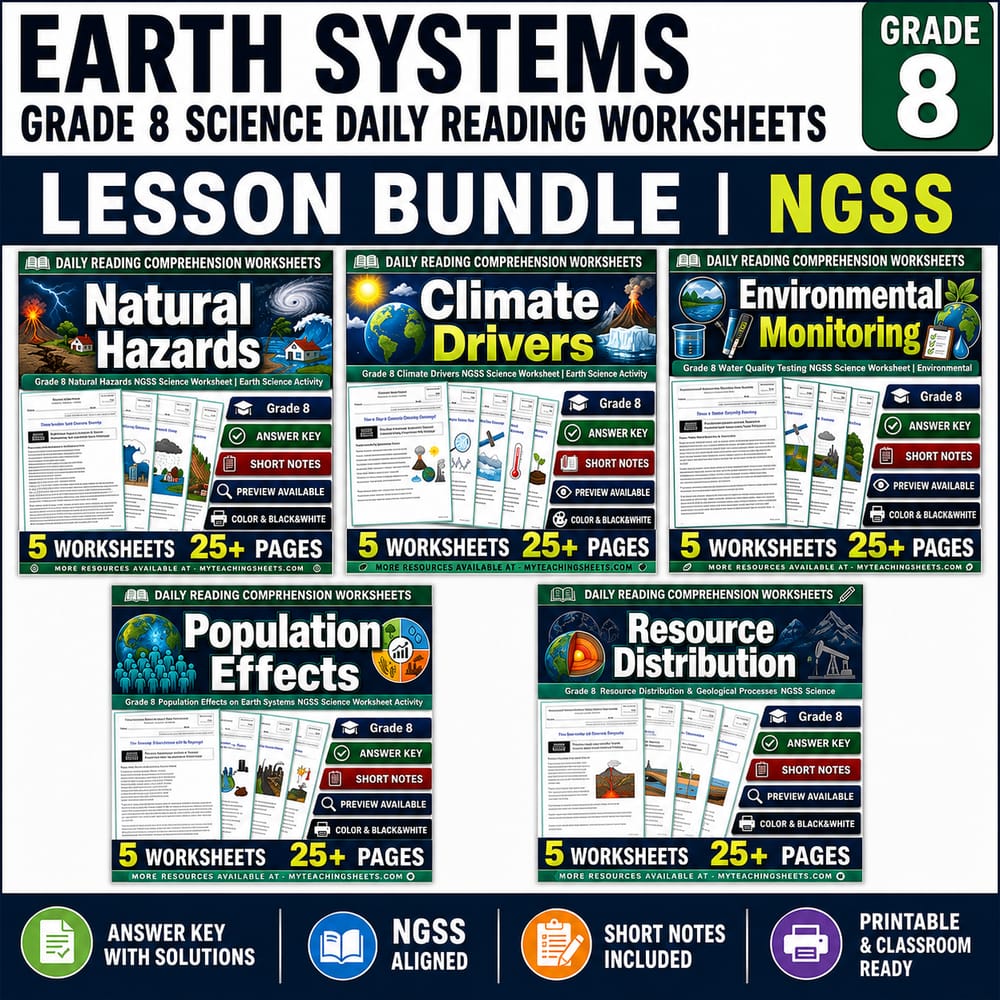
Earth Systems Grade 8 Science Daily Reading Worksheets Lesson Bundle | NGSS
$24.00$30.00Save $6.00
BRIGHT PATH RESOURCES
·3 followers·23 sales
SubjectScienceGradeGrade 8
What’s included
6 worksheets · Save $6.00 (20%) · prices shown inside the bundle
 Grade 8 Natural Hazards NGSS Science Worksheet | Earth Science Activity
- Analyze seismic data patterns to assess earthquake probabilities.
- Interpret historical earthquake and seismic activity records.
- Understand how data informs hazard mapping and early-warning systems.
$4.00$5.00 Grade 8 Climate Drivers NGSS Science Worksheet | Earth Science Activity
- Identify natural and human factors influencing climate change.
- Understand evidence sources such as ice cores and temperature datasets.
- Differentiate between natural and anthropogenic climate influences.
$4.00$5.00 Grade 8 Resource Distribution in Geology NGSS Science Worksheet Activity
- Understand how geological processes influence mineral and water resource formation.
- Identify various types of mineral deposits and aquifers.
- Analyze geologic maps, rock records, and stratigraphy to explain resource locations.
$4.00$5.00 Grade 8 Water Quality Testing NGSS Science Worksheet | Environmental Monitoring
- Understand the methods used by scientists to test and assess water quality
- Identify indicators of water pollution and ecosystem health
- Recognize different approaches to measuring and minimizing human impacts on water resources
$4.00$5.00 Grade 8 Population Effects on Earth Systems NGSS Science Worksheet Activity
- Analyze how population growth influences resource consumption and environmental change
- Evaluate evidence linking demographic trends to climate, water, and biodiversity shifts
- Interpret data and cause-and-effect reasoning in environmental studies
$4.00$5.00 Grade 8 Resource Distribution & Geological Processes NGSS Science Worksheet
- Understand geological processes that lead to mineral, energy, and groundwater resource formation
- Analyze how geological phenomena like plate tectonics, sedimentation, and metamorphism contribute to resource deposits
- Explore different types of groundwater aquifers and their significance for resource accessibility
$4.00$5.00
Reviews & Feedback
Loading reviews...
Questions & Answers
Loading questions…
About this bundle
Related categories
Frequently asked questions
Who is Earth Systems Grade 8 Science Daily Reading Worksheets Lesson Bundle | NGSS designed for?
Earth Systems Grade 8 Science Daily Reading Worksheets Lesson Bundle | NGSS is designed for Grade 8 students and Science learners and can be used in classrooms, homeschool, or independent practice.
How do I download Earth Systems Grade 8 Science Daily Reading Worksheets Lesson Bundle | NGSS?
Add it to your cart and complete checkout. After payment, you can download immediately from your account, and you'll also receive a download link by email.
Similar Products

Grade 10 Earth Science Worksheets | NGSS Earth’s Systems Bundle
$16.80$21.00

Earth and Human Activity Grade 11 Science Daily Reading Worksheets Bundle | NGSS
$24.00$30.00

Grade 4 Earth Science Worksheets | NGSS Earth's Systems Bundle
$4.80$6.00

Earth's Place in the Universe Grade 11 Science Daily Reading Bundle | NGSS
$8.00$10.00

Earth Systems Grade 10 Science Daily Reading Worksheets Lesson Bundle | NGSS
$28.00$35.00