
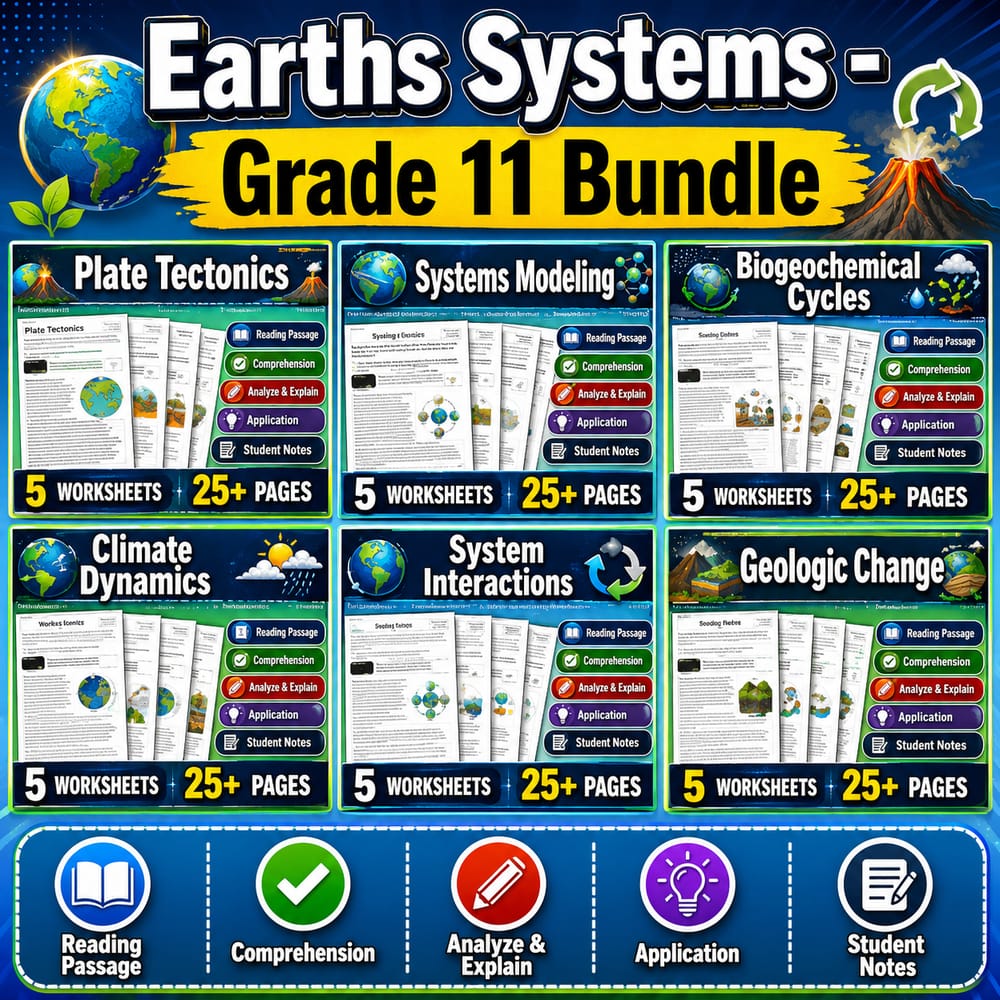
Earths Systems Lesson Bundle | Grade 11 Earth Science | NGSS
$24.00$30.00Save $6.00
BRIGHT PATH RESOURCES
·3 followers·23 sales
SubjectScienceGradeGrade 11
What’s included
6 worksheets · Save $6.00 (20%) · prices shown inside the bundle
 Grade 11 Plate Tectonics Worksheet | NGSS Earth Science Activity & Review
- Understand and identify different types of plate boundaries
- Describe processes occurring at divergent, convergent, and transform boundaries
- Analyze geologic evidence supporting plate movements
$4.00$5.00 Grade 11 Systems Modeling in Earth Sciences Worksheet | NGSS Science
- Understand the components that make up the Earth's system
- Learn how different Earth system processes interact over time
- Explore the role of models in representing complex Earth processes
$4.00$5.00 Grade 11 Biogeochemical Cycles Worksheet | NGSS Earth Science Activity
- Understand the components and flow of the carbon cycle
- Identify reservoirs and fluxes involved in the carbon cycle
- Assess human impacts on the carbon cycle
$4.00$5.00 Grade 11 Climate Dynamics Worksheet | NGSS Earth Science Activity & Review
- Understand the composition of Earth's atmosphere and its role in climate regulation.
- Learn about the mechanisms such as greenhouse gases, albedo feedbacks, and ocean-atmosphere interactions.
- Explore how instrumental and proxy records help analyze climate variability and change.
$4.00$5.00 Grade 11 Earth Systems Interactions Worksheet | NGSS Earth Science Activity
- Identify Earth's major reservoirs: atmosphere, hydrosphere, geosphere, biosphere.
- Understand how solar energy input influences Earth's processes.
- Describe energy exchanges among Earth's systems and feedback mechanisms.
$4.00$5.00 Grade 11 Geologic Change Worksheet | NGSS Earth Science Activity & Review
- Understand how stratigraphy reveals Earth's geological history.
- Identify and interpret different sedimentary layers and their significance.
- Recognize evidence of surface and subsurface geologic processes.
$4.00$5.00
Reviews & Feedback
Loading reviews...
Questions & Answers
Loading questions…
About this bundle
Related categories
Frequently asked questions
Who is Earths Systems Lesson Bundle | Grade 11 Earth Science | NGSS designed for?
Earths Systems Lesson Bundle | Grade 11 Earth Science | NGSS is designed for Grade 11 students and Science learners and can be used in classrooms, homeschool, or independent practice.
How do I download Earths Systems Lesson Bundle | Grade 11 Earth Science | NGSS?
Add it to your cart and complete checkout. After payment, you can download immediately from your account, and you'll also receive a download link by email.
Similar Products

Grade 10 Earth Science Worksheets | NGSS Earth’s Systems Bundle
$16.80$21.00

Grade 7 Human Impacts on Earth Systems Science Lesson Bundle – NGSS
$20.00$25.00

Grade 6 Human Impacts Earth Systems Science Lesson Bundle Resource – NGSS
$16.00$20.00

Space & Earth Systems Lesson Bundle | Grade 10 Science | Florida NGSSS
$36.00$45.00

Plate Tectonics & Earth Systems Grade 9 Science Lesson Bundle | NGSS
$28.00$35.00