
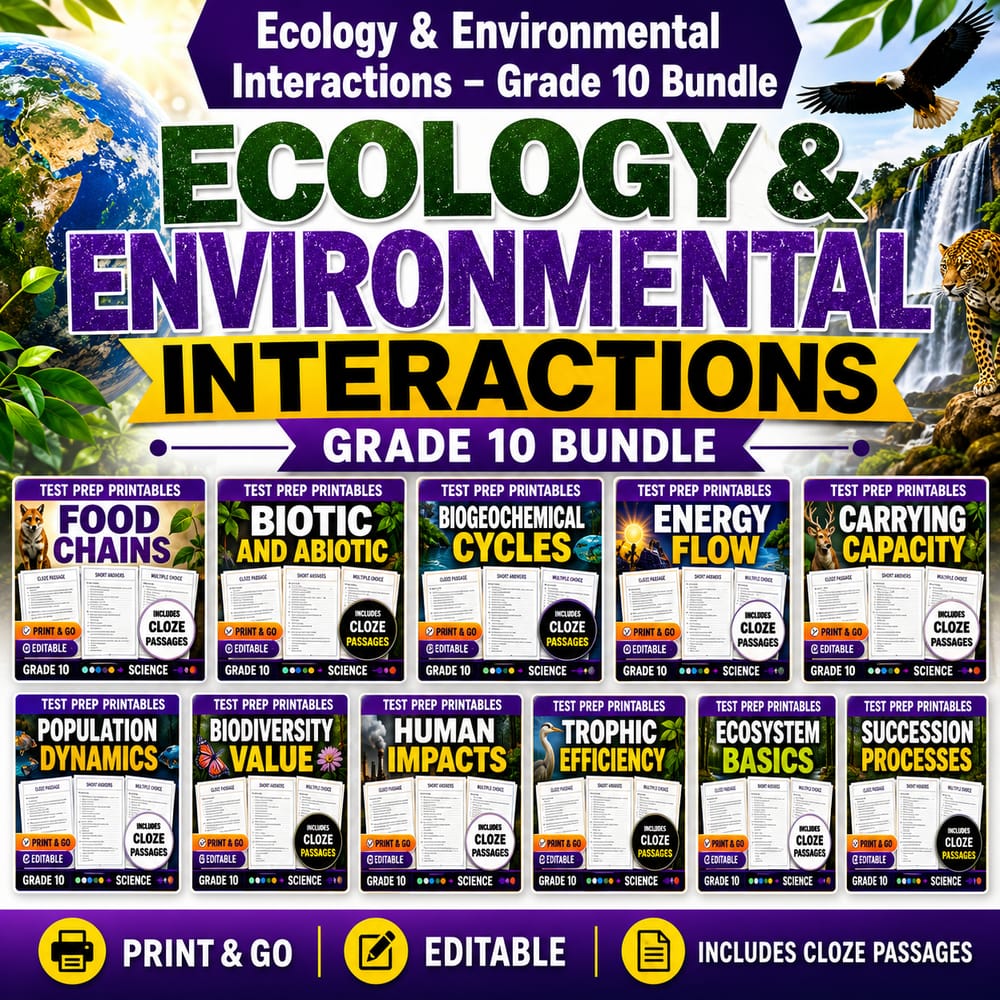


Ecology & Environmental Interactions Lesson Bundle | Grade 10 Science | TEKS
$48.00$60.00Save $12.00
Prism Point Learning
·2 followers·13 sales
SubjectScienceGradeGrade 10
What’s included
12 worksheets · Save $12.00 (20%) · prices shown inside the bundle
 Food Chains Worksheet | Grade 10 Science Activities
- Explain how energy and matter move through food chains and food webs.
- Describe the roles of primary producers, herbivores, carnivores, and decomposers.
- Evaluate how changes to one link in a food web can cause cascading effects.
$4.00$5.00 Biotic and Abiotic Worksheet | Grade 10 Science Practice TEKS
- Explain the difference between biotic and abiotic factors in an ecosystem.
- Describe how abiotic gradients (such as light and temperature) influence species distribution.
- Use biotic interactions (such as competition and predation) to predict changes in population outcomes.
$4.00$5.00 Biogeochemical Cycles Worksheet Pack | Grade 10 Science Activities
- Explain how carbon, nitrogen, phosphorus, and water cycle through living organisms and Earth systems
- Describe how biological processes (photosynthesis, respiration, decomposition) transform matter in biogeochemical cycles
- Analyze how human activities can disrupt or speed up nutrient cycling and affect ecosystem productivity
$4.00$5.00 Energy Flow Worksheet Pack | Grade 10 Science Activities
- Explain how sunlight drives energy flow through an ecosystem using trophic levels and food chains or webs.
- Describe why energy decreases at higher trophic levels due to metabolic processes and heat loss.
- Interpret how energy constraints limit biomass and population sizes across trophic levels.
$4.00$5.00 Carrying Capacity Worksheet | Grade 10 Science Activities
- Define carrying capacity and explain how it depends on resources, habitat, and ecosystem interactions.
- Identify factors that lower or raise carrying capacity, including predation, disease, and waste accumulation.
- Describe how populations typically fluctuate around carrying capacity and what happens when they exceed it.
$4.00$5.00 Population Dynamics Worksheet | Grade 10 Science Activities
- Explain how births, deaths, and migration influence changes in population size and density.
- Describe how biotic interactions (competition, predation, disease) and abiotic factors (resources) affect survival and reproduction.
- Distinguish exponential growth from logistic growth using the idea of carrying capacity.
$4.00$5.00 Biodiversity Value Worksheet | Grade 10 Science Practice TEKS Standards
- Explain how biodiversity supports ecosystem resilience and productivity.
- Describe how loss of species can reduce ecological interactions and adaptive capacity.
- Identify ecosystem services provided by diverse species and habitats.
$4.00$5.00 Human Impacts Worksheet | Grade 10 Science Activities
- Explain how human activities can alter ecosystems through habitat alteration, pollution, species introductions, resource extraction, and climate change.
- Describe how nutrient cycles and energy flows can change as biodiversity and population dynamics shift.
- Apply scientific reasoning to predict ecosystem effects such as habitat fragmentation, invasive species disruption, and hypoxic zones.
$4.00$5.00 Trophic Efficiency Worksheet | Grade 10 Science Activities
- Explain how trophic efficiency affects the flow of energy through food chains and food webs.
- Describe why efficiency is usually low due to metabolic loss and heat dissipation.
- Predict how changes in trophic efficiency can alter biomass pyramids and the number of trophic levels an ecosystem can support.
$4.00$5.00 Ecosystem Basics Worksheet | Grade 10 Science Practice
- Identify major ecosystem components, including producers, consumers, decomposers, and key abiotic factors.
- Explain how energy flows and how matter cycles through an ecosystem.
- Describe how interactions among organisms and their environment support population size and stability.
$4.00$5.00
Reviews & Feedback
Loading reviews...
Questions & Answers
Loading questions…
About this bundle
Related categories
Frequently asked questions
Who is Ecology & Environmental Interactions Lesson Bundle | Grade 10 Science | TEKS designed for?
Ecology & Environmental Interactions Lesson Bundle | Grade 10 Science | TEKS is designed for Grade 10 students and Science learners and can be used in classrooms, homeschool, or independent practice.
How do I download Ecology & Environmental Interactions Lesson Bundle | Grade 10 Science | TEKS?
Add it to your cart and complete checkout. After payment, you can download immediately from your account, and you'll also receive a download link by email.
Similar Products

Grade 10 Ecology & Environmental Interactions Science Worksheets | TEKS
$48.00$60.00

Grade 11 Ecosystem & Ecology Science Lesson Bundle | TEKS Daily Reading
$32.00$40.00

Grade 9 Science Ecosystems Lesson Bundle | NGSS Interactions & Energy
$12.00$15.00

Ecology & Environmental Interactions Lesson Bundle | Grade 11 Science | TEKS
$40.00$50.00

Grade 9 Ecology Environmental Science Reading Worksheets Bundle | TEKS
$40.00$50.00