
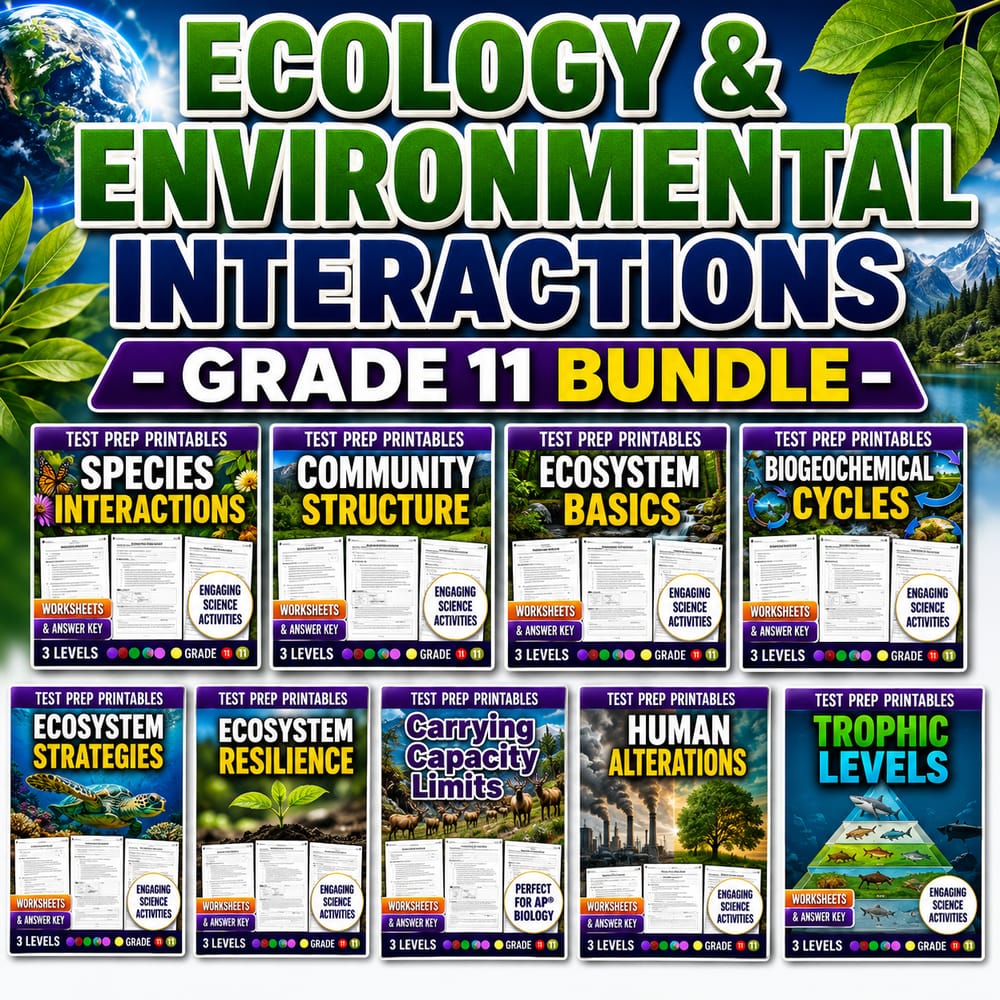
Ecology & Environmental Interactions Lesson Bundle | Grade 11 Science | TEKS
$40.00$50.00Save $10.00
Prism Point Learning
·2 followers·13 sales
SubjectScienceGradeGrade 11Pages315 Pages
What’s included
10 worksheets · 315 pages · Save $10.00 (20%) · prices shown inside the bundle
 Species Interactions Worksheet | Grade 11 Science Practice
- Explain how different types of species interactions (competition, predation, herbivory, mutualism, commensalism, and parasitism) affect population sizes and community structure.
- Describe trophic interactions and how top-down and bottom-up effects can cascade across multiple levels of an ecosystem.
- Analyze how abiotic factors like temperature, moisture, and nutrients influence the strength and outcomes of species interactions.
$4.00$5.00 Community Structure Worksheet | Grade 11 Science Practice
- Explain how species composition, relative abundance, and spatial arrangement describe community structure.
- Use biodiversity metrics (species richness and evenness) to predict how communities may function and remain stable.
- Describe how succession and spatial heterogeneity influence community assembly after disturbance.
$4.00$5.00 Ecosystem Basics Worksheet | Grade 11 Science Practice
- Explain how energy flows through food chains and food webs in an ecosystem.
- Describe how ecosystems cycle nutrients such as carbon and nitrogen.
- Distinguish primary productivity and biomass from nutrient recycling processes.
$4.00$5.00 Biogeochemical Cycles Worksheet | Grade 11 Science Activities
- Explain how carbon, nitrogen, and phosphorus move among living organisms, soil, water, and the atmosphere
- Describe major steps in the nitrogen and carbon cycles and how they affect ecosystem productivity
- Relate residence time and human impacts to changes in nutrient availability
$4.00$5.00 Conservation Strategies Worksheet | Grade 11 Science Activities
- Explain how different conservation strategies (protected areas, habitat restoration, and sustainable management) reduce biodiversity loss.
- Describe how monitoring, connectivity corridors, and invasive species control support ecosystem function.
- Evaluate conservation trade-offs and the role of policy and adaptive management in long-term success.
$4.00$5.00 Ecosystem Resilience Worksheet | Grade 11 Science Practice
- Define ecosystem resilience and explain how it helps ecosystems maintain essential functions after disturbances.
- Identify key mechanisms of resilience, including redundancy among species, buffering functional traits, and feedback loops.
- Explain how disturbance intensity, frequency, and landscape context can influence recovery and alternate stable states.
$4.00$5.00 Carrying Capacity Limits Worksheet | Grade 11 Science Practice
- Define carrying capacity and explain how it sets an upper limit on sustainable population size
- Distinguish density-dependent and density-independent factors that affect population size
- Analyze how human activities can lower carrying capacity or shift limiting resources
$4.00$5.00 Population Growth Worksheet | Grade 11 Science Activities
- Explain how birth rate, death rate, immigration, and emigration affect population size over time
- Compare exponential growth with logistic growth using the idea of carrying capacity
- Describe how density-dependent and density-independent factors influence population trajectories
$4.00$5.00 Human Alterations Worksheet | Grade 11 Science Practice
- Explain how human actions such as habitat fragmentation, pollution, and resource extraction affect biodiversity and ecological processes.
- Analyze how invasive species and greenhouse gas emissions can change species interactions and ecosystem functions.
- Evaluate trade-offs between economic development, ecosystem services, and conservation to reduce ecosystem degradation.
$4.00$5.00 Trophic Levels Worksheet | Grade 11 Science Activities
- Explain how energy and matter move through trophic levels from producers to consumers and decomposers.
- Distinguish omnivory, detritivory, and trophic cascades in real ecosystem examples.
- Interpret how food webs connect organisms and how changes at one level can affect others.
$4.00$5.00
Reviews & Feedback
Loading reviews...
Questions & Answers
Loading questions…
About this bundle
Related categories
Frequently asked questions
Who is Ecology & Environmental Interactions Lesson Bundle | Grade 11 Science | TEKS designed for?
Ecology & Environmental Interactions Lesson Bundle | Grade 11 Science | TEKS is designed for Grade 11 students and Science learners and can be used in classrooms, homeschool, or independent practice.
How do I download Ecology & Environmental Interactions Lesson Bundle | Grade 11 Science | TEKS?
Add it to your cart and complete checkout. After payment, you can download immediately from your account, and you'll also receive a download link by email.
Similar Products

Grade 10 Ecology & Environmental Interactions Science Worksheets | TEKS
$48.00$60.00

Ecology & Environmental Interactions Lesson Bundle | Grade 10 Science | TEKS
$48.00$60.00

Grade 11 Ecosystem & Ecology Science Lesson Bundle | TEKS Daily Reading
$32.00$40.00

Grade 9 Science Ecosystems Lesson Bundle | NGSS Interactions & Energy
$12.00$15.00

Grade 9 Ecology Environmental Science Reading Worksheets Bundle | TEKS
$40.00$50.00