
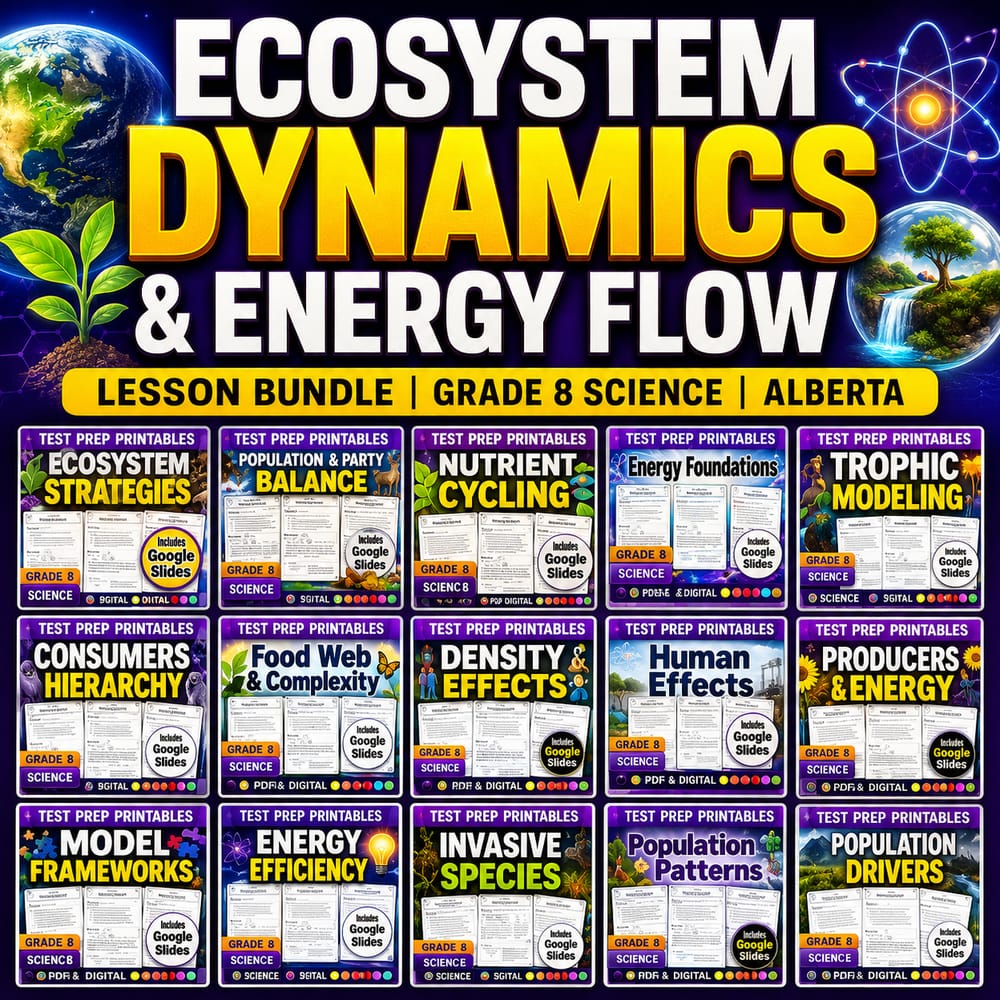


Ecosystem Dynamics & Energy Flow Lesson Bundle | Grade 8 Science | Alberta
$56.00$70.00Save $14.00
Prism Point Learning
·2 followers·13 sales
SubjectScienceGradeGrade 8
What’s included
15 worksheets · Save $14.00 (20%) · prices shown inside the bundle
 Restoration Strategies Worksheet | Grade 8 Science Activities
- Explain how ecological restoration and mitigation work to re-establish habitat, ecosystem function, and connectivity.
- Describe common restoration actions (e.g., recontouring, soil amendment, riparian buffers, species reintroductions) and why they are used.
- Use adaptive management and monitoring to evaluate recovery over time, especially under climate constraints.
$4.00$5.00 Predator–Prey Balance Worksheet | Grade 8 Science Activities
- Explain how predator–prey interactions affect population size and behavior over time
- Describe how refuges and compensatory mechanisms can reduce or change predator impacts
- Use functional response ideas to predict how predator consumption can change with prey density
$4.00$5.00 Nutrient Cycling Worksheet | Grade 8 Science Practice
- Explain how matter cycles through ecosystems using decomposition, mineralization, nitrogen fixation, and sedimentation.
- Describe how carbon and nitrogen move between biotic and abiotic pools in soil and wetlands.
- Analyze how environmental factors (temperature and moisture) and human activities can change nutrient availability and productivity.
$4.00$5.00 Energy Foundations Worksheet | Grade 8 Science Practice
- Explain how energy moves through prairie food webs from primary sources to top predators
- Describe how energy decreases at each trophic level and why ecosystems cannot support unlimited biomass
- Connect decomposers and detritivores to recycling energy and matter in ecosystems
$4.00$5.00 Trophic Modeling Worksheet | Grade 8 Science Activities
- Explain how trophic models use mass balance to represent energy and matter flow through trophic compartments and environmental pools.
- Interpret how model assumptions and parameter sensitivity affect estimates of production, respiration, and decomposition rates.
- Describe how flow diagrams and simple equations can compare scenarios of disturbance or management in lake and forest systems.
Free Consumers Hierarchy Worksheet | Grade 8 Science Activities
- Explain how consumers occupy trophic positions that determine feeding relationships in food chains
- Differentiate herbivores, omnivores, and carnivores and describe how omnivory can blur trophic levels
- Describe how trophic position influences energy transfer and vulnerability when environmental conditions change
$4.00$5.00 Food Web Complexity Worksheet | Grade 8 Science Activities
- Explain how food webs show interconnected energy pathways using direct and indirect interactions.
- Describe how redundancy and alternative pathways can stabilize communities when a species is lost.
- Analyze how seasonal migration and life-cycle stages can change the strength of feeding links.
$4.00$5.00 Density Effects Worksheet | Grade 8 Science Practice
- Explain how density-dependent factors can change population growth as population density increases
- Differentiate density-independent factors (such as weather events) from density-dependent factors
- Describe how habitat fragmentation and human barriers can alter density effects and dispersal
$4.00$5.00 Human Effects Worksheet | Grade 8 Science Activities
- Explain how human land use, resource extraction, and urban expansion can change habitat structure and species interactions.
- Describe how irrigation and wetland drainage can affect nutrient cycles and freshwater ecosystems in Alberta watersheds.
- Evaluate how invasive species and cumulative watershed effects can disrupt ecological balance.
$4.00$5.00 Producers & Energy Worksheet | Grade 8 Science Activities
- Explain how primary producers convert energy into organic matter for ecosystems
- Identify factors that influence primary productivity (light, nutrients, and seasonality)
- Describe how algae and terrestrial plants support energy transfer to higher trophic levels
$4.00$5.00
Reviews & Feedback
Loading reviews...
Questions & Answers
Loading questions…
About this bundle
Related categories
Frequently asked questions
Who is Ecosystem Dynamics & Energy Flow Lesson Bundle | Grade 8 Science | Alberta designed for?
Ecosystem Dynamics & Energy Flow Lesson Bundle | Grade 8 Science | Alberta is designed for Grade 8 students and Science learners and can be used in classrooms, homeschool, or independent practice.
How do I download Ecosystem Dynamics & Energy Flow Lesson Bundle | Grade 8 Science | Alberta?
Add it to your cart and complete checkout. After payment, you can download immediately from your account, and you'll also receive a download link by email.
Similar Products

Ecosystems Interactions Energy Dynamics Lesson Bundle | Grade 6 Science | NGSS
$24.00$30.00

Grade 8 Ecosystems Interactions Energy Dynamics Science Lesson Bundle NGSS
$12.80$16.00

Grade 7 Ecosystems Interactions Energy Dynamics Science Lesson Bundle: NGSS
$20.00$25.00

Grade 11 Ecosystem Dynamics and Energy Flow Science Lesson Bundle | NGSS
$14.40$18.00

Grade 9 Ecosystems Lesson Bundle: Interactions, Energy & Dynamics NGSS
$20.00$25.00