
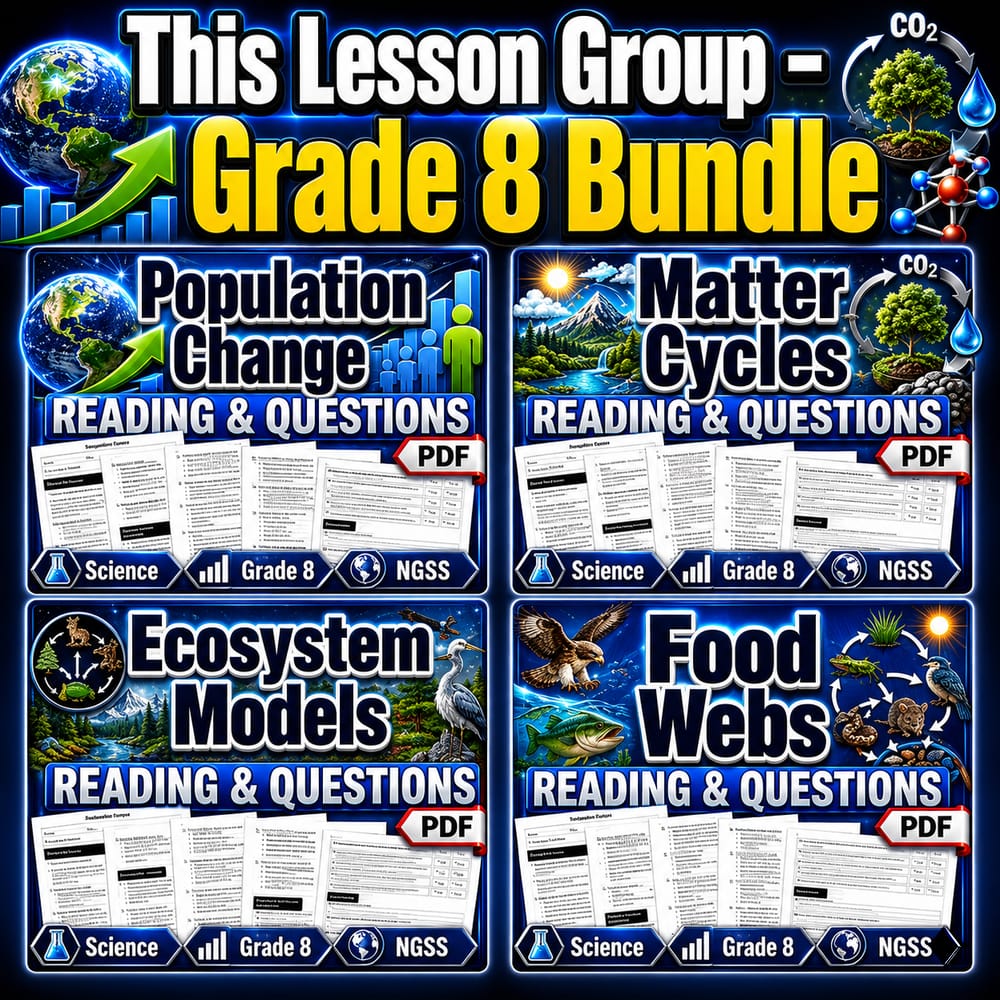
Grade 8 Ecosystems Interactions Energy Dynamics Science Lesson Bundle NGSS
$12.80$16.00Save $3.20
Skylark Worksheets
New·0 followers·0 sales
SubjectScienceGradeGrade 8Pages64 Pages
What’s included
4 worksheets · 64 pages · Save $3.20 (20%) · prices shown inside the bundle
 Population Change Worksheet | NGSS Grade 8 Science Assessment
- Explain how carrying capacity affects population growth over time
- Differentiate between density-dependent and density-independent factors in population changes
- Analyze how birth/death rates and resource limits can lead to population equilibrium or oscillations
$3.20$4.00 Matter Cycles Worksheet | NGSS Grade 8 Science Assessment
- Explain how matter cycles through ecosystems by tracing atoms through producers, consumers, decomposers, and abiotic reservoirs
- Describe the roles of photosynthesis, respiration, and decomposition in transforming and transferring carbon and water
- Apply conservation of mass to biological processes and distinguish key molecular forms (organic vs inorganic carbon; liquid vs water vapor)
$3.20$4.00 Ecosystem Models Worksheet | NGSS Grade 8 Science Assessment
- Explain how ecosystem models represent biotic and abiotic components using boundaries, variables, and scale.
- Interpret stock-and-flow system diagrams to predict how changes propagate through an ecosystem.
- Use model reasoning to describe equilibrium, resilience, and temporal dynamics after disturbances.
$3.20$4.00 Food Webs Worksheet | NGSS Grade 8 Science Assessment PDF
- Explain how energy moves through producers, consumers, and decomposers in terrestrial and aquatic food webs.
- Describe trophic levels and predict how energy loss affects biomass and population size at higher levels.
- Use ecological efficiency and primary production to interpret patterns in community structure.
$3.20$4.00
Reviews & Feedback
Loading reviews...
Questions & Answers
Loading questions…
About this bundle
Related categories
Frequently asked questions
Who is Grade 8 Ecosystems Interactions Energy Dynamics Science Lesson Bundle NGSS designed for?
Grade 8 Ecosystems Interactions Energy Dynamics Science Lesson Bundle NGSS is designed for Grade 8 students and Science learners and can be used in classrooms, homeschool, or independent practice.
How do I download Grade 8 Ecosystems Interactions Energy Dynamics Science Lesson Bundle NGSS?
Add it to your cart and complete checkout. After payment, you can download immediately from your account, and you'll also receive a download link by email.
Similar Products

Ecosystems Interactions Energy and Dynamics Grade 11 Science Bundle | NGSS
$24.00$30.00

Ecosystem Dynamics & Energy Flow Lesson Bundle | Grade 8 Science | Alberta
$56.00$70.00

Grade 7 Ecosystems Interactions Energy Dynamics Science Lesson Bundle: NGSS
$20.00$25.00

Grade 11 Ecosystem Dynamics and Energy Flow Science Lesson Bundle | NGSS
$14.40$18.00

Grade 11 Ecology and Ecosystem Dynamics Science Lesson Bundle – NGSS Framework
$28.00$35.00