
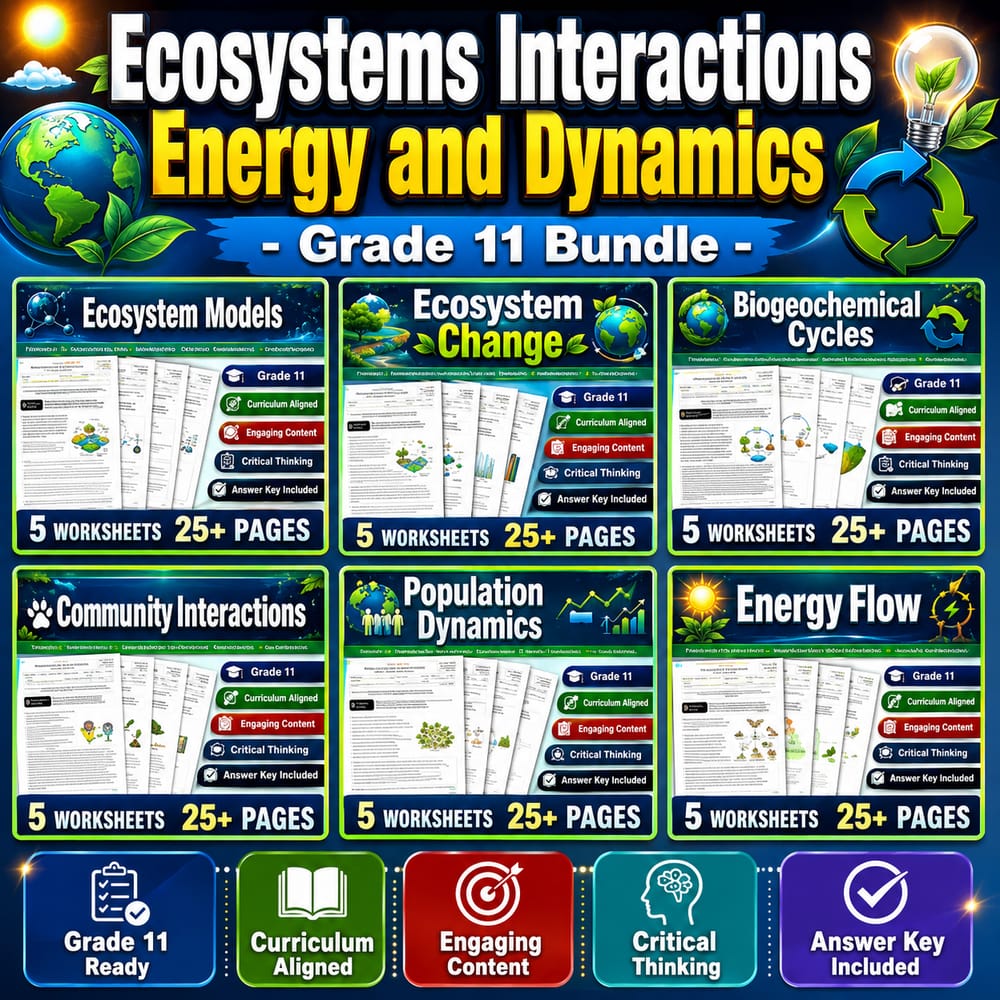
Ecosystems Interactions Energy and Dynamics Grade 11 Science Bundle | NGSS
$24.00$30.00Save $6.00
BRIGHT PATH RESOURCES
·3 followers·23 sales
SubjectScienceGradeGrade 11
What’s included
6 worksheets · Save $6.00 (20%) · prices shown inside the bundle
 Grade 11 Understanding Ecosystem Models Worksheet | NGSS Ecology Activity
- Identify different types of ecosystem models
- Understand the purpose of conceptual, mathematical, and computational models
- Recognize examples of ecosystem phenomena modeled
$4.00$5.00 Grade 11 Ecosystem Change and Resilience Worksheet | NGSS Ecology Activity
- Identify components of ecosystems and understand how they interact
- Explain the drivers of ecosystem stability and change
- Analyze case studies related to ecosystem disturbance and recovery
$4.00$5.00 Grade 11 Carbon Cycle Worksheet | Biogeochemical Cycles | NGSS Science
- Understand how carbon moves through biological, geological, and atmospheric reservoirs.
- Identify processes such as fixation, mineralization, and respiration that influence the carbon cycle.
- Recognize human impacts like fossil fuel combustion and deforestation on climate change and carbon pools.
$4.00$5.00 Grade 11 Community Interactions in Ecosystems Worksheet | NGSS Ecology Activity
- Understand mutualism, competition, and other interactions in ecological communities.
- Identify examples of mutualism and competition in real-world ecosystems.
- Analyze how species interactions influence community diversity and stability.
$4.00$5.00 Grade 11 Population Dynamics in Ecology Worksheet | NGSS Ecology Activity
- Understand the key factors affecting population size, including birth, death, immigration, and emigration
- Identify different forms of population growth: exponential and logistic
- Recognize predator-prey interactions and their impact on populations
$4.00$5.00 Grade 11 Energy Flow and Trophic Levels Worksheet | NGSS Ecology Activity
- Identify producers, consumers, and decomposers within food webs.
- Explain the flow of energy through different trophic levels.
- Understand biomass pyramids and energy loss during transfers.
$4.00$5.00
Reviews & Feedback
Loading reviews...
Questions & Answers
Loading questions…
About this bundle
Related categories
Frequently asked questions
Who is Ecosystems Interactions Energy and Dynamics Grade 11 Science Bundle | NGSS designed for?
Ecosystems Interactions Energy and Dynamics Grade 11 Science Bundle | NGSS is designed for Grade 11 students and Science learners and can be used in classrooms, homeschool, or independent practice.
How do I download Ecosystems Interactions Energy and Dynamics Grade 11 Science Bundle | NGSS?
Add it to your cart and complete checkout. After payment, you can download immediately from your account, and you'll also receive a download link by email.
Similar Products

Grade 8 Ecosystems Interactions Energy Dynamics Science Lesson Bundle NGSS
$12.80$16.00

Grade 7 Ecosystems Interactions Energy Dynamics Science Lesson Bundle: NGSS
$20.00$25.00

Grade 9 Ecosystems Lesson Bundle: Interactions, Energy & Dynamics NGSS
$20.00$25.00

Grade 10 Science Ecosystems Interactions Energy and Dynamics Lesson Bundle | NGSS
$16.80$21.00

Grade 6 Science Ecosystems Lesson Bundle | NGSS Interactions & Energy
$16.00$20.00