
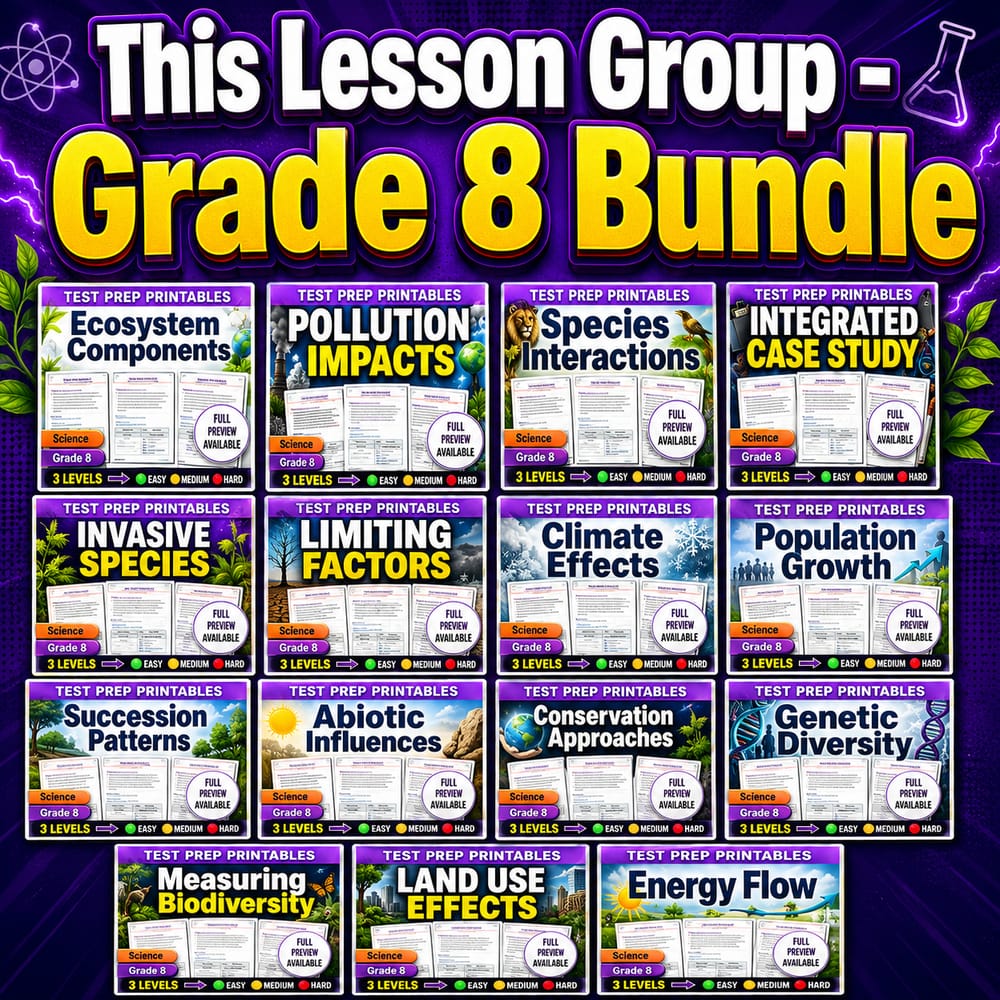


Ecosystems & Biodiversity Lesson Bundle | Grade 8 Science | BC
$60.00$75.00Save $15.00
Prism Point Learning
·2 followers·13 sales
SubjectScienceGradeGrade 8
What’s included
15 worksheets · Save $15.00 (20%) · prices shown inside the bundle
 Ecosystem Components Worksheet | Grade 8 Science Activities
- Identify biotic and abiotic components of an ecosystem and explain how they affect living organisms
- Describe how producers, consumers, and decomposers help cycle energy and matter
- Explain how physical conditions such as sunlight, water, soil, and temperature influence where species live
$4.00$5.00 Pollution Impacts Worksheet | Grade 8 Science Activities
- Explain how pollution changes ecosystem chemistry and nutrient cycles.
- Describe how excess nutrients lead to eutrophication and oxygen loss.
- Identify ways contaminants move through ecosystems and bioaccumulate in food webs.
$4.00$5.00 Species Interactions Worksheet | Grade 8 Science Practice
- Describe how predation, competition, parasitism, mutualism, and commensalism affect populations in an ecosystem.
- Explain how species interactions influence community structure and ecosystem resilience.
- Use examples to distinguish between different types of species interactions and predict likely outcomes.
$4.00$5.00 Integrated Case Study Worksheet | Grade 8 Science Activities
- Explain how abiotic factors and biotic interactions can change population dynamics and food-web relationships.
- Analyze how human activities can interact with environmental change to affect ecosystem resilience and biodiversity.
- Use evidence from an integrated case to support trade-off decisions in conservation.
$4.00$5.00 Invasive Species Worksheet | Grade 8 Science Activities
- Explain how introduced species can become invasive by establishing, spreading, and outcompeting native species
- Describe ecological traits and conditions that help invasive species succeed
- Evaluate ecosystem impacts of invasive species on biodiversity, nutrient cycling, and habitat structure
$4.00$5.00 Limiting Factors Worksheet | Grade 8 Science Practice
- Explain how limiting factors determine the maximum population size an ecosystem can support.
- Describe how carrying capacity can change over time due to fluctuations in resources and biotic/abiotic conditions.
- Identify examples of limiting factors and predict how populations may overshoot and crash or stabilize.
$4.00$5.00 Climate Effects Worksheet | Grade 8 Science Activities
- Explain how climate variation and change can alter temperature, precipitation, and extreme events in an ecosystem.
- Describe how climate-driven changes can cause timing mismatches that affect reproduction, survival, and species interactions.
- Use examples to predict how species ranges and life-cycle events (phenology) may shift with warming.
$4.00$5.00 Population Growth Worksheet | Grade 8 Science Activities
- Explain how birth rates, death rates, immigration, and emigration affect population growth over time.
- Describe how age structure, reproductive strategies, and resource availability influence intrinsic growth rates.
- Distinguish between density-dependent and density-independent factors that change population trajectories.
$4.00$5.00 Succession Patterns Worksheet Grade 8 Science Activities
- Differentiate primary and secondary ecological succession using key starting conditions and disturbance history.
- Explain how species traits and interactions influence the sequence of communities during succession.
- Describe how disturbance frequency and magnitude can change successional pathways and ecosystem heterogeneity.
$4.00$5.00 Abiotic Influences Worksheet | Grade 8 Science Practice
- Explain how abiotic factors such as light availability, temperature, water supply, soil composition, and nutrient levels affect where species can live.
- Describe how seasonal and microhabitat changes can create different niches within the same ecosystem.
- Use evidence to predict how changing abiotic conditions can influence growth, reproduction, and community structure.
$4.00$5.00
Reviews & Feedback
Loading reviews...
Questions & Answers
Loading questions…
About this bundle
Related categories
Frequently asked questions
Who is Ecosystems & Biodiversity Lesson Bundle | Grade 8 Science | BC designed for?
Ecosystems & Biodiversity Lesson Bundle | Grade 8 Science | BC is designed for Grade 8 students and Science learners and can be used in classrooms, homeschool, or independent practice.
How do I download Ecosystems & Biodiversity Lesson Bundle | Grade 8 Science | BC?
Add it to your cart and complete checkout. After payment, you can download immediately from your account, and you'll also receive a download link by email.
Similar Products

Grade 6 Science Biodiversity Lesson Bundle – Ecosystems and Conservation
$36.00$45.00

Grade 6 Biodiversity & Plant Ecosystems Science Lesson Bundle | Alberta
$60.00$75.00

Grade 7 Science Lesson Bundle with Ontario Framework | Ecosystems & Biodiversity
$28.80$36.00

Grade 7 Ecosystems & Biodiversity Science Lesson Bundle for Alberta Framework
$60.00$75.00

Grade 6 Science Ecosystems, Adaptations & Biodiversity Lesson Bundle | Ontario
$60.00$75.00