
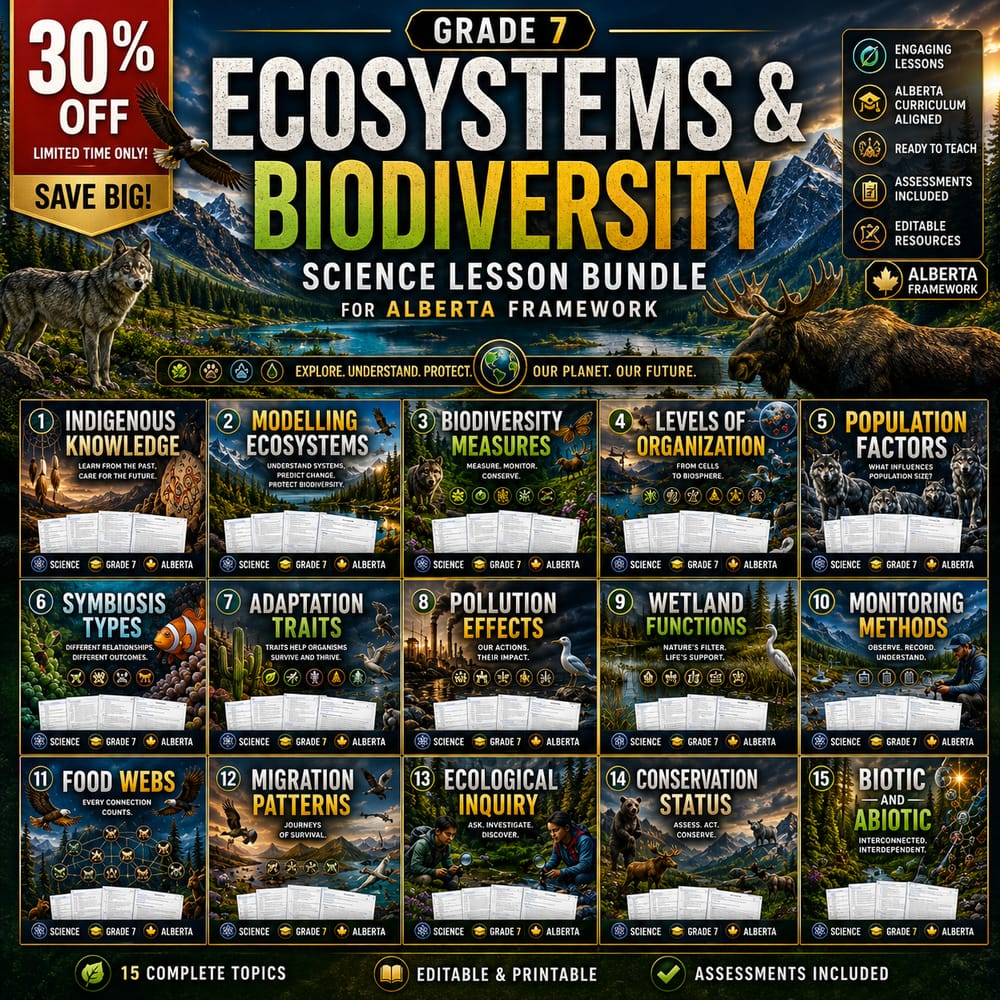


Grade 7 Ecosystems & Biodiversity Science Lesson Bundle for Alberta Framework
$60.00$75.00Save $15.00
Silver Birch Teaching
New·0 followers·0 sales
SubjectScienceGradeGrade 7Pages120 Pages
What’s included
15 worksheets · 120 pages · Save $15.00 (20%) · prices shown inside the bundle
 Grade 7 Science – Indigenous Knowledge Worksheet (PDF) Alberta Standards
- Explain how traditional ecological knowledge (TEK) is based on long-term observations and community learning.
- Describe how oral histories and place-based knowledge can support understanding of species interactions and seasonal cycles.
- Identify examples of stewardship that help maintain healthy ecosystems in Alberta and beyond.
$4.00$5.00 Grade 7 Science | Modelling Ecosystems Worksheet (PDF) Alberta Standards
- Describe how ecological models represent relationships among ecosystem components using simplified variables and assumptions
- Distinguish between conceptual and quantitative ecological models and explain how each is used to predict outcomes
- Identify common model inputs and limitations, and explain why model predictions should be checked against real observations
$4.00$5.00 Grade 7 Science Worksheet – Biodiversity Measures (PDF) | Alberta Standards
- Explain how biodiversity can be described using richness, evenness, and habitat heterogeneity.
- Interpret what different biodiversity metrics may indicate about ecosystem resilience and ecological function.
- Connect habitat complexity to changes in species assemblages in Alberta-like environments.
$4.00$5.00 Grade 7 Science Levels Of Organization Worksheet (PDF) – Alberta Standards
- Identify and describe ecological levels of organization from individuals to ecosystems
- Explain how higher-level patterns (population, community, ecosystem) can’t be predicted from individual traits alone
- Use examples (such as trout in Alberta waters) to distinguish levels by their properties and processes
$4.00$5.00 Grade 7 Science Worksheet | Population Factors & Growth (PDF)
- Explain how birth and death rates, immigration and emigration, and abiotic constraints affect population size and distribution
- Describe how regional factors (such as seasonal water, fire regimes, disease, and land-use change) can cause population fluctuations
- Use population trends to reason about local extirpations and expansions
$4.00$5.00 Grade 7 Science – Symbiosis Types Worksheet (Alberta) | PDF & Answer Key
- Identify and distinguish mutualism, commensalism, and parasitism using key features
- Explain how symbiosis relationships affect population size, resource use, and survival
- Use examples from Alberta habitats to describe real-world ecological consequences
$4.00$5.00 Grade 7 Science Worksheet | Adaptation Traits Alberta Standards (PDF)
- Explain how adaptation traits (structural, physiological, and behavioural) help organisms survive and reproduce in specific environments.
- Describe how selective pressures shape trait variation and how trade-offs can affect survival.
- Connect examples from Alberta habitats to niches and long-term persistence of species.
$4.00$5.00 Grade 7 Science Worksheet | Pollution Effects & Environmental Impact (PDF)
- Explain how common anthropogenic pollutants (nutrient runoff, hydrocarbons, and airborne deposition) move through terrestrial and aquatic ecosystems.
- Describe measurable ecological effects of pollution, including organism health changes and food web disruption.
- Use cause-and-effect reasoning to connect pollutant sources to ecosystem chemistry and community-level outcomes.
$4.00$5.00 Grade 7 Science | Wetland Functions Worksheet (Alberta Standards) (PDF)
- Describe how wetlands regulate water at the landscape scale through storage, slow release, and flood buffering.
- Explain how wetlands support ecosystem services through nutrient cycling and filtration.
- Identify how wetland type (e.g., peatlands vs. marshes) relates to different habitats and biological functions.
$4.00$5.00 Grade 7 Science – Monitoring Methods Worksheet (Alberta Standards) (PDF)
- Explain why long-term ecological monitoring uses standardized sampling protocols
- Identify common monitoring methods (fixed-site surveys, point counts, remote sensing, and water quality sampling)
- Describe how sampling design, temporal replication, and data quality improve the reliability of ecological trends
$4.00$5.00
Reviews & Feedback
Loading reviews...
Questions & Answers
Loading questions…
About this bundle
Related categories
Frequently asked questions
Who is Grade 7 Ecosystems & Biodiversity Science Lesson Bundle for Alberta Framework designed for?
Grade 7 Ecosystems & Biodiversity Science Lesson Bundle for Alberta Framework is designed for Grade 7 students and Science learners and can be used in classrooms, homeschool, or independent practice.
How do I download Grade 7 Ecosystems & Biodiversity Science Lesson Bundle for Alberta Framework?
Add it to your cart and complete checkout. After payment, you can download immediately from your account, and you'll also receive a download link by email.
Similar Products

Grade 7 Ecosystems & Biodiversity Science Lesson Bundle | Alberta
$60.00$75.00

Grade 6 Biodiversity & Plant Ecosystems Science Lesson Bundle | Alberta
$60.00$75.00

Grade 7 Science Lesson Bundle with Ontario Framework | Ecosystems & Biodiversity
$28.80$36.00

Grade 6 Science Biodiversity Lesson Bundle – Ecosystems and Conservation
$36.00$45.00

Grade 6 Science Ecosystems, Adaptations & Biodiversity Lesson Bundle | Ontario
$60.00$75.00