
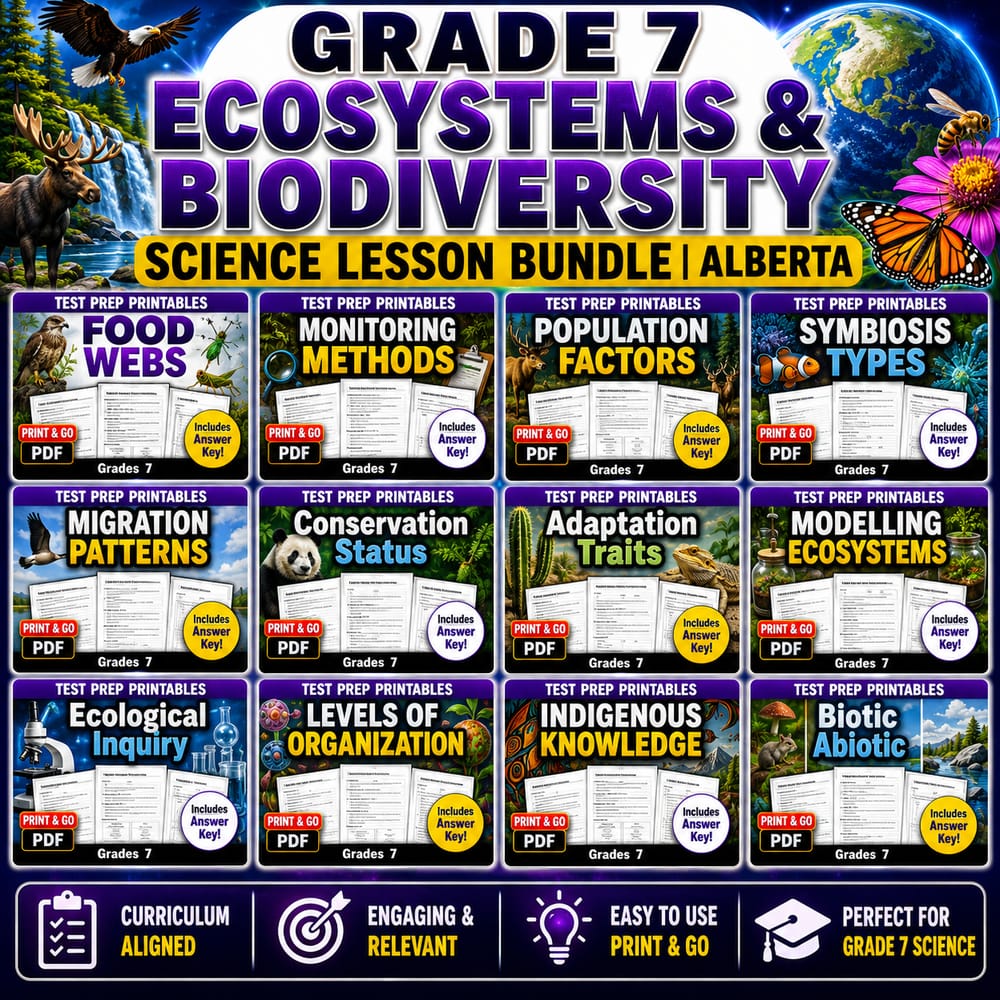


Grade 7 Ecosystems & Biodiversity Science Lesson Bundle | Alberta
$60.00$75.00Save $15.00
Prism Point Learning
·2 followers·13 sales
SubjectScienceGradeGrade 7
What’s included
15 worksheets · Save $15.00 (20%) · prices shown inside the bundle
 Food Webs Worksheet | Grade 7 Science Activities
- Explain how energy flows through interconnected feeding relationships in a food web
- Identify producers, consumers, and decomposers and describe their roles in trophic connections
- Predict how adding or removing a species can change dependencies and stability in an ecosystem
$4.00$5.00 Monitoring Methods Worksheet | Grade 7 Science Activities
- Explain how standardized sampling protocols and consistent data recording support long-term ecological monitoring.
- Describe how temporal replication helps detect trends in species and habitat conditions over time.
- Compare monitoring methods such as fixed-site surveys, point counts, remote sensing, and water quality sampling.
$4.00$5.00 Population Factors Worksheet | Grade 7 Science Practice
- Explain how birth rates, death rates, immigration, and emigration influence population size and distribution
- Describe how abiotic constraints and resource availability can limit population growth in different regions
- Use examples (prairies, boreal forests, disease outbreaks, and human land-use change) to predict how populations can fluctuate
$4.00$5.00 Symbiosis Types Worksheet | Grade 7 Science Activities
- Distinguish mutualism, commensalism, and parasitism by the effects on both species.
- Explain how symbiosis types can influence population dynamics and community structure.
- Use examples to describe ecological consequences such as resource distribution and coevolution.
$4.00$5.00 Migration Patterns Worksheet | Grade 7 Science Activities
- Explain how seasonal and annual migrations connect distant habitats
- Identify common drivers of migration such as food availability and breeding needs
- Describe how timing cues and energy demands affect survival during migration
$4.00$5.00 Conservation Status Worksheet | Grade 7 Science Activities
- Explain how conservation status is assessed using population trends, threat severity, and recovery potential
- Describe how land use, genetic diversity, and habitat connectivity affect a species’ vulnerability
- Interpret conservation evidence to understand regional species persistence
$4.00$5.00 Adaptation Traits Worksheet Pack | Grade 7 Science Activities
- Explain how adaptations (structural, physiological, and behavioural) help organisms survive in specific environments.
- Identify examples of adaptation traits related to temperature, water availability, and seasonal change.
- Describe trade-offs in resource allocation and how they affect which traits are favored by natural selection.
$4.00$5.00 Modelling Ecosystems Worksheet | Grade 7 Science Practice
- Explain how ecological models use assumptions to simplify complex ecosystem relationships.
- Identify common model inputs and how models are tested using real-world observations.
- Compare conceptual and quantitative modelling approaches and describe their strengths and limits.
$4.00$5.00 Ecological Inquiry Worksheet | Grade 7 Science Activities
- Explain how ecological inquiry uses questions, evidence, and clear conclusions to evaluate relationships in the environment.
- Identify measurable variables and describe how observations and data help test or revise a hypothesis.
- Interpret ecological data while accounting for natural variability and human impacts.
$4.00$5.00 Levels Of Organization Worksheet Pack | Grade 7 Science Activities
- Explain the ecological levels of organization from individual organisms to ecosystems
- Identify examples of individual, population, community, and ecosystem using Alberta-style scenarios
- Describe why patterns at higher levels cannot always be predicted from single organisms
$4.00$5.00
Reviews & Feedback
Loading reviews...
Questions & Answers
Loading questions…
About this bundle
Related categories
Frequently asked questions
Who is Grade 7 Ecosystems & Biodiversity Science Lesson Bundle | Alberta designed for?
Grade 7 Ecosystems & Biodiversity Science Lesson Bundle | Alberta is designed for Grade 7 students and Science learners and can be used in classrooms, homeschool, or independent practice.
How do I download Grade 7 Ecosystems & Biodiversity Science Lesson Bundle | Alberta?
Add it to your cart and complete checkout. After payment, you can download immediately from your account, and you'll also receive a download link by email.
Similar Products

Grade 6 Biodiversity & Plant Ecosystems Science Lesson Bundle | Alberta
$60.00$75.00

Grade 7 Ecosystems & Biodiversity Science Lesson Bundle for Alberta Framework
$60.00$75.00

Grade 6 Science Biodiversity Lesson Bundle – Ecosystems and Conservation
$36.00$45.00

Grade 7 Science Lesson Bundle with Ontario Framework | Ecosystems & Biodiversity
$28.80$36.00

Grade 6 Science Ecosystems, Adaptations & Biodiversity Lesson Bundle | Ontario
$60.00$75.00