
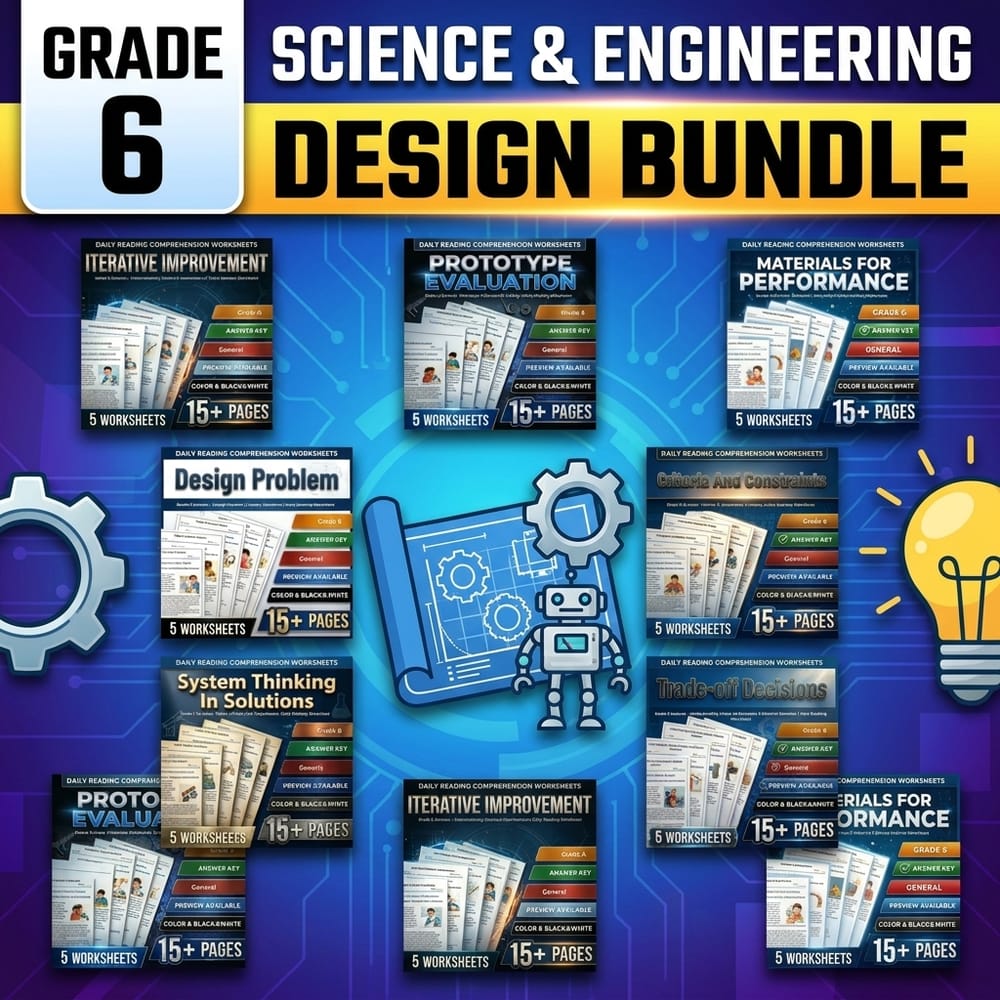
Engineering & Technology Grade 6 Science Worksheets Lesson Bundle | General
$22.40$28.00Save $5.60
Bright Mind Resources
New·1 followers·12 sales
SubjectScienceGradeGrade 6
What’s included
7 worksheets · Save $5.60 (20%) · prices shown inside the bundle
 Grade 6 Science – Understanding Iterative Improvement | Daily Reading Worksheet
- Define iterative improvement and explain its importance in science and engineering.
- Identify how evaluation results guide design refinements.
- Describe the process of testing and fixing in iterative development.
$3.20$4.00 Grade 6 Science – Prototype Evaluation & Testing | Daily Reading Worksheet
- Understand the purpose of prototype evaluation in science projects.
- Identify different types of data used to assess prototypes.
- Learn how to interpret measurements and observations to improve models.
$3.20$4.00 Grade 6 Science – Materials & Properties | Daily Reading Worksheet
- Identify different material properties relevant to performance.
- Compare how properties like strength, water resistance, and conductivity affect material choice.
- Understand how practical limitations influence material selection in design.
$3.20$4.00 Grade 6 Science – Design Problem & Inquiry Questions | Daily Reading Worksheet
- Understand what a design problem is and the importance of defining needs and constraints.
- Identify different components that influence the design of a protective case.
- Develop skills to analyze design requirements carefully.
$3.20$4.00 Grade 6 Science – Criteria & Constraints in Design | Daily Reading Worksheet
- Understand the difference between criteria and constraints in a design process.
- Identify criteria and constraints in given design scenarios.
- Explain how criteria help determine success and constraints restrict options.
$3.20$4.00 Grade 6 Science – System Thinking & Components | Daily Reading Worksheet
- Understand the basic components of a system.
- Identify how parts of a system interact and influence each other.
- Learn cause-and-effect reasoning in system design.
$3.20$4.00 Grade 6 Science – Trade-off Decisions & Material Selection | Reading Worksheet
- Explain what trade-offs are in selecting materials.
- Identify how choosing stronger materials can affect weight and cost.
- Analyze different material properties and their impacts on design choices.
$3.20$4.00
Reviews & Feedback
Loading reviews...
Questions & Answers
Loading questions…
About this bundle
Related categories
Frequently asked questions
Who is Engineering & Technology Grade 6 Science Worksheets Lesson Bundle | General designed for?
Engineering & Technology Grade 6 Science Worksheets Lesson Bundle | General is designed for Grade 6 students and Science learners and can be used in classrooms, homeschool, or independent practice.
How do I download Engineering & Technology Grade 6 Science Worksheets Lesson Bundle | General?
Add it to your cart and complete checkout. After payment, you can download immediately from your account, and you'll also receive a download link by email.
Similar Products

Grade 7 Technology & Engineering Science Lesson Bundle: Daily Reading | TEKS
$25.60$32.00

Grade 7 Technology & Engineering Design in Science: Lesson Bundle TEKS
$32.00$40.00

Grade 12 Science Engineering & Technology Systems Worksheets Bundle
$19.20$24.00

Grade 7 Investigation & Engineering Science Lesson Bundle: General Framework
$19.20$24.00

Grade 7 Science Structural Engineering Design & Materials Lesson Bundle |Ontario
$48.00$60.00