
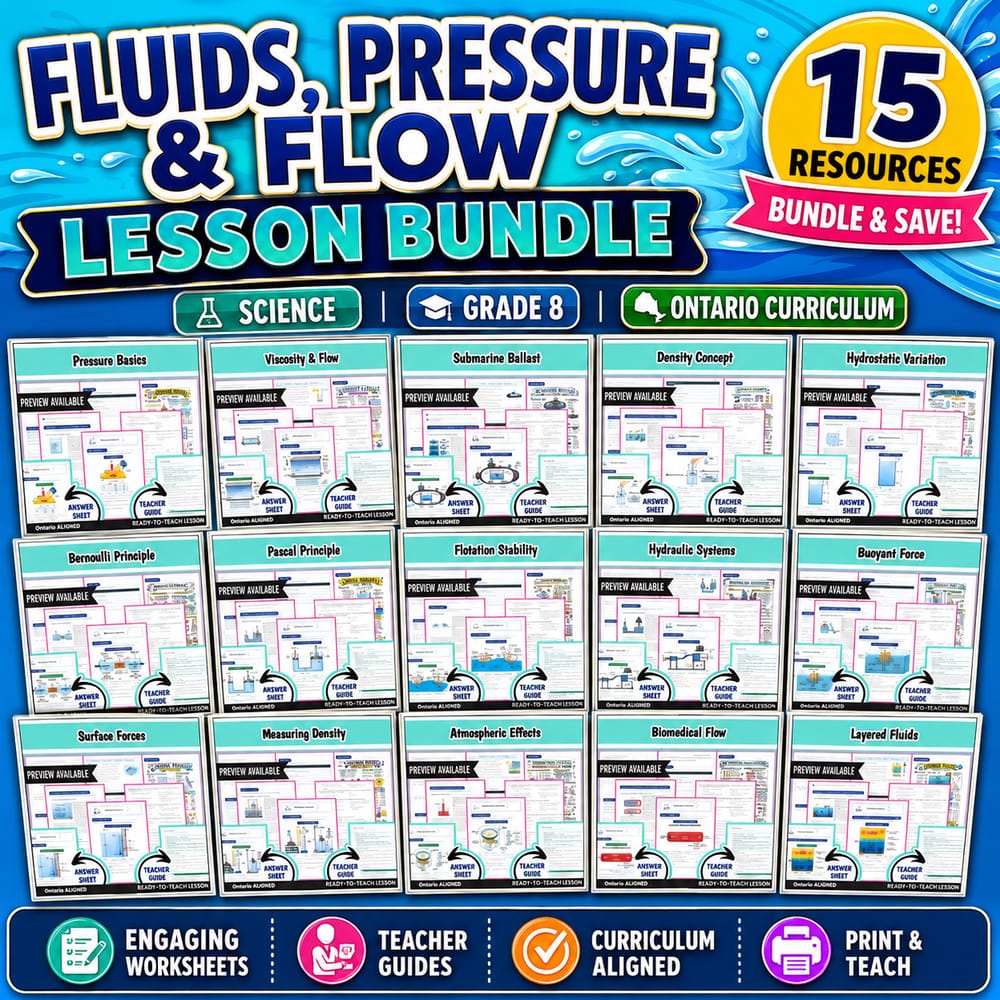


Fluids, Pressure & Flow Lesson Bundle — Grade 8 Science Ontario
$60.00$75.00Save $15.00
Chalk and Compass
·5 followers·13 sales
SubjectScienceGradeGrade 8
What’s included
15 worksheets · Save $15.00 (20%) · prices shown inside the bundle
 Grade 8 Pressure Basics Worksheet | Force, Area & Fluids | Ontario Science
- Define pressure as force per unit area and identify its SI unit
- Compare surface contact pressure with internal (hydrostatic) fluid pressure
- Use P = F/A and convert between pascals (Pa) and kilopascals (kPa)
$4.00$5.00 Grade 8 Science Viscosity & Flow Worksheet | Ontario | Doodle Notes & Guide
- Define dynamic viscosity and kinematic viscosity and describe how they relate to fluid flow.
- Explain how viscosity affects whether flow in a pipe is smooth (laminar) or more chaotic (turbulent).
- Predict how temperature and shear (forces between layers) can change viscosity and pumping needs.
$4.00$5.00 Grade 8 Science Submarine Ballast Worksheet | Buoyancy & Doodle Notes
- Explain how ballast tanks change a submarine’s buoyancy by altering displaced volume and internal mass
- Describe neutral buoyancy and why it matters for submerged navigation and depth control
- Evaluate how stability (trim) and external pressure affect safe ballast operation
$4.00$5.00 Grade 8 Density Concept Worksheet | Ontario Science + Doodle Notes
- Explain density as mass per unit volume using SI units
- Calculate and interpret density values to predict whether objects float or sink in water
- Differentiate relative density and specific gravity using water as the reference
$4.00$5.00 Grade 8 Hydrostatic Variation Worksheet | Pressure, Density & Depth Ontario
- Explain how hydrostatic pressure depends on fluid density and depth using p = ρgh
- Compare pressure at different heights in a fluid and predict where the pressure is greatest
- Describe how hydrostatic pressure principles apply to communicating vessels and real structures
$4.00$5.00 Grade 8 Bernoulli Principle Worksheet | Ontario Science + Doodle Notes
- Explain how Bernoulli’s principle relates fluid speed and pressure for ideal, incompressible flow.
- Use the continuity idea to describe how speed changes when a fluid moves through a constricted pipe.
- Apply Bernoulli’s principle to qualitatively explain reduced pressure near faster airflow and airfoil lift.
$4.00$5.00 Pascal Principle Worksheet Grade 8 Science | Hydraulics Doodle Notes Ontario
- Explain Pascal’s principle and how pressure transmits through confined fluids
- Use hydraulic relationships to connect force output to piston area and input force
- Interpret diagrams and statements about hydraulic systems, including real-world limitations
$4.00$5.00 Grade 8 Flotation Stability Worksheet | Ontario Science + Doodle Notes
- Explain how the centre of gravity and centre of buoyancy affect whether a floating object stays upright
- Describe how loading and hull shape influence stability, tipping, and capsizing thresholds
- Use basic stability relationships (relative positions and metacentric height) to predict upright equilibrium
$4.00$5.00 Grade 8 Hydraulic Systems Worksheet | Pascal's Law | Ontario Science
- Explain how hydraulic systems use confined fluids to transmit pressure and produce larger output forces.
- Use force-area relationships to calculate required input pressure and identify mechanical advantage in piston assemblies.
- Evaluate design constraints such as fluid viscosity, seal effectiveness, and compressibility that affect performance and reliability.
$4.00$5.00 Grade 8 Buoyant Force Worksheet | Ontario Science with Doodle Notes
- Explain Archimedes’ principle and relate buoyant force to the weight of displaced fluid
- Compare apparent weight in air versus when an object is submerged
- Use density relationships to predict floating, sinking, and neutral buoyancy
$4.00$5.00
Reviews & Feedback
Loading reviews...
Questions & Answers
Loading questions…
About this bundle
Related categories
Frequently asked questions
Who is Fluids, Pressure & Flow Lesson Bundle — Grade 8 Science Ontario designed for?
Fluids, Pressure & Flow Lesson Bundle — Grade 8 Science Ontario is designed for Grade 8 students and Science learners and can be used in classrooms, homeschool, or independent practice.
How do I download Fluids, Pressure & Flow Lesson Bundle — Grade 8 Science Ontario?
Add it to your cart and complete checkout. After payment, you can download immediately from your account, and you'll also receive a download link by email.
Similar Products

Grade 8 Fluid Mechanics Science Lesson Bundle | Ontario Pressure & Flow Practice
$60.00$75.00

Grade 8 Fluid Mechanics & Pressure Science Lesson Bundle | Ontario
$48.00$60.00

Grade 8 Fluid Pressure & Forces Science Lesson Bundle: Ontario Worksheet Set
$48.00$60.00

Grade 8 Science Lesson Group Bundle | Hydrostatics & Fluid Mechanics
$36.00$45.00