
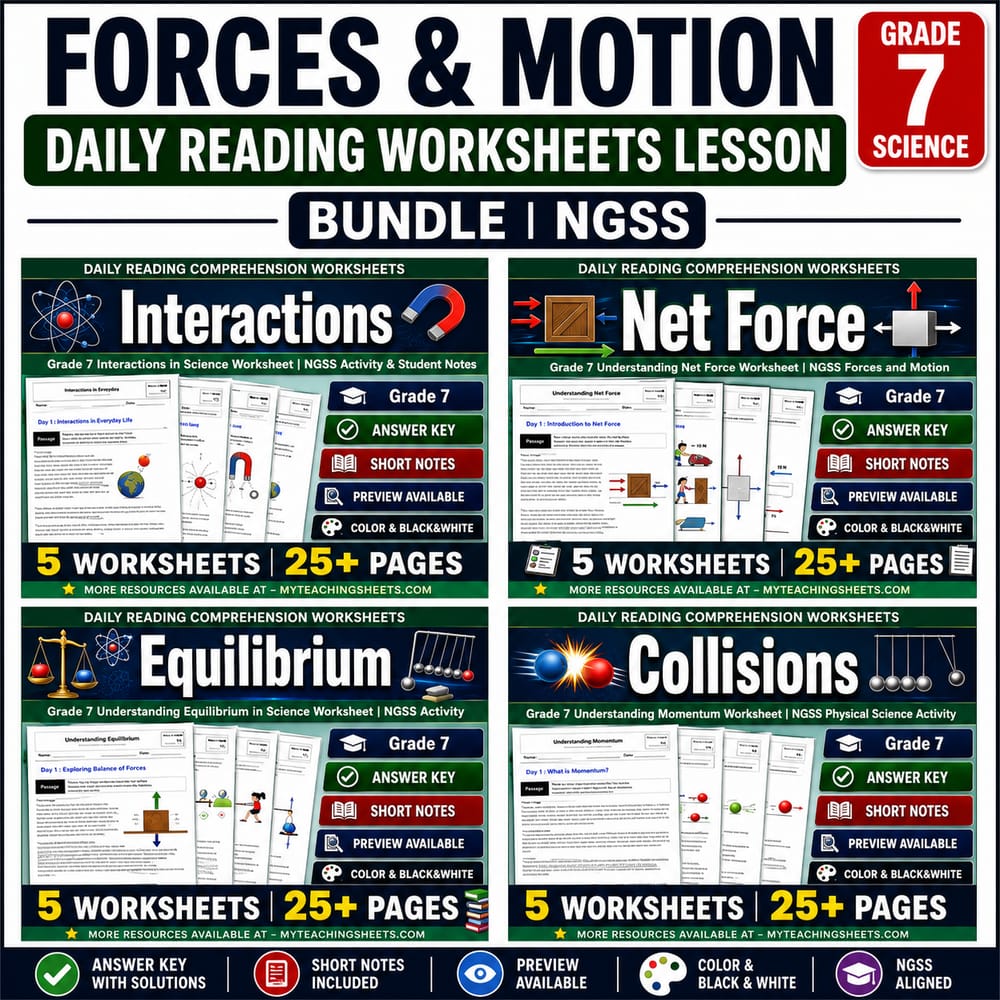
Forces & Motion Grade 7 Science Daily Reading Worksheets Lesson Bundle | NGSS
$16.00$20.00Save $4.00
BRIGHT PATH RESOURCES
·3 followers·23 sales
SubjectScienceGradeGrade 7
What’s included
4 worksheets · Save $4.00 (20%) · prices shown inside the bundle
 Grade 7 Interactions in Science Worksheet | NGSS Activity & Student Notes
- Understand the concept of gravitational force as a long-range attractive force.
- Identify how gravity is affected by mass and distance.
- Describe electric and magnetic interactions with real-world examples.
$4.00$5.00 Grade 7 Understanding Net Force Worksheet | NGSS Forces and Motion Activity
- Define net force as the vector sum of all forces acting on an object.
- Describe how unbalanced forces cause changes in an object's motion.
- Use diagrams and reasoning to analyze the effects of forces, including friction and applied forces.
$4.00$5.00 Grade 7 Understanding Equilibrium in Science Worksheet | NGSS Activity
- Define equilibrium and identify conditions under which it occurs.
- Differentiate between static and dynamic equilibrium.
- Recognize forces such as normal, gravitational, and tension forces acting on objects.
$4.00$5.00 Grade 7 Understanding Momentum Worksheet | NGSS Physical Science Activity
- Define momentum and explain its role in collisions.
- Differentiate between elastic and inelastic collisions.
- Describe how momentum is conserved during collisions.
$4.00$5.00
Reviews & Feedback
Loading reviews...
Questions & Answers
Loading questions…
About this bundle
Related categories
Frequently asked questions
Who is Forces & Motion Grade 7 Science Daily Reading Worksheets Lesson Bundle | NGSS designed for?
Forces & Motion Grade 7 Science Daily Reading Worksheets Lesson Bundle | NGSS is designed for Grade 7 students and Science learners and can be used in classrooms, homeschool, or independent practice.
How do I download Forces & Motion Grade 7 Science Daily Reading Worksheets Lesson Bundle | NGSS?
Add it to your cart and complete checkout. After payment, you can download immediately from your account, and you'll also receive a download link by email.
Similar Products

Motion Stability Forces G11 Science Daily Reading Worksheets Lesson Bundle |NGSS
$16.00$20.00

Forces & Motion Grade 10 Science Daily Reading Worksheets Lesson Bundle | NGSS
$24.00$30.00

Motion and Stability Grade 3 Science Daily Reading Worksheets Bundle | NGSS
$12.00$15.00

Grade 8 Motion Forces Energy Science Daily Reading Lesson Bundle | BC
$48.00$60.00

Forces & Electromagnetism Grade 8 Science Daily Reading Lesson Bundle | NGSS
$16.00$20.00