
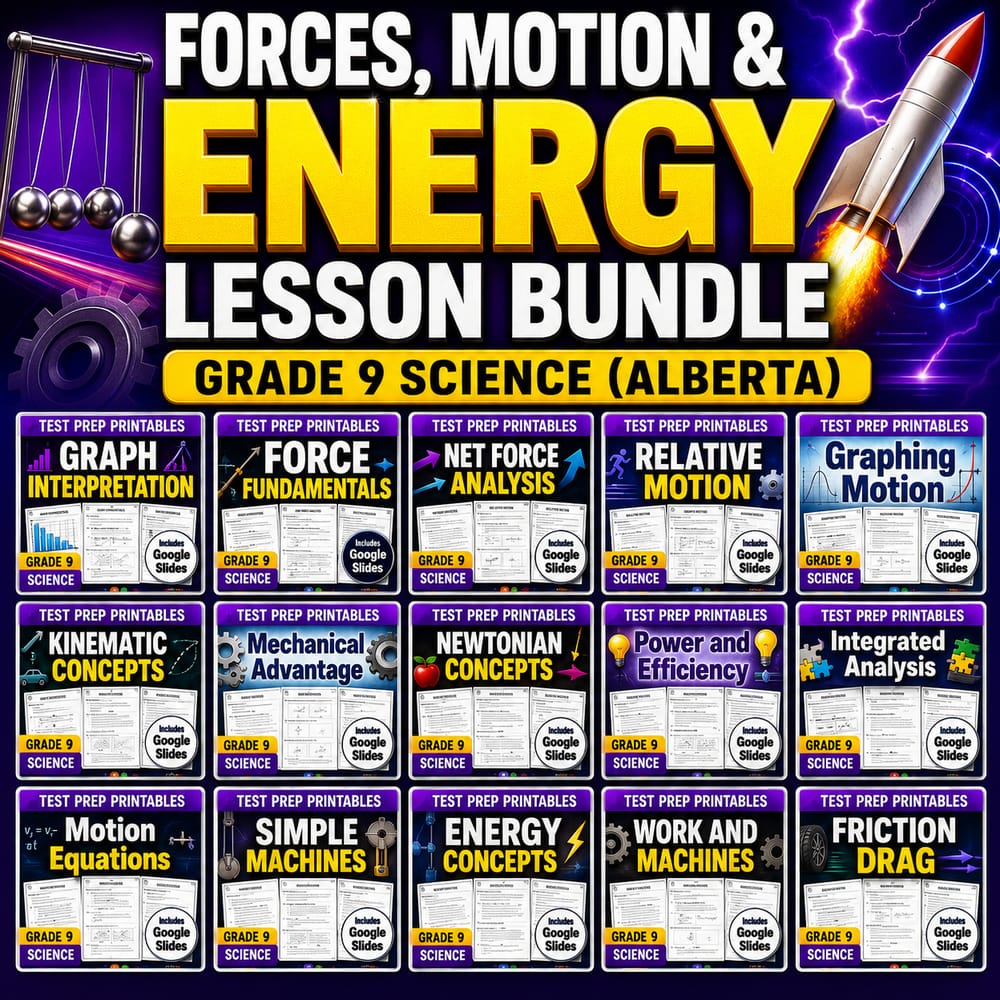


Forces, Motion & Energy Lesson Bundle | Grade 9 Science (Alberta)
$56.00$70.00Save $14.00
Prism Point Learning
·2 followers·13 sales
SubjectScienceGradeGrade 9
What’s included
15 worksheets · Save $14.00 (20%) · prices shown inside the bundle
 Graph Interpretation Worksheet Grade 9 Science Activities
- Interpret displacement–time and velocity–time graphs by connecting slope to physical meaning.
- Use the area under a velocity–time graph to determine displacement.
- Identify key features of motion graphs, including constant segments, sign changes, discontinuities, and curved (non-uniform) behavior.
$4.00$5.00 Force Fundamentals Worksheet | Grade 9 Science Activities
- Explain how forces can change an object’s motion through push or pull effects
- Distinguish between contact forces and non-contact forces using real-world Alberta examples
- Describe how force magnitude and direction combine to predict qualitative motion
Free Net Force Analysis Worksheet | Grade 9 Science Practice
- Explain how net force is found by adding forces as vectors (including direction).
- Use net force to predict changes in motion, including acceleration or equilibrium.
- Identify how opposing forces like friction and air resistance affect the resultant force.
$4.00$5.00 Relative Motion Worksheet | Grade 9 Science Activities
- Explain how relative motion depends on the choice of frame of reference
- Use vector ideas (speed and direction) to combine motion in different reference frames
- Distinguish between displacement and distance when comparing observed motion
$4.00$5.00 Graphing Motion Worksheet | Grade 9 Science Activities
- Interpret displacement–time, velocity–time, and acceleration–time graphs by using slope and area.
- Explain how changes in slope on a motion graph relate to changing acceleration.
- Choose correct axis labels and scales to compare different motion profiles accurately.
$4.00$5.00 Kinematic Concepts Worksheet | Grade 9 Science Practice Activity
- Differentiate speed, velocity, and acceleration using scalar vs. vector ideas and direction conventions.
- Use basic kinematics relationships and unit conversions to compare motion in real contexts.
- Interpret sign conventions for motion and determine whether acceleration is increasing or decreasing velocity.
$4.00$5.00 Mechanical Advantage Worksheet | Grade 9 Science Activities
- Explain how mechanical advantage relates input force, load force, input distance, and load distance
- Calculate mechanical advantage for simple lever, pulley, and wheel systems using ratios
- Compare trade-offs between force reduction and increased displacement in real devices
$4.00$5.00 Newtonian Concepts Worksheet | Grade 9 Science Practice
- Explain Newton’s three laws using force, motion, and mass (inertia).
- Use action–reaction pairs to predict how interacting objects move.
- Apply Newton’s laws to real situations such as snowplows, recoil, and anchoring.
$4.00$5.00 Power and Efficiency Worksheet | Grade 9 Science Activities
- Explain how power relates to the rate of energy transfer in everyday and engineering systems
- Calculate and interpret efficiency as the fraction of input energy converted to useful output
- Identify major sources of energy loss and describe how they affect operational limits and design trade-offs
$4.00$5.00 Integrated Analysis Worksheet Pack | Grade 9 Science Activities
- Explain how kinematics, net-force reasoning, and energy considerations work together to predict complex motion.
- Use force balance and energy ideas to determine acceleration and changes in speed during braking.
- Interpret how graphs and equations combine to estimate stopping distance under varying conditions.
$4.00$5.00
Reviews & Feedback
Loading reviews...
Questions & Answers
Loading questions…
About this bundle
Related categories
Frequently asked questions
Who is Forces, Motion & Energy Lesson Bundle | Grade 9 Science (Alberta) designed for?
Forces, Motion & Energy Lesson Bundle | Grade 9 Science (Alberta) is designed for Grade 9 students and Science learners and can be used in classrooms, homeschool, or independent practice.
How do I download Forces, Motion & Energy Lesson Bundle | Grade 9 Science (Alberta)?
Add it to your cart and complete checkout. After payment, you can download immediately from your account, and you'll also receive a download link by email.
Similar Products

Grade 9 Relative Motion, Forces & Energy Science Lesson Bundle – Alberta
$60.00$75.00

Grade 8 Motion Forces Energy Science Daily Reading Lesson Bundle | BC
$48.00$60.00

Grade 9 Science Lesson Group: Energy, Forces & Motion Worksheets Bundle
$36.00$45.00

Grade 9 Motion & Forces Science Lesson Bundle | AP Kinematics & Forces
$9.60$12.00

Forces, Motion & Energy Lesson Bundle | Grade 8 Science | Alberta
$60.00$75.00