
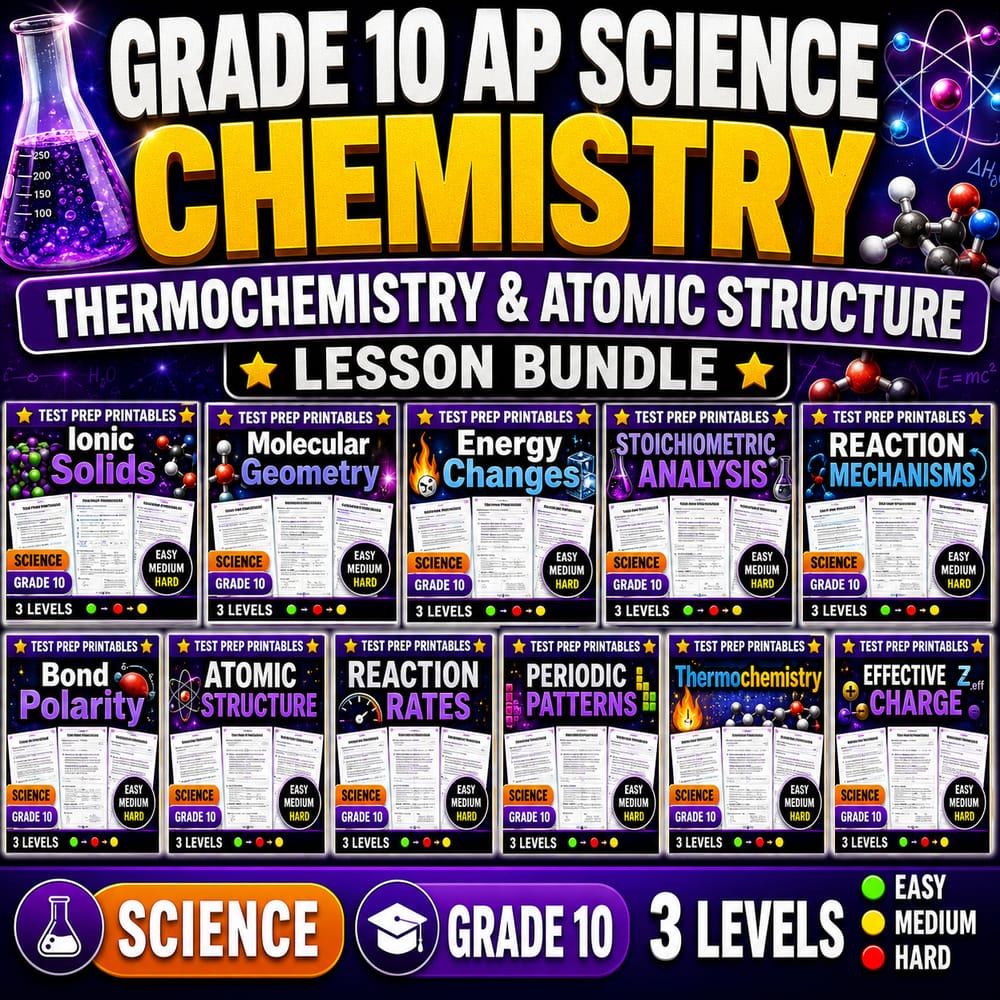


Grade 10 AP Science Chemistry Thermochemistry & Atomic Structure Lesson Bundle
$52.00$65.00Save $13.00
Prism Point Learning
·2 followers·13 sales
SubjectScienceGradeGrade 10Pages404 Pages
What’s included
13 worksheets · 404 pages · Save $13.00 (20%) · prices shown inside the bundle
 Ionic Solids Worksheet | AP Grade 10 Chemistry Practice Pack
- Explain how ionic solids form crystal lattices and how ion charge and packing affect coordination number.
- Describe how lattice energy and Coulombic attraction influence melting point and solubility.
- Relate ionic motion in solids and molten states to electrical conductivity.
$4.00$5.00 Molecular Geometry Worksheet Pack | AP Grade 10 Chemistry Practice
- Define molecular geometry using electron-domain (VSEPR) ideas and explain how bonding and nonbonding electron domains control 3D shape.
- Use simple orbital hybridization and electron-domain reasoning to predict molecular shapes.
- Explain how molecular shape affects molecular polarity and can influence macroscopic properties like boiling point and solvent interactions.
$4.00$5.00 Energy Changes Worksheet Grade 10 AP Science Thermodynamics Activities
- Distinguish endothermic and exothermic chemical processes using energy changes and temperature observations
- Explain enthalpy as the energy change associated with reactions and connect it to bond breaking and bond forming
- Use qualitative energy diagrams to describe reaction pathways and relate energy changes to reaction heat
$4.00$5.00 Stoichiometric Analysis Worksheet Grade 10 AP Science Practice Chemistry Pack
- Use balanced chemical equations and mole ratios to predict product amounts in multi-step reaction sequences.
- Convert between concentration units and interpret solutions in stoichiometric calculations.
- Determine limiting reactants and compute theoretical yield and percent yield from mass and composition data.
$4.00$5.00 Reaction Stoichiometry Worksheet Grade 10 AP Science Practice Chemistry Pack
- Use balanced chemical equations and mole ratios to relate reactant amounts to product amounts.
- Convert between mass, moles, and molar mass using unit analysis.
- Identify limiting reactants and estimate theoretical yield from stoichiometric calculations.
$4.00$5.00 Bond Polarity Worksheet Grade 10 Science AP Chemistry Activities
- Explain how electronegativity differences determine bond polarity and the direction of bond dipoles.
- Use dipole moment representations to describe electron distribution asymmetry in polar molecules.
- Relate bond polarity to intermolecular attraction and physical properties such as solubility.
$4.00$5.00 Atomic Structure Worksheet AP Science Practice Grade 10 Chemistry
- Explain the roles of protons, neutrons, and electrons in determining atomic number, mass number, and isotopes.
- Relate electron distribution and quantum-number ideas to observed atomic properties and spectra.
- Use emission spectra and scattering evidence to support models of atomic structure and electron behavior.
$4.00$5.00 Reaction Rates Worksheet | AP Grade 10 Chemistry Practice Activities
- Explain how collision frequency, collision orientation, and activation energy influence reaction rates.
- Describe how temperature and catalysts can change reaction rates.
- Interpret concentration-versus-time graphs and use qualitative reasoning to infer reaction order.
$4.00$5.00 Periodic Patterns Worksheet | Grade 10 AP Chemistry Practice Pack
- Explain how effective nuclear charge and electron shielding influence trends in atomic radius, ionization energy, and electronegativity across periods and down groups.
- Use periodic trends to predict how elements’ properties and reactivity patterns change with position on the periodic table.
- Connect periodic patterns to underlying electron configurations and nuclear effects.
$4.00$5.00 Thermochemistry Worksheet Grade 10 AP Science Practice Activities Pack
- Explain thermochemical representations and how enthalpy changes relate to reaction stoichiometry.
- Use calorimetric energy accounting (q = mcΔT and energy conservation) to determine heat transfer.
- Apply Hess’s law and bond-enthalpy ideas to predict overall reaction enthalpy and reaction favorability.
$4.00$5.00
Reviews & Feedback
Loading reviews...
Questions & Answers
Loading questions…
About this bundle
Related categories
Frequently asked questions
Who is Grade 10 AP Science Chemistry Thermochemistry & Atomic Structure Lesson Bundle designed for?
Grade 10 AP Science Chemistry Thermochemistry & Atomic Structure Lesson Bundle is designed for Grade 10 students and Science learners and can be used in classrooms, homeschool, or independent practice.
How do I download Grade 10 AP Science Chemistry Thermochemistry & Atomic Structure Lesson Bundle?
Add it to your cart and complete checkout. After payment, you can download immediately from your account, and you'll also receive a download link by email.
Similar Products

Grade 10 Science Unit Bundle | Thermochemistry, Stoichiometry & Atomic Structure
$20.80$26.00

Grade 9 Science Unit Bundle – Chemistry, States & Atomic Structure Worksheets
$36.00$45.00

Grade 12 Chemistry Stoichiometry & Atomic Models Science Lesson Bundle AP
$48.00$60.00

Grade 12 Science Unit Bundle | Atomic Structure, Thermochemistry & More
$16.00$20.00

Grade 10 Science Chemistry Foundations Lesson Bundle for AP Curriculum
$31.20$39.00