
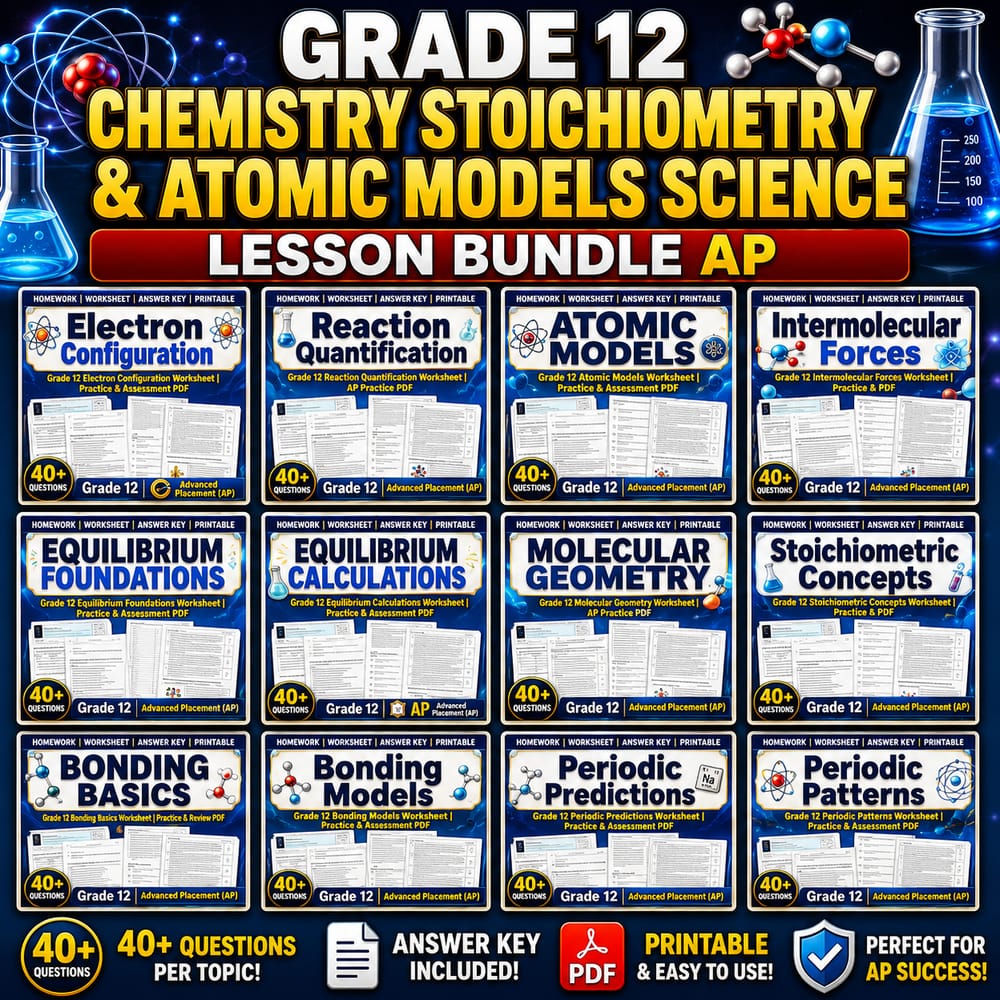


Grade 12 Chemistry Stoichiometry & Atomic Models Science Lesson Bundle AP
$48.00$60.00Save $12.00
Clear Sky Classroom
·1 followers·19 sales
SubjectScienceGradeGrade 12
What’s included
12 worksheets · Save $12.00 (20%) · prices shown inside the bundle
 Grade 12 Electron Configuration Worksheet | Practice & Assessment PDF
- Assign electron configurations using the orbital-filling order (Aufbau principle) and understand the role of quantum numbers (n and l) in determining subshells and orbitals.
- Apply Hund’s rule to predict how electrons distribute among degenerate orbitals and connect this to magnetic behavior and valence structure.
- Identify common exceptions in transition elements and use configuration notation to predict ion electron configurations and oxidation-state trends.
$4.00$5.00 Grade 12 Reaction Quantification Worksheet | AP Practice PDF
- Use molarity and dilution relationships to determine concentrations in titration and reaction experiments
- Apply dimensional analysis and stoichiometry to convert between mass, moles, and gas volumes under standard and nonstandard conditions
- Identify the limiting reagent and predict reaction extent, theoretical yield, and percent yield in multistep contexts
$4.00$5.00 Grade 12 Atomic Models Worksheet | Practice & Assessment PDF
- Explain how historical atomic models evolved toward the modern quantum model using evidence from spectra and scattering.
- Describe the nucleus and electron cloud and relate discrete energy states to emission/absorption spectral lines.
- Use quantum-number ideas (conceptually) to connect electron structure with chemical behavior.
$4.00$5.00 Grade 12 Intermolecular Forces Worksheet | Practice & PDF
- Distinguish dispersion forces, dipole–dipole interactions, and hydrogen bonding as different intermolecular mechanisms.
- Explain how intermolecular strength influences macroscopic properties such as boiling point, vapor pressure, viscosity, and solubility.
- Predict relative intermolecular forces using molecular size, shape, and polarity.
$4.00$5.00 Grade 12 Equilibrium Foundations Worksheet | Practice & Assessment PDF
- Explain chemical equilibrium as a dynamic balance between forward and reverse reaction rates
- Use reaction quotient and the equilibrium constant to predict the direction of a reaction
- Relate concentration-based and pressure-based equilibrium expressions to reaction directionality and response to perturbations
$4.00$5.00 Grade 12 Equilibrium Calculations Worksheet | Practice & Assessment PDF
- Use ICE tables to set up and solve equilibrium concentration problems using the equilibrium constant expression.
- Compare reaction quotient Q to K to predict the direction of shift and interpret the sign of change.
- Apply algebraic approximations and explain when they are valid in equilibrium calculations.
$4.00$5.00 Grade 12 Molecular Geometry Worksheet | AP Practice PDF
- Use VSEPR (valence-shell electron-pair repulsion) theory to predict molecular shape and approximate bond angles from electron-pair counts.
- Apply hybridization concepts to connect valence-shell electron arrangements to observed molecular geometries.
- Relate molecular geometry to polarity and symmetry by reasoning about bond dipoles and lone pairs.
$4.00$5.00 Grade 12 Stoichiometric Concepts Worksheet | Practice & PDF
- Use the mole concept to convert between mass, moles, and particle counts.
- Apply molar mass and balanced chemical equations to relate reactant and product quantities.
- Determine the limiting reactant and calculate theoretical yield from stoichiometric ratios.
$4.00$5.00 Grade 12 Bonding Basics Worksheet | Practice & Review + PDF
- Differentiate ionic, covalent, and metallic bonding using electron distribution and representative models.
- Explain how bonding type influences bulk properties such as electrical conductivity, melting point, and solubility.
- Use Lewis structures and formal charge to evaluate and compare bonding alternatives.
$4.00$5.00 Grade 12 Bonding Models Worksheet | Practice & Review PDF
- Explain how molecular orbital (MO) theory extends valence-bond ideas to describe bonding, bond order, and electron delocalization.
- Use MO and symmetry/energy-level concepts to predict magnetic behavior and relative bond strength in diatomic species.
- Connect band formation in extended solids to electrical conduction and to transitions between energy levels.
$4.00$5.00
Reviews & Feedback
Loading reviews...
Questions & Answers
Loading questions…
About this bundle
Related categories
Frequently asked questions
Who is Grade 12 Chemistry Stoichiometry & Atomic Models Science Lesson Bundle AP designed for?
Grade 12 Chemistry Stoichiometry & Atomic Models Science Lesson Bundle AP is designed for Grade 12 students and Science learners and can be used in classrooms, homeschool, or independent practice.
How do I download Grade 12 Chemistry Stoichiometry & Atomic Models Science Lesson Bundle AP?
Add it to your cart and complete checkout. After payment, you can download immediately from your account, and you'll also receive a download link by email.
Similar Products

Grade 10 AP Science Chemistry Thermochemistry & Atomic Structure Lesson Bundle
$52.00$65.00

Grade 10 Chemistry Lesson Bundle – AP Chemistry Concepts & Practice
$52.00$65.00

Grade 11 Chemistry Titration & Stoichiometry Lesson Bundle Alberta
$48.00$60.00

Grade 9 Chemistry Lesson Bundle | NGSS: Stoichiometry, Reactions & Bonding
$22.40$28.00

Grade 10 Science Chemistry Foundations Lesson Bundle for AP Curriculum
$31.20$39.00