
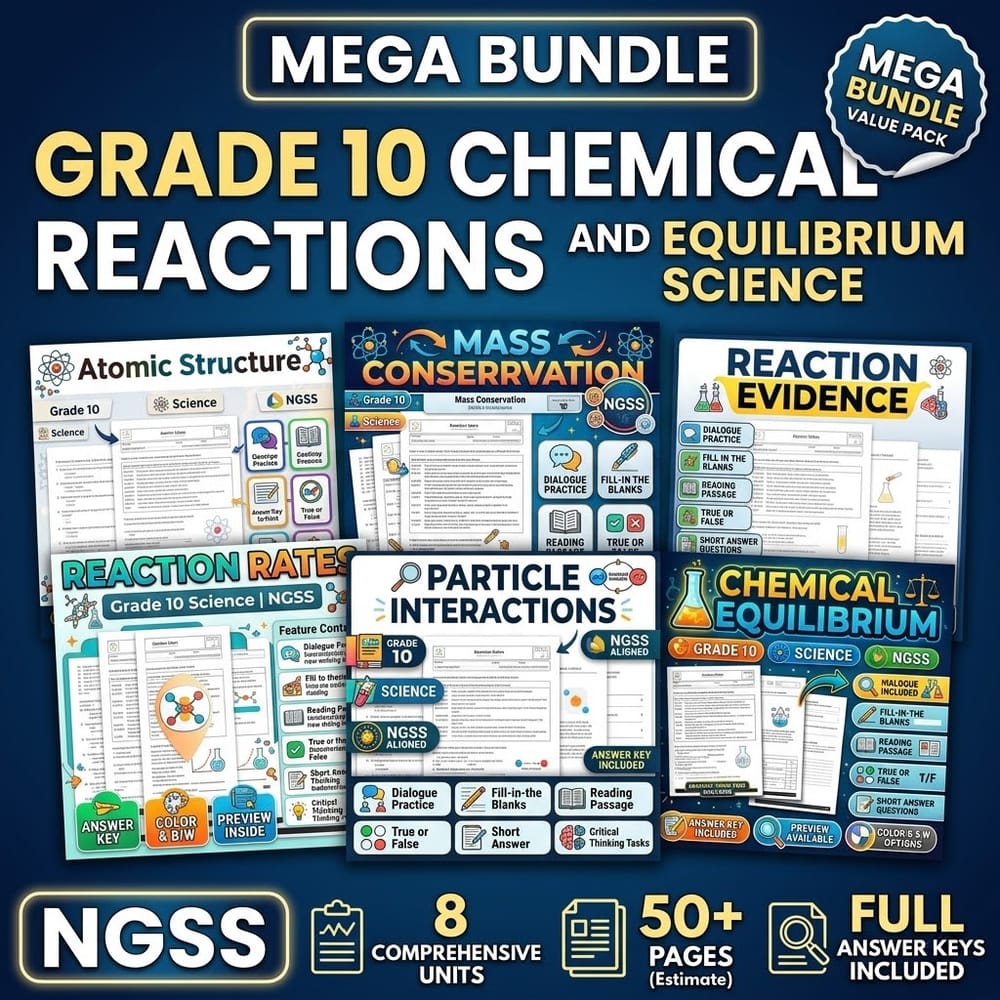
Grade 10 Chemical Reactions and Equilibrium Science – Lesson Bundle NGSS
$28.00$35.00Save $7.00
J.S Sheets
New·3 followers·24 sales
SubjectScienceGradeGrade 10
What’s included
7 worksheets · Save $7.00 (20%) · prices shown inside the bundle
 Atomic Structure Worksheet for Grade 10 Science | NGSS-Aligned Practice
- Explain the relationship between electron configuration, nuclear composition, and periodic trends.
- Describe how the periodic table models valence electron patterns and ion formation.
- Understand isotopes, atomic mass, and their connection to reactivity and oxidation states.
$4.00$5.00 Reaction Rates Worksheet for Grade 10 Science | NGSS-Aligned Practice
- Explain how collision theory and rate laws describe factors affecting reaction speed.
- Identify the influence of temperature, concentration, surface area, and catalysts on reaction rates.
- Interpret empirical rate data using concepts of molecular collision frequency, activation energy, and rate constants.
$4.00$5.00 Particle Interactions Worksheet for Grade 10 Science – NGSS-Aligned Practice
- Compare how crystal structures and molecular interactions influence material properties.
- Explain the role of electrical forces, lattice energy, and hydrogen bonding in phase transitions.
- Distinguish between ionic lattices and molecular solids based on properties like melting points and solubility.
$4.00$5.00 Mass Conservation Worksheet for Grade 10 Science | NGSS Practice PDF
- Understand how to balance chemical equations to verify atom and mass conservation.
- Use molar relationships and coefficients to track atom counts across reactions.
- Apply the mole concept and molar masses to demonstrate invariant total mass in chemical processes.
$4.00$5.00 Reaction Evidence Worksheet | NGSS Grade 10 Science Assessment PDF
- Understand how conservation of atoms supports evidence of chemical reactions.
- Identify observable signs indicating a chemical reaction has occurred.
- Correlate reactant properties with product identities in various reactions.
$4.00$5.00 Bond Energetics Worksheet for Grade 10 Science | NGSS Aligned Practice
- Explain how bond formation and breaking relate to energy changes in chemical reactions.
- Differentiate between exothermic and endothermic processes based on energy flow.
- Interpret potential energy diagrams and bond enthalpy values to understand reaction heat changes.
$4.00$5.00 Chemical Equilibrium Worksheet | NGSS Grade 10 Science Practice
- Understand the principles of chemical equilibrium and how conditions influence system shifts.
- Identify the roles of catalysts, temperature, pressure, and concentration in dynamic equilibria.
- Interpret equilibrium constants and how modifications to conditions affect product yields.
$4.00$5.00
Reviews & Feedback
Loading reviews...
Questions & Answers
Loading questions…
About this bundle
Related categories
Frequently asked questions
Who is Grade 10 Chemical Reactions and Equilibrium Science – Lesson Bundle NGSS designed for?
Grade 10 Chemical Reactions and Equilibrium Science – Lesson Bundle NGSS is designed for Grade 10 students and Science learners and can be used in classrooms, homeschool, or independent practice.
How do I download Grade 10 Chemical Reactions and Equilibrium Science – Lesson Bundle NGSS?
Add it to your cart and complete checkout. After payment, you can download immediately from your account, and you'll also receive a download link by email.
Similar Products

Grade 7 Physical Science: Matter & Chemical Reactions Lesson Bundle | NGSS
$28.00$35.00

Grade 8 Science Thermal Effects & Chemical Reactions Lesson Bundle | NGSS
$20.00$25.00

Reaction Stoichiometry & Chemical Reaction Structure Lesson Bundle | Grade 11 Science | NGSS
$19.60$28.00

Grade 8 Matter & Chemical Reactions Science Lesson Bundle (NGSS)
$20.00$25.00

Grade 6 Matter and Chemical Reactions Science Lesson Bundle NGSS Worksheets
$16.00$20.00