
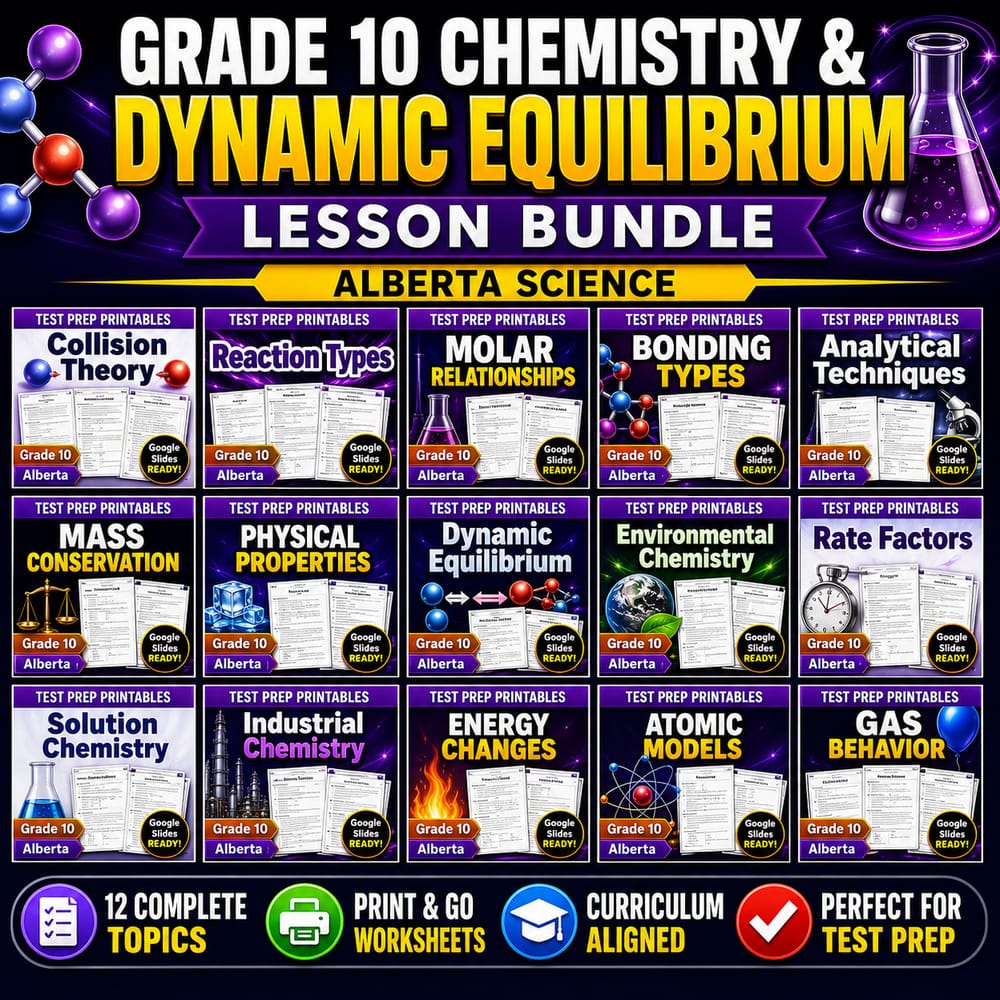


Grade 10 Chemistry & Dynamic Equilibrium Lesson Bundle | Alberta Science
$60.00$75.00Save $15.00
Prism Point Learning
·2 followers·14 sales
SubjectScienceGradeGrade 10
What’s included
15 worksheets · Save $15.00 (20%) · prices shown inside the bundle
 Collision Theory Worksheet Pack | Grade 10 Science Activities
- Explain how collision frequency and collision energy affect reaction rates using collision theory.
- Describe activation energy and the role of energy barriers in determining whether collisions lead to reactions.
- Connect temperature and concentration changes to particle-level behavior and observed chemical rates.
$4.00$5.00 Reaction Types Worksheet | Grade 10 Science Activities
- Identify and classify common chemical reaction types (synthesis, decomposition, displacement, combustion, and neutralization) based on particle changes and observable indicators.
- Use representative word equations and simple indicators (heat, light, gas, color change, precipitate, temperature change) to predict likely product categories.
- Apply reaction-type classification to real-world contexts relevant to Alberta, such as oxidation, natural gas combustion, and water treatment.
$4.00$5.00 Molar Relationships Worksheet | Grade 10 Science Practice
- Convert between moles, particle counts, and mass using Avogadro’s number and molar mass.
- Use mole-to-mole ratios from balanced equations to apply stoichiometry and predict amounts of products.
- Identify the limiting reagent and estimate theoretical yield while tracking units for consistency.
$4.00$5.00 Bonding Types Worksheet Grade 10 Science Practice for Alberta Standards
- Compare ionic, covalent, and metallic bonding using particle-level explanations.
- Relate bonding type to observable properties such as conductivity and melting point.
- Use electron transfer, sharing, and electron delocalization to predict physical behavior.
$4.00$5.00 Analytical Techniques Worksheet | Grade 10 Science Practice
- Compare common analytical techniques (spectroscopy, chromatography, and titration) by what each measures and what the data show.
- Interpret instrumental results using ideas such as calibration, detection limits, and uncertainty in mass-based calculations.
- Apply analytical chemistry concepts to real-world compliance contexts such as water quality and industrial composition checks.
$4.00$5.00 Mass Conservation Worksheet | Grade 10 Science Activities
- Explain conservation of mass using particle ideas and closed-system reasoning.
- Interpret and balance chemical equations to account for atoms and mass.
- Use mass accounting to calculate and compare reactant and product masses in real contexts.
$4.00$5.00 Physical Properties Worksheet | Grade 10 Science Activities
- Differentiate between physical properties and chemical properties using examples from everyday materials.
- Classify physical properties as intensive or extensive and predict how each helps identify substances.
- Use property classifications (e.g., melting point, density, solubility, reactivity) to reason about material choice and environmental impact.
$4.00$5.00 Dynamic Equilibrium Worksheet for Grade 10 Science | Alberta Standards
- Describe dynamic equilibrium as the balance between forward and reverse reaction rates.
- Interpret the equilibrium constant using concentrations or partial pressures for given reaction expressions.
- Predict the net effect of concentration, pressure, and temperature changes on a system at equilibrium.
$4.00$5.00 Environmental Chemistry Worksheet | Grade 10 Science Activities
- Explain how chemical reactions and rates influence air, water, and soil quality
- Interpret chemical pathways involved in ozone/smog formation and pollutant fate
- Use basic mass-flow ideas to predict how seasonal changes affect environmental impacts
$4.00$5.00 Rate Factors Worksheet Pack | Grade 10 Science Activities
- Explain how temperature, concentration, surface area, and catalysts affect reaction rates using collision and activation-energy ideas
- Predict how changing a condition will likely speed up or slow down a chemical reaction
- Use real-world examples to justify rate-control strategies in daily life and industry
$4.00$5.00
Reviews & Feedback
Loading reviews...
Questions & Answers
Loading questions…
About this bundle
Related categories
Frequently asked questions
Who is Grade 10 Chemistry & Dynamic Equilibrium Lesson Bundle | Alberta Science designed for?
Grade 10 Chemistry & Dynamic Equilibrium Lesson Bundle | Alberta Science is designed for Grade 10 students and Science learners and can be used in classrooms, homeschool, or independent practice.
How do I download Grade 10 Chemistry & Dynamic Equilibrium Lesson Bundle | Alberta Science?
Add it to your cart and complete checkout. After payment, you can download immediately from your account, and you'll also receive a download link by email.
Similar Products

Grade 10 Chemistry Lesson Bundle | Alberta Science Reaction & Analysis
$36.00$45.00

Grade 9 Environmental Chemistry Lesson Bundle | Alberta Science
$12.80$16.00

Grade 12 Chemistry Daily Reading Worksheets Lesson Bundle | Alberta Science
$48.00$60.00

Chemistry 30 Reading Comprehension Lesson Bundle – Grade 12 Science Alberta
$60.00$75.00

Grade 11 Acids, Bases & pH Chemistry Science Lesson Bundle | Alberta
$60.00$75.00