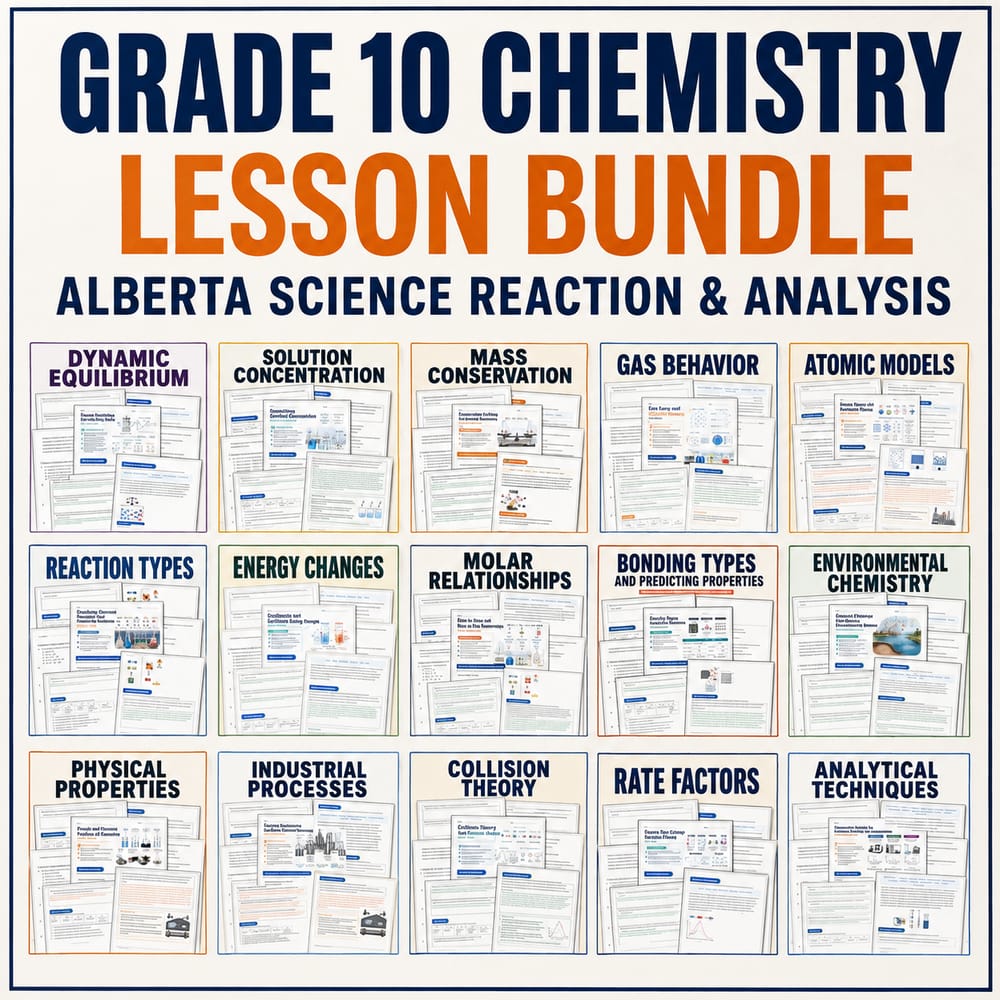
Grade 10 Chemistry Lesson Bundle | Alberta Science Reaction & Analysis — bundle cover
Grade 10 Chemistry Lesson Bundle | Alberta Science Reaction & Analysis — included worksheet 1
Grade 10 Chemistry Lesson Bundle | Alberta Science Reaction & Analysis — included worksheet 2
Grade 10 Chemistry Lesson Bundle | Alberta Science Reaction & Analysis — included worksheet 3
Grade 10 Chemistry Lesson Bundle | Alberta Science Reaction & Analysis — included worksheet 4
Grade 10 Chemistry Lesson Bundle | Alberta Science Reaction & Analysis — included worksheet 5
Grade 10 Chemistry Lesson Bundle | Alberta Science Reaction & Analysis — included worksheet 6
Grade 10 Chemistry Lesson Bundle | Alberta Science Reaction & Analysis — included worksheet 7
Grade 10 Chemistry Lesson Bundle | Alberta Science Reaction & Analysis — included worksheet 8
Grade 10 Chemistry Lesson Bundle | Alberta Science Reaction & Analysis — included worksheet 9
Grade 10 Chemistry Lesson Bundle | Alberta Science Reaction & Analysis — included worksheet 10
Grade 10 Chemistry Lesson Bundle | Alberta Science Reaction & Analysis — included worksheet 11
Grade 10 Chemistry Lesson Bundle | Alberta Science Reaction & Analysis — included worksheet 12
Grade 10 Chemistry Lesson Bundle | Alberta Science Reaction & Analysis — included worksheet 13
Grade 10 Chemistry Lesson Bundle | Alberta Science Reaction & Analysis — included worksheet 14
Grade 10 Chemistry Lesson Bundle | Alberta Science Reaction & Analysis — included worksheet 15
Grade 10 Science worksheet — Grade 10 Chemistry Lesson Bundle | Alberta Science Reaction & Analysis

Description

Overview


Grade 10 Chemistry is the focus of this Alberta Science Lesson Bundle for Grade 10 students, with 15 worksheet activities that build competency from concentration to equilibrium, energy changes, and instrumental analysis.

Use this unit to strengthen how learners interpret data, apply mole-based reasoning, and explain chemical changes using evidence. Each worksheet is designed for focused practice and consistent classroom routines, so students can move from core concepts (models of matter and particle interactions) to structured problem-solving (stoichiometry, gas laws, and reaction rate reasoning).

Whether you are teaching after a lab demo or reinforcing key ideas from instruction, these ready-to-print pages support daily skill development while aligning with Alberta Science expectations for scientific thinking, representation, and evidence-based communication.

Emoji-free, teacher-ready, and organized as a single unit packet—this is a practical way to keep the pace and coherence of a full chemistry topic.

Worksheet count: 15 worksheets.


What's Included


  • ✅ Quantifying Solution Concentration Worksheet | Grade 10 Science – Practice calculating and interpreting concentration measures in solution contexts.
  • ✅ Chemical Reactions and Predicting Products Worksheets | Grade 10 Science – Reinforce predicting reaction outcomes using chemical patterns and reasoning.
  • ✅ Reaction Rates Worksheets: Factors Affecting Reaction Rates Grade 10 – Explore how temperature, concentration, surface area, and catalysts influence reaction speed.
  • ✅ Physical & Chemical Properties Worksheets | Grade 10 Science – Sort and explain properties, distinguishing observable physical vs chemical changes.
  • ✅ Mole-to-Mass and Mole-to-Mole Relationships Chemistry Worksheets Grade 10 – Convert between moles, mass, and related quantities using stoichiometric reasoning.
  • ✅ Conservation of Mass Worksheets: Chemical Reactions Grade 10 Science – Apply conservation of mass to balance and justify changes in particle models.
  • ✅ Stoichiometry and Reaction Rate Worksheets | Grade 10 Chemistry – Connect mole-based calculations to how quickly reactions proceed.
  • ✅ Gas Laws and Kinetic Theory Worksheets | Grade 10 Science – Link gas law variables to particle motion, collisions, and measurable trends.
  • ✅ Chemical Pathways and Reaction Rates Worksheets Grade 10 Science – Use pathway diagrams and rate relationships to explain why reaction steps matter.
  • ✅ Endothermic and Exothermic Energy Changes Worksheets Grade 10 Science – Interpret energy profiles and support claims using evidence from diagrams and data.
  • ✅ Chemical Equilibrium Worksheets | Le Châtelier’s Principle Grade 10 – Predict shifts in equilibrium when conditions change, using particle-based explanations.
  • ✅ Collision Theory and Reaction Rates Worksheets | Grade 10 Science – Analyze collision frequency vs successful collisions to reason about rate changes.
  • ✅ Chemical Bonding Types Worksheets: Ionic, Covalent & Metallic Grade 10 – Model bonding types and explain how structures relate to properties of substances.
  • ✅ Atomic Models and Particulate Matter Worksheets | Grade 10 Science – Strengthen atom/particle models and use them to interpret macroscopic observations.
  • ✅ Instrumental Analysis Chemistry Worksheets: Substance Identity & Concentration – Interpret typical instrumental information to support identification and concentration claims.

Skills & Standards


Aligned to the Alberta Science framework, this Grade 10 chemistry unit builds disciplinary thinking through crosscutting concepts such as patterns, models, systems, and cause-and-effect relationships. Students practice representing matter and reactions in multiple forms—particle models, diagrams, and quantitative calculations—then connecting those representations to observable evidence.

Core reasoning skills focus on modeling and analytical thinking: learners quantify solution concentration, interpret mole-to-mass and mole-to-mole relationships, and apply conservation of mass to justify balanced chemical equations. Students also use evidence-based explanation skills when describing reaction rate changes using collision theory, reaction rate factors, and pathway reasoning.

Throughout the unit, students develop analytical skills for gas behavior by linking gas law variables to kinetic theory and collision interpretations. They strengthen energy-change communication by reading endothermic and exothermic representations and explaining energy transfer in terms of particle interactions. For equilibrium, learners use Le Châtelier’s Principle to predict system responses and articulate why the shift occurs at the particle level. Finally, instrumental analysis activities support scientific communication by requiring students to connect data patterns to claims about substance identity and concentration—key steps in evidence-based lab and inquiry tasks.

Overall, students build a coherent set of chemical problem-solving routines that support Alberta Science expectations for thoughtful modeling, data interpretation, and clear reasoning in Grade 10 Chemistry contexts.


Perfect For


  • Teachers seeking structured instruction
  • Sub plans
  • Homework or review
  • Intervention or centers
  • Assessment preparation

How to Use


Plan for roughly 1–3 weeks of instruction depending on pacing, with each worksheet serving as a daily practice page or a targeted homework/center activity. A common approach is to start with concept-focused warm-ups (for example, concentration interpretation or properties sorting), follow with guided practice for calculations and diagrams (mole relationships, gas laws, reaction rate factors), and then consolidate with exit tickets that require short evidence-based explanations.

Try these classroom routines: (1) Use the worksheets as “worked example → practice → quick check” sequences, especially for stoichiometry and conservation of mass; (2) Pair reaction rate and collision theory pages with a brief class discussion or demo and have students answer one evidence prompt per worksheet; (3) Reserve the final set for a culminating end-of-unit review that combines equilibrium predictions with instrumental analysis interpretation to assess integrated understanding.


Closing


With consistent practice across reaction predictions, energy changes, equilibrium, and data interpretation, students strengthen Grade 10 Chemistry reasoning you can assess quickly and revisit confidently.

Grade 10 Chemistry Lesson Bundle | Alberta Science Reaction & Analysis

$36.00$45.00Save $9.00
Sunny Desk Resources
·2 followers·18 sales
SubjectScienceGradeGrade 10Pages194 Pages

What’s included

15 worksheets · 194 pages · Save $9.00 (20%) · prices shown inside the bundle

  1. Chemical Equilibrium Worksheets | Le Châtelier’s Principle Grade 10
    Chemical Equilibrium Worksheets | Le Châtelier’s Principle Grade 10

    Grade 10 · Science · 14 Pages

    • Explain dynamic chemical equilibrium as equal forward and reverse reaction rates with constant concentrations
    • Use equilibrium expressions to interpret how changes in concentration, pressure, and temperature affect equilibrium position
    • Predict the direction of net change after a perturbation and justify using Le Châtelier’s principle and equilibrium reasoning
    $2.40$3.00
  2. Quantifying Solution Concentration Worksheet | Grade 10 Science
    Quantifying Solution Concentration Worksheet | Grade 10 Science

    Grade 10 · Science · 12 Pages

    • Define concentration as the proportion of solute in a solvent by mass, volume, or amount of substance.
    • Calculate and compare concentrations using molarity and mass percent.
    • Explain how dilution and mixing change concentration and relate to environmental compliance.
    $2.40$3.00
  3. Conservation of Mass Worksheets: Chemical Reactions Grade 10 Science
    Conservation of Mass Worksheets: Chemical Reactions Grade 10 Science

    Grade 10 · Science · 14 Pages

    • Explain that atoms are rearranged but not created or destroyed during chemical reactions in a closed system
    • Interpret balanced symbolic equations using mass relationships between reactants and products
    • Use mass accounting to identify how and why measurement discrepancies can occur in real settings
    $2.40$3.00
  4. Gas Laws and Kinetic Theory Worksheets | Grade 10 Science
    Gas Laws and Kinetic Theory Worksheets | Grade 10 Science

    Grade 10 · Science · 12 Pages

    • Explain how kinetic theory links molecular motion to gas pressure and temperature
    • Use relationships among pressure, volume, and temperature to predict qualitative changes in a gas
    • Describe how real gases deviate from ideal behaviour and what that means for storage and transport
    $2.40$3.00
  5. Atomic Models and Particulate Matter Worksheets | Grade 10 Science
    Atomic Models and Particulate Matter Worksheets | Grade 10 Science

    Grade 10 · Science · 13 Pages

    • Describe how particulate models explain macroscopic properties of matter.
    • Use atomic-scale ideas to relate density, phase, and conductivity to particle arrangement and motion.
    • Differentiate among atomic model features and the role of intermolecular forces.
    $2.40$3.00
  6. Chemical Reactions and Predicting Products Worksheets | Grade 10 Science
    Chemical Reactions and Predicting Products Worksheets | Grade 10 Science

    Grade 10 · Science · 12 Pages

    • Identify synthesis, decomposition, single displacement, double displacement, and combustion reactions from word descriptions and equations.
    • Predict likely product patterns for common reaction types using balancing and particle-charge ideas.
    • Use observable indicators such as gas formation, temperature change, or precipitation to support reaction classification.
    $2.40$3.00
  7. Endothermic and Exothermic Energy Changes Worksheets Grade 10 Science
    Endothermic and Exothermic Energy Changes Worksheets Grade 10 Science

    Grade 10 · Science · 12 Pages

    • Differentiate endothermic and exothermic chemical changes based on energy flow
    • Relate temperature change and calorimetry observations to heat absorbed or released
    • Explain how enthalpy connects to bond breaking and bond formation
    $2.40$3.00
  8. Mole-to-Mass and Mole-to-Mole Relationships Chemistry Worksheets Grade 10
    Mole-to-Mass and Mole-to-Mole Relationships Chemistry Worksheets Grade 10

    Grade 10 · Science · 13 Pages

    • Convert between moles and grams using molar mass and track units correctly
    • Use mole ratios from a balanced chemical equation to convert between reactant and product amounts
    • Identify the limiting reagent and predict expected yield using mole relationships
    $2.40$3.00
  9. Chemical Bonding Types Worksheets: Ionic, Covalent & Metallic Grade 10
    Chemical Bonding Types Worksheets: Ionic, Covalent & Metallic Grade 10

    Grade 10 · Science · 12 Pages

    • Compare ionic, covalent, and metallic bonding using particle-level descriptions.
    • Predict macroscopic properties such as conductivity, melting point, and solubility from bonding type.
    • Relate electron transfer, electron sharing, and electron delocalization to observed behaviours.
    $2.40$3.00
  10. Chemical Pathways and Reaction Rates Worksheets Grade 10 Science
    Chemical Pathways and Reaction Rates Worksheets Grade 10 Science

    Grade 10 · Science · 14 Pages

    • Explain how reaction types and rates influence air, water, and soil chemistry.
    • Interpret chemical pathways that form and remove ozone and smog in urban air.
    • Describe nutrient cycling and pollutant fate using mass-flow ideas over seasons.
    $2.40$3.00

Reviews & Feedback

Loading reviews...

Questions & Answers

Loading questions…

About this bundle

Related categories

Frequently asked questions

Who is Grade 10 Chemistry Lesson Bundle | Alberta Science Reaction & Analysis designed for?
Grade 10 Chemistry Lesson Bundle | Alberta Science Reaction & Analysis is designed for Grade 10 students and Science learners and can be used in classrooms, homeschool, or independent practice.
How do I download Grade 10 Chemistry Lesson Bundle | Alberta Science Reaction & Analysis?
Add it to your cart and complete checkout. After payment, you can download immediately from your account, and you'll also receive a download link by email.