
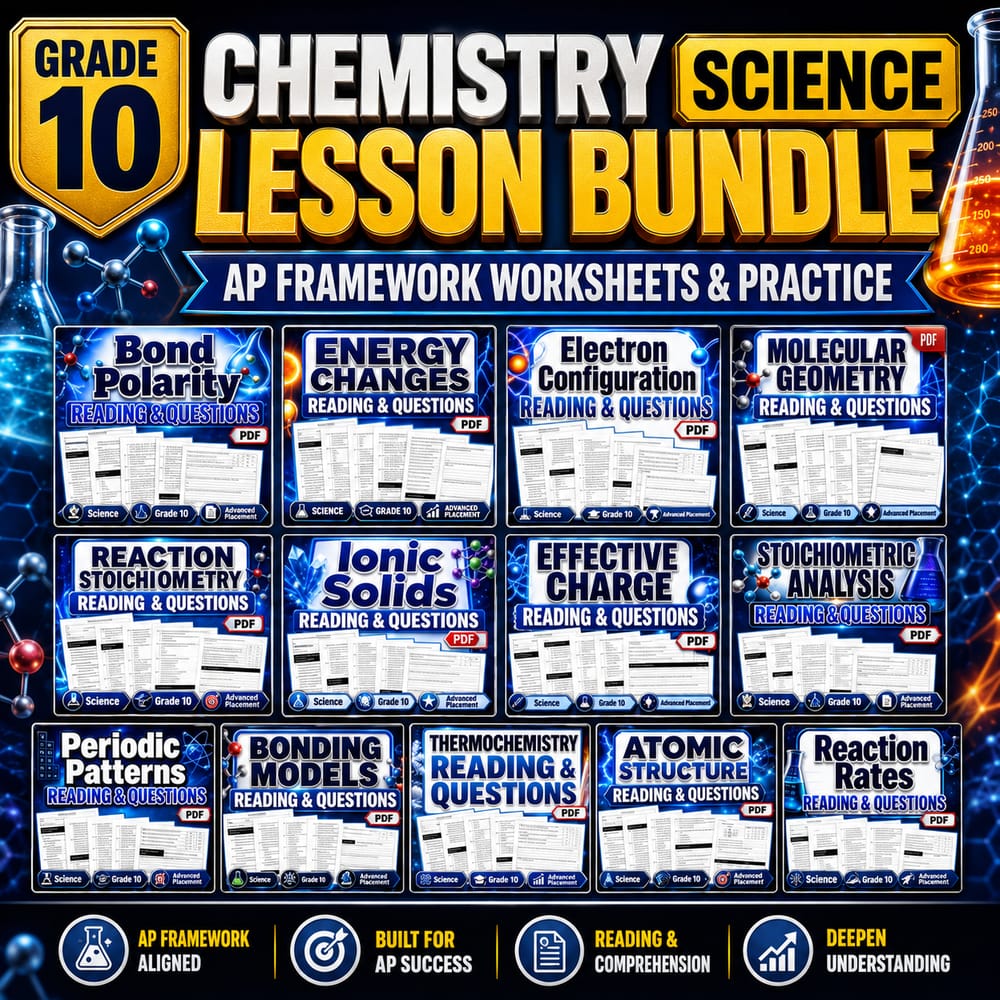


Grade 10 Chemistry Science Lesson Bundle AP Framework Worksheets Practice
$41.60$52.00Save $10.40
Evergreen Desk Education
·2 followers·17 sales
SubjectScienceGradeGrade 10Pages211 Pages
What’s included
13 worksheets · 211 pages · Save $10.40 (20%) · prices shown inside the bundle
 Grade 10 Science | Bond Polarity Worksheet (AP Standards) (PDF)
- Characterize bond polarity using electronegativity differences and describe how uneven electron distribution creates a bond dipole.
- Represent bond polarity with dipole moments (direction and magnitude) and relate vector ideas to electron density.
- Explain how polar covalent vs. ionic character varies on a continuum and connect polarity to intermolecular attractions and solubility.
$3.20$4.00 Grade 10 Science – Energy Changes Worksheet (AP) with Answer Key (PDF)
- Explain how energy changes during chemical reactions can be endothermic or exothermic and relate this to temperature changes.
- Describe the enthalpy idea qualitatively, including how bond breaking and bond formation contribute to reaction heat.
- Interpret simple potential energy diagrams to determine whether a reaction absorbs or releases energy and to discuss reaction pathways and spontaneity qualitatively.
$3.20$4.00 Grade 10 Science – Electron Configuration Worksheet (AP Standard) (PDF)
- Explain what the principal, angular, magnetic, and spin quantum numbers mean and how they describe an electron in an atom.
- Use orbital shapes and orbital-diagram rules to predict electron distribution and energy ordering.
- Connect electron configurations and valence patterns to periodic behavior, chemical reactivity, and simple magnetic properties.
$3.20$4.00 Grade 10 Science – Molecular Geometry Worksheet (AP Standards) PDF
- Define molecular geometry using electron-domain models (bonding and nonbonding electron domains).
- Predict common molecular shapes from electron-domain arrangements and basic hybridization ideas.
- Explain how molecular geometry relates to polarity and real-world structure–property relationships.
$3.20$4.00 Grade 10 Science – Reaction Stoichiometry Worksheet (AP) (PDF)
- Use the mole concept and molar mass to convert between mass, moles, and particle amounts in chemical reactions.
- Apply balanced chemical equations to determine stoichiometric mole ratios for mass-to-mass calculations.
- Identify the limiting reagent and calculate theoretical yield using mole ratios and unit analysis.
$3.20$4.00 Grade 10 Science – Ionic Solids Worksheet (AP Standard) (PDF)
- Explain how ionic crystal lattice structures and coordination number influence properties of ionic solids.
- Relate Coulombic attractions and lattice energy to melting point and electrical conductivity in solid vs. molten states.
- Use ion charge and ionic radius trends to predict how lattice energy affects solubility and melting point among salts.
$3.20$4.00 Grade 10 Science | Effective Charge Worksheet (AP Standards) Practice
- Explain effective nuclear charge (Zeff) and how inner-shell electrons provide shielding.
- Use simplified Zeff reasoning to predict trends in atomic radius, ionization energy, and electron affinity across an isoelectronic series.
- Connect Zeff-based mechanistic thinking to real periodic behavior and chemical reactivity.
$3.20$4.00 Grade 10 Science – Stoichiometric Analysis Worksheet (AP) PDF
- Use mole ratios to solve multi-step stoichiometry problems and track units consistently.
- Identify limiting reactants and determine theoretical yields from balanced chemical equations.
- Convert between mass, concentration, moles, and percent composition, including empirical formulas.
$3.20$4.00 Grade 10 Science Worksheet – Periodic Patterns | AP Standards (PDF)
- Explain how electron configurations, shielding, and effective nuclear charge (Z_eff) drive periodic trends across the periodic table.
- Interpret how atomic radius, ionization energy, and electronegativity change across periods and down groups.
- Use periodic position to predict reactivity and macroscopic properties such as metallic character and acid–base tendencies.
$3.20$4.00 Grade 10 Science Bonding Models Worksheet (AP) | PDF & Answer Key
- Compare ionic, covalent, and metallic bonding using electron-transfer and electron-sharing models.
- Use Lewis structures and basic molecular orbital ideas to explain structure and bonding behavior.
- Predict macroscopic properties (conductivity, melting point, and solubility) from bonding type.
$3.20$4.00
Reviews & Feedback
Loading reviews...
Questions & Answers
Loading questions…
About this bundle
Related categories
Frequently asked questions
Who is Grade 10 Chemistry Science Lesson Bundle AP Framework Worksheets Practice designed for?
Grade 10 Chemistry Science Lesson Bundle AP Framework Worksheets Practice is designed for Grade 10 students and Science learners and can be used in classrooms, homeschool, or independent practice.
How do I download Grade 10 Chemistry Science Lesson Bundle AP Framework Worksheets Practice?
Add it to your cart and complete checkout. After payment, you can download immediately from your account, and you'll also receive a download link by email.
Similar Products

Grade 10 Chemistry Lesson Bundle – AP Chemistry Concepts & Practice
$52.00$65.00

Grade 12 Chemistry Science Lesson Bundle Assessments | Alberta Framework
$60.00$75.00

Grade 10 Science Chemistry Foundations Lesson Bundle for AP Curriculum
$31.20$39.00

Grade 10 Chemistry Foundations Science Lesson Bundle: AP Worksheet Set
$48.00$60.00

Grade 11 Science Chemistry Lesson Bundle | Ontario
$48.00$60.00