
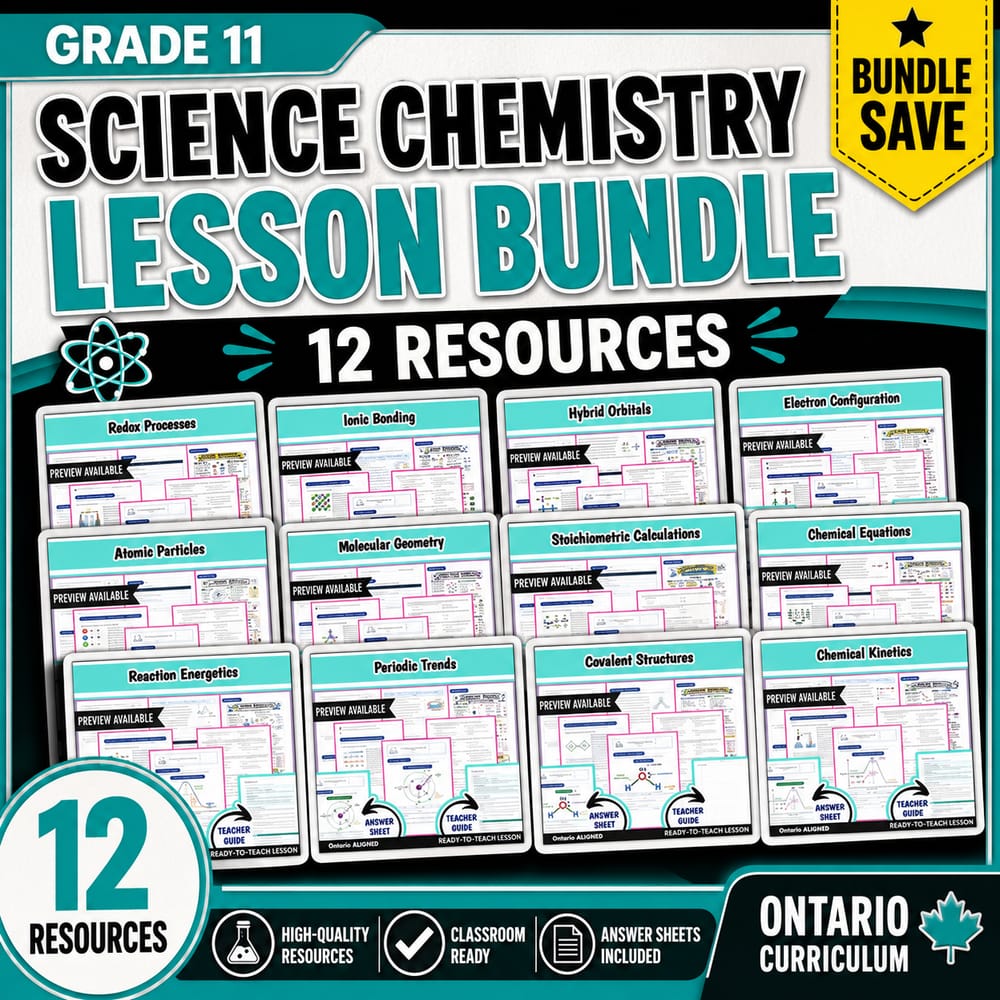


Grade 11 Science Chemistry Lesson Bundle | Ontario
$48.00$60.00Save $12.00
Chalk and Compass
·5 followers·13 sales
SubjectScienceGradeGrade 11
What’s included
12 worksheets · Save $12.00 (20%) · prices shown inside the bundle
 Grade 11 Redox Equations & Electrochemical Cells Worksheet | Ontario
- Use oxidation state conventions to identify what is oxidized and what is reduced.
- Write and systematically balance redox equations using half-reactions.
- Relate standard reduction potentials to spontaneity and predicted cell voltage.
$4.00$5.00 Grade 11 Ionic Bonding & Lattice Energy Worksheet | Ontario Chemistry
- Explain how electrostatic attraction leads to ionic bonding and crystal lattice formation
- Use Coulombic reasoning to describe how ion charge and ion size affect attraction
- Relate lattice energy to the stability and physical properties of ionic compounds
$4.00$5.00 Grade 11 Hybrid Orbitals & Molecular Bonding Models Worksheet | Ontario
- Explain how hybridization affects molecular geometry and the type of bonding (sigma versus pi).
- Describe the difference between localized covalent bonding and delocalized molecular orbitals in conjugated systems.
- Use orbital overlap ideas to predict bond multiplicity and bonding patterns.
$4.00$5.00 Grade 11 Electron Configuration Worksheet | Aufbau, Hund & Pauli Rules
- Use quantum numbers to describe how electrons fill orbitals in atoms.
- Write and interpret electron configurations using orbital notation and subshells.
- Apply Aufbau order, Hund’s rule, and the Pauli exclusion principle to predict electron arrangements.
$4.00$5.00 Grade 11 Atomic Particles and Isotope Properties Worksheet with Answer Key
- Explain how protons determine atomic number and how neutrons influence atomic mass and isotopes.
- Compare early atomic models with quantum-informed electron probability distributions.
- Relate nuclear stability, radioactive decay, and natural isotopic abundance to observable data.
$4.00$5.00 Grade 11 VSEPR Shapes and Molecular Polarity Worksheet | Ontario Science
- Use electron-domain reasoning and VSEPR to predict molecular geometry and approximate bond angles.
- Explain how lone pairs and molecular symmetry affect polarity and dipole moments.
- Connect molecular geometry to trends in intermolecular forces and physical properties such as boiling point and solubility.
$4.00$5.00 Grade 11 Mole-Based Stoichiometric Calculations Worksheet | Ontario Science
- Convert between mass, moles, and particle counts using molar mass and Avogadro’s number
- Determine the limiting reactant and theoretical yield in a chemical reaction
- Calculate percent yield from experimental and theoretical yields
$4.00$5.00 Grade 11 Balanced Chemical Equations & Reaction Types Worksheet | Ontario
- Represent chemical changes using balanced symbolic equations, including stoichiometric coefficients.
- Classify chemical reactions as synthesis, decomposition, combustion, and single or double displacement.
- Use the law of conservation of mass to justify balancing and interpret reaction notation with states of matter.
$4.00$5.00 Grade 11 Reaction Enthalpy & Energy Profiles Worksheet | Ontario Science
- Connect bond energies to reaction enthalpy changes and heat flow (endothermic vs exothermic).
- Use Hess’s law with standard enthalpies of formation to estimate reaction enthalpy.
- Interpret calorimetry ideas to relate measured heat transfer to enthalpy change.
$4.00$5.00 Grade 11 Periodic Trends & Effective Nuclear Charge Worksheet | Ontario
- Explain how effective nuclear charge and shielding affect atomic radius, ionization energy, and electronegativity across periods and groups.
- Predict and justify trends in ion formation and reactivity for representative elements.
- Use evidence from deviations from ideal trends to refine predictions about element behavior.
$4.00$5.00
Reviews & Feedback
Loading reviews...
Questions & Answers
Loading questions…
About this bundle
Related categories
Frequently asked questions
Who is Grade 11 Science Chemistry Lesson Bundle | Ontario designed for?
Grade 11 Science Chemistry Lesson Bundle | Ontario is designed for Grade 11 students and Science learners and can be used in classrooms, homeschool, or independent practice.
How do I download Grade 11 Science Chemistry Lesson Bundle | Ontario?
Add it to your cart and complete checkout. After payment, you can download immediately from your account, and you'll also receive a download link by email.
Similar Products

Grade 10 Chemistry Lesson Bundle – AP Chemistry Concepts & Practice
$52.00$65.00

Grade 11 Chemistry Practice Science Lesson Bundle – Ontario Worksheets
$38.40$48.00

Grade 10 Chemistry Review Science Lesson Bundle: Ontario Stoichiometry & Periodic Trends
$48.00$60.00

Grade 9 Chemistry Science Lesson Bundle Daily Reading Worksheets | Ontario
$51.20$64.00

Grade 10 Science Chemistry Foundations Lesson Bundle for AP Curriculum
$31.20$39.00