
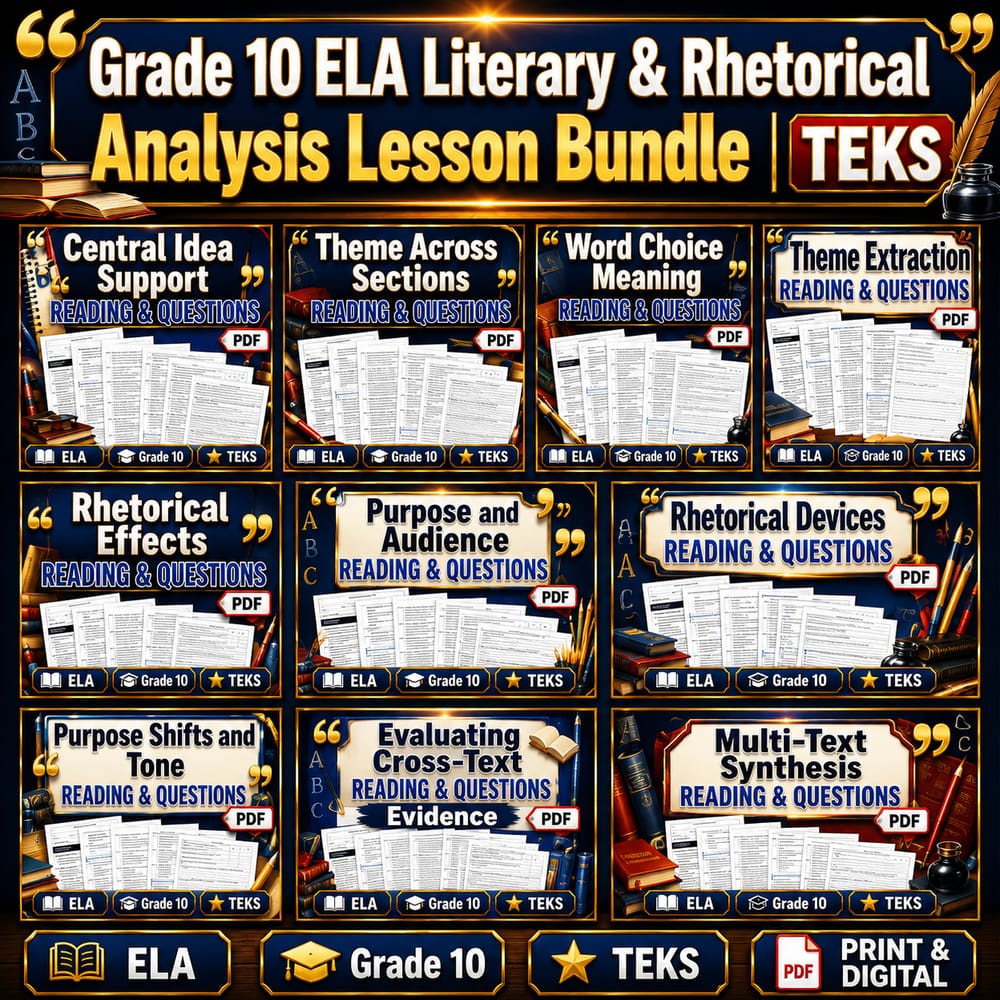
Grade 10 ELA Literary & Rhetorical Analysis Lesson Bundle | TEKS
$32.00$40.00Save $8.00
Golden Apple Studio
New·2 followers·3 sales
SubjectELAGradeGrade 10Pages161 Pages
What’s included
10 worksheets · 161 pages · Save $8.00 (20%) · prices shown inside the bundle
 Grade 10 Central Idea Support Worksheet | TEKS ELA Reading Analysis
- Determine a passage’s central idea and explain what the text is mainly about
- Use details (examples, definitions, and cause-effect relationships) to support a central idea
- Explain how ideas develop across paragraphs, including refinement or shifts in emphasis
$3.20$4.00 Grade 10 Theme Across Sections Worksheet | TEKS ELA Theme Analysis
- Explain how a text builds theme by developing ideas across multiple sections rather than stating one theme at the start
- Identify patterns (conflicts, reflections, perspective shifts) and describe how they change from early to later parts of a text
- Use evidence from different sections to show theme progression (confirmation, complication, or challenge of initial expectations)
$3.20$4.00 Grade 10 Word Choice Meaning Worksheet | TEKS ELA Vocabulary Analysis
- Analyze how connotation and implied attitude affect meaning in persuasive and informational text.
- Determine how precise word choice (nouns, verbs, adjectives, and modifiers) shapes tone, urgency, and credibility.
- Evaluate claims by examining diction, figurative language, abstract terms, and strategic repetition.
$3.20$4.00 Theme Extraction Worksheet for Grade 10 ELA | TEKS Literary Analysis
- Define theme as a central message revealed across a text rather than a single plot event
- Differentiate topic from theme by using evidence that shows recurring ideas, values, or social concerns
- Extract theme statements and explain how specific repeated situations, reflections, or contrasts support them
$3.20$4.00 Rhetorical Effects Worksheet for Grade 10 ELA | TEKS Literary Analysis
- Explain how rhetorical strategies change meaning and reader interpretation, not just identify devices
- Analyze cause-and-effect relationships between a writer’s choices and the audience’s understanding of claims
- Evaluate how framing, credibility signals, and contrast influence perceived fairness and urgency
$3.20$4.00 Grade 10 Purpose and Audience Worksheet | TEKS ELA Reading Analysis
- Infer an author’s purpose by analyzing structure, emphasis, and the selection of details in nonfiction and editorials.
- Identify audience awareness through diction, level of explicitness, and concessions or appeals within a text.
- Explain how purpose, evidence, and perspective work together to shape an author’s intent.
$3.20$4.00 Grade 10 Rhetorical Devices Worksheet | TEKS ELA Literary Analysis
- Identify rhetorical devices (contrast, analogy, repetition, rhetorical questions, parallelism, imagery) in arguments and narratives
- Explain how the placement and frequency of rhetorical devices strengthen a writer’s key claim or turning point
- Analyze how rhetorical structures guide readers’ emotional and logical responses
$3.20$4.00 Purpose Shifts and Tone Worksheet for Grade 10 ELA | TEKS Analysis
- Analyze how a writer’s purpose can shift in response to counterpoints and refined definitions.
- Explain how tone changes using evidence from diction, modality, and sentence rhythm.
- Connect structural moves in an argumentative or explanatory text to changes in language intensity and perspective.
$3.20$4.00 Grade 10 Evaluating Cross-Text Evidence Worksheet | TEKS ELA Analysis
- Evaluate sources for credibility and relevance before integrating evidence into a synthesis
- Compare how texts differ in perspective, scope, time frame, and consistency of evidence
- Identify bias, limitations, and conflicts among sources and explain how they affect conclusions
$3.20$4.00 Multi-Text Synthesis Worksheet for Grade 10 ELA | TEKS Analysis Skills
- Explain how synthesis builds a coherent understanding that combines ideas and evidence from multiple texts.
- Compare similarities and differences across texts, including distinct claims and varying emphasis.
- Use cross-text details to support an overall synthesis claim that goes beyond any single source.
$3.20$4.00
Reviews & Feedback
Loading reviews...
Questions & Answers
Loading questions…
About this bundle
Related categories
Frequently asked questions
Who is Grade 10 ELA Literary & Rhetorical Analysis Lesson Bundle | TEKS designed for?
Grade 10 ELA Literary & Rhetorical Analysis Lesson Bundle | TEKS is designed for Grade 10 students and ELA learners and can be used in classrooms, homeschool, or independent practice.
How do I download Grade 10 ELA Literary & Rhetorical Analysis Lesson Bundle | TEKS?
Add it to your cart and complete checkout. After payment, you can download immediately from your account, and you'll also receive a download link by email.
Similar Products

Grade 4 Literary Analysis and Character Development ELA Lesson Bundle - TEKS
$19.20$24.00

Grade 11 Literary Analysis ELA Lesson Bundle for Daily Reading | CCSS
$28.80$36.00

Grade 10 Literary Analysis & Text Evidence Lesson Bundle | General ELA
$24.00$30.00

Grade 7 ELA Literary Analysis & Writing Lesson Bundle | TEKS
$32.00$40.00

Literary Analysis Grade 9 ELA Daily Reading Worksheets Lesson Bundle | TEKS
$44.80$56.00