
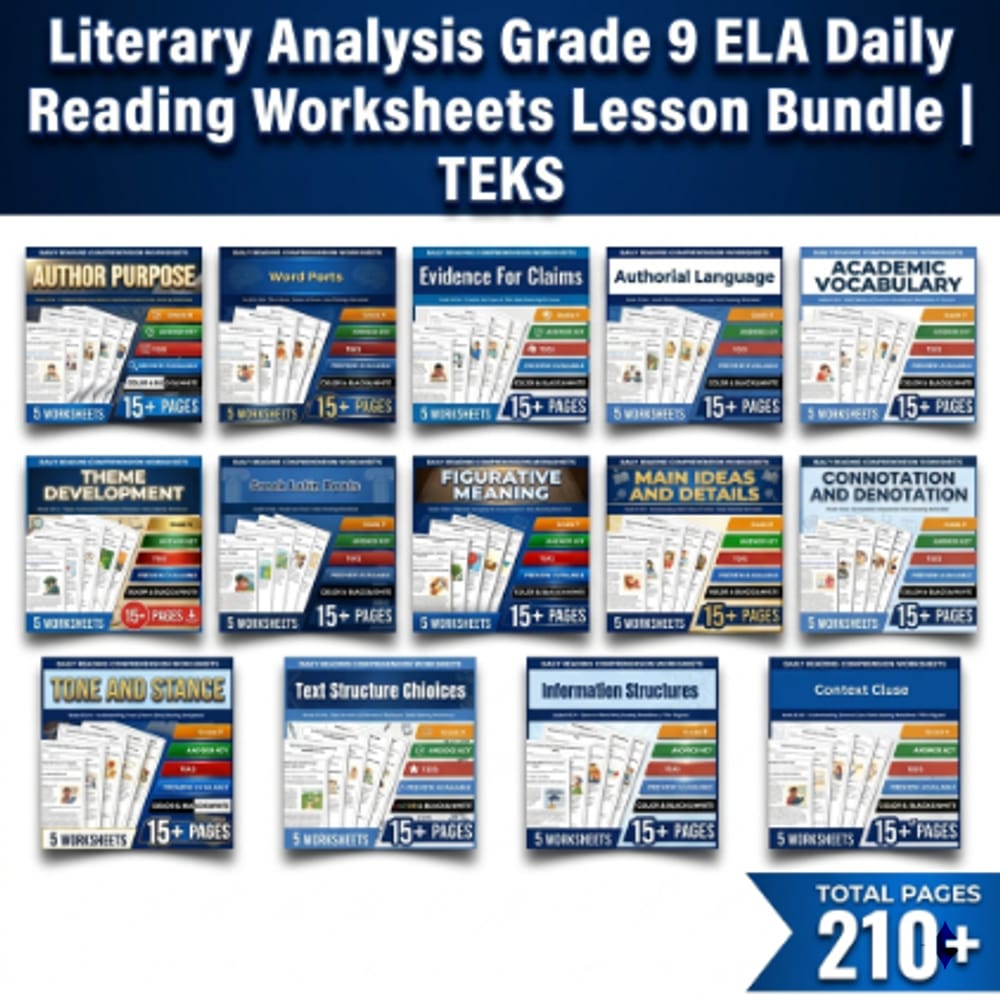


Literary Analysis Grade 9 ELA Daily Reading Worksheets Lesson Bundle | TEKS
$44.80$56.00Save $11.20
Quiet Forest Education
·3 followers·20 sales
SubjectELAGradeGrade 9Pages430 Pages
What’s included
14 worksheets · 430 pages · Save $11.20 (20%) · prices shown inside the bundle
 Grade 9 ELA – Understanding the Author's Purpose & Inform | Daily Worksheet
- Identify when an author’s intent is to inform readers.
- Analyze text features that reveal informative purpose.
- Differentiate between informational and other types of texts.
$3.20$4.00 Grade 9 ELA – Word Parts: Prefixes & Roots | Daily Reading Worksheet
- Identify common prefixes and their meanings
- Understand how prefixes change the meaning of base words
- Apply knowledge of prefixes to determine word meanings in context
$3.20$4.00 Grade 9 ELA – Evidence for Claims in Texts Daily Reading Worksheet
- Identify examples of direct support used by authors to strengthen claims
- Distinguish between relevant and loosely related evidence
- Analyze how evidence connects to an author's purpose
$3.20$4.00 Grade 9 ELA – Cause-Effect & Authorial Language Daily Reading Worksheet
- Identify cause-and-effect relationships within texts
- Recognize authorial signals such as 'because', 'as a result', 'although', and similar phrases
- Interpret how word choice and sentence patterns reveal logical connections
$3.20$4.00 Grade 9 ELA – Daily Reading & Academic Vocabulary | Worksheets & Practice
- Understand and define the word 'analyze' and its usage in academic contexts.
- Identify the meaning of academic vocabulary words in literary and informational texts.
- Develop skills to comprehend complex sentences using discipline-specific terms.
$3.20$4.00 Grade 9 ELA – Theme Development & Character Decisions | Daily Reading Worksheet
- Identify how character decisions reveal underlying themes.
- Analyze patterns of events and ideas that support a central message.
- Understand how themes develop gradually through shifting circumstances.
$3.20$4.00 Grade 9 ELA – Greek Latin Roots | Daily Reading Worksheet
- Understand key concepts related to ELA
- Apply knowledge through practice questions
- Demonstrate comprehension of the material
$3.20$4.00 Grade 9 ELA – Figurative Language & Literary Devices | Daily Reading Worksheet
- Identify similes and metaphors in literary texts
- Interpret the meaning of figurative expressions
- Analyze how figurative language enhances themes and mood in literature
$3.20$4.00 Grade 9 ELA – Understanding Main Ideas & Details | Daily Reading Worksheet
- Understand key concepts related to ELA
- Apply knowledge through practice questions
- Demonstrate comprehension of the material
$3.20$4.00 Grade 9 ELA – Connotation & Denotation | Daily Reading Worksheet
- Understand the difference between denotation and connotation of words.
- Identify literal and emotional meanings in context.
- Analyze how authors use connotation to shape tone and attitude.
$3.20$4.00
Reviews & Feedback
Loading reviews...
Questions & Answers
Loading questions…
About this bundle
Related categories
Frequently asked questions
Who is Literary Analysis Grade 9 ELA Daily Reading Worksheets Lesson Bundle | TEKS designed for?
Literary Analysis Grade 9 ELA Daily Reading Worksheets Lesson Bundle | TEKS is designed for Grade 9 students and ELA learners and can be used in classrooms, homeschool, or independent practice.
How do I download Literary Analysis Grade 9 ELA Daily Reading Worksheets Lesson Bundle | TEKS?
Add it to your cart and complete checkout. After payment, you can download immediately from your account, and you'll also receive a download link by email.
Similar Products

Grade 7 ELA Literary Analysis & Writing Lesson Bundle | TEKS
$32.00$40.00

Grade 10 ELA Literary & Rhetorical Analysis Lesson Bundle | TEKS
$32.00$40.00

Grade 4 Literary Analysis and Character Development ELA Lesson Bundle - TEKS
$19.20$24.00

Grade 12 ELA Daily Reading & Literary Media Literacy Lesson Bundle | Ontario
$112.00$160.00

Grade 10 Literary Analysis & Text Evidence Lesson Bundle | General ELA
$24.00$30.00