
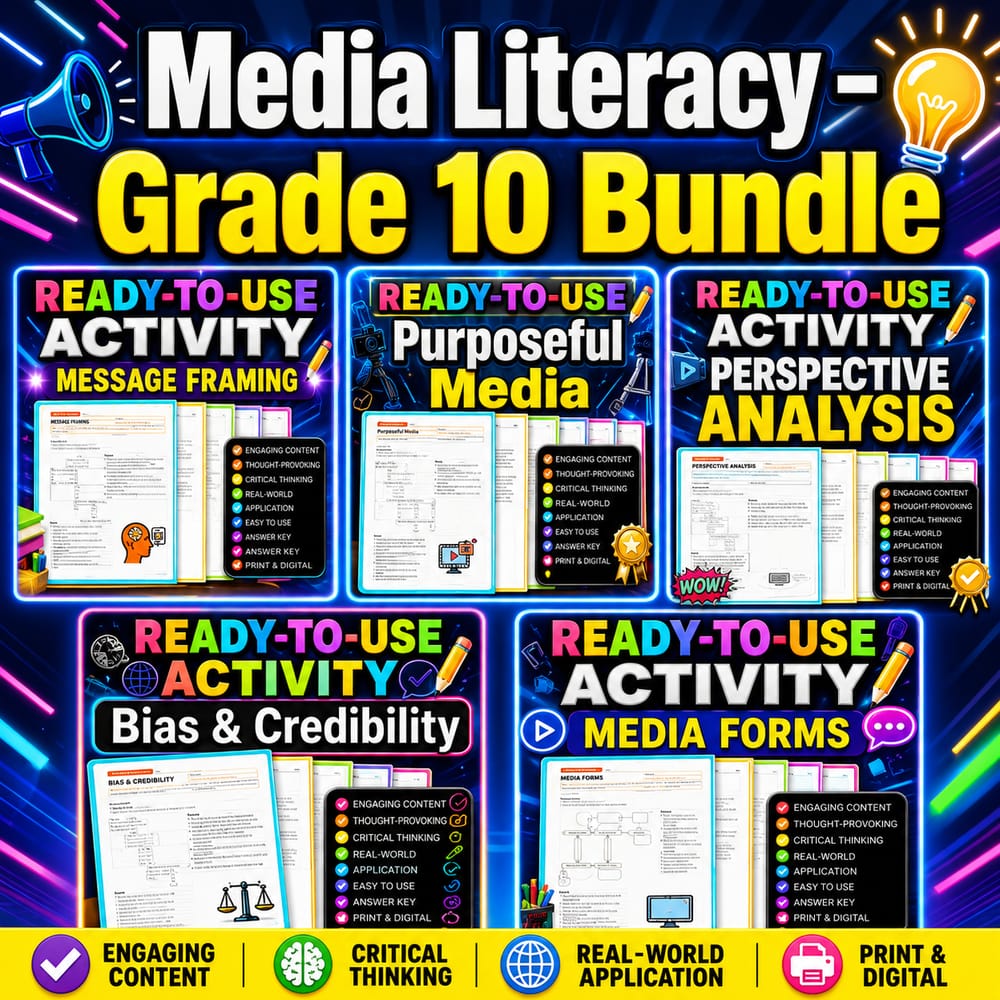
Grade 10 ELA Purposeful Media, Perspective & Bias Lesson Bundle | Alberta
$12.00$15.00Save $3.00
Sunny Desk Resources
·2 followers·18 sales
SubjectELAGradeGrade 10Pages55 Pages
What’s included
5 worksheets · 55 pages · Save $3.00 (20%) · prices shown inside the bundle
 Message Framing Worksheet Pack | Grade 10 ELA Practice
- Define message framing and explain how it influences interpretation in texts and media.
- Identify framing techniques such as headlines, captions, quotes, ordering, narration, and loaded language.
- Evaluate how framing can shape judgments about cause, responsibility, and importance.
$2.40$3.00 Purposeful Media Worksheet | Grade 10 ELA Practice and Review
- Explain how message, medium, and evidence work together to achieve a clear purpose for a specific audience.
- Identify how tone, structure, visuals, and pacing affect clarity and emotional impact.
- Apply ethical communication practices by attributing sources, avoiding misleading edits, and representing perspectives fairly.
$2.40$3.00 Perspective Analysis Worksheet Pack | Grade 10 ELA Practice
- Analyze how media choices shape perspective by focusing on whose voices are included or excluded.
- Evaluate how evidence and claim types (predictions vs. verified facts) affect credibility.
- Identify how audience expectations and imagery influence meaning and implied assumptions.
$2.40$3.00 Bias & Credibility Worksheet for Grade 10 ELA Practice
- Explain how source credibility depends on authorship, funding, and transparency.
- Identify bias by analyzing evidence quality, accuracy, and representation of multiple viewpoints.
- Evaluate media claims by checking for manipulated screenshots, out-of-context quotes, and selective omission.
$2.40$3.00 Media Forms Worksheet Pack | Grade 10 ELA Practice
- Analyze how media conventions (camera distance, pacing, layout, and sound) shape meaning and implied emphasis.
- Identify what a message foregrounds, omits, or normalizes by comparing the same idea across different media forms.
- Use media-form vocabulary to support interpretations with evidence.
$2.40$3.00
Reviews & Feedback
Loading reviews...
Questions & Answers
Loading questions…
About this bundle
Related categories
Frequently asked questions
Who is Grade 10 ELA Purposeful Media, Perspective & Bias Lesson Bundle | Alberta designed for?
Grade 10 ELA Purposeful Media, Perspective & Bias Lesson Bundle | Alberta is designed for Grade 10 students and ELA learners and can be used in classrooms, homeschool, or independent practice.
How do I download Grade 10 ELA Purposeful Media, Perspective & Bias Lesson Bundle | Alberta?
Add it to your cart and complete checkout. After payment, you can download immediately from your account, and you'll also receive a download link by email.
Similar Products

Grade 3 ELA Media & Purpose Signals Lesson Bundle | Alberta Framework
$20.00$25.00

Media Literacy Purpose, Audience & Bias Lesson Bundle | Grade 10 ELA | BC
$12.00$15.00

Grade 3 ELA Comprehension & Purpose Signals Lesson Bundle for Alberta
$16.00$20.00

Grade 12 ELA Purpose, Claim & Evidence Writing Lesson Bundle | Alberta
$48.00$60.00

Grade 10 Purposeful Communication ELA Lesson Bundle for Alberta Framework
$19.20$24.00