
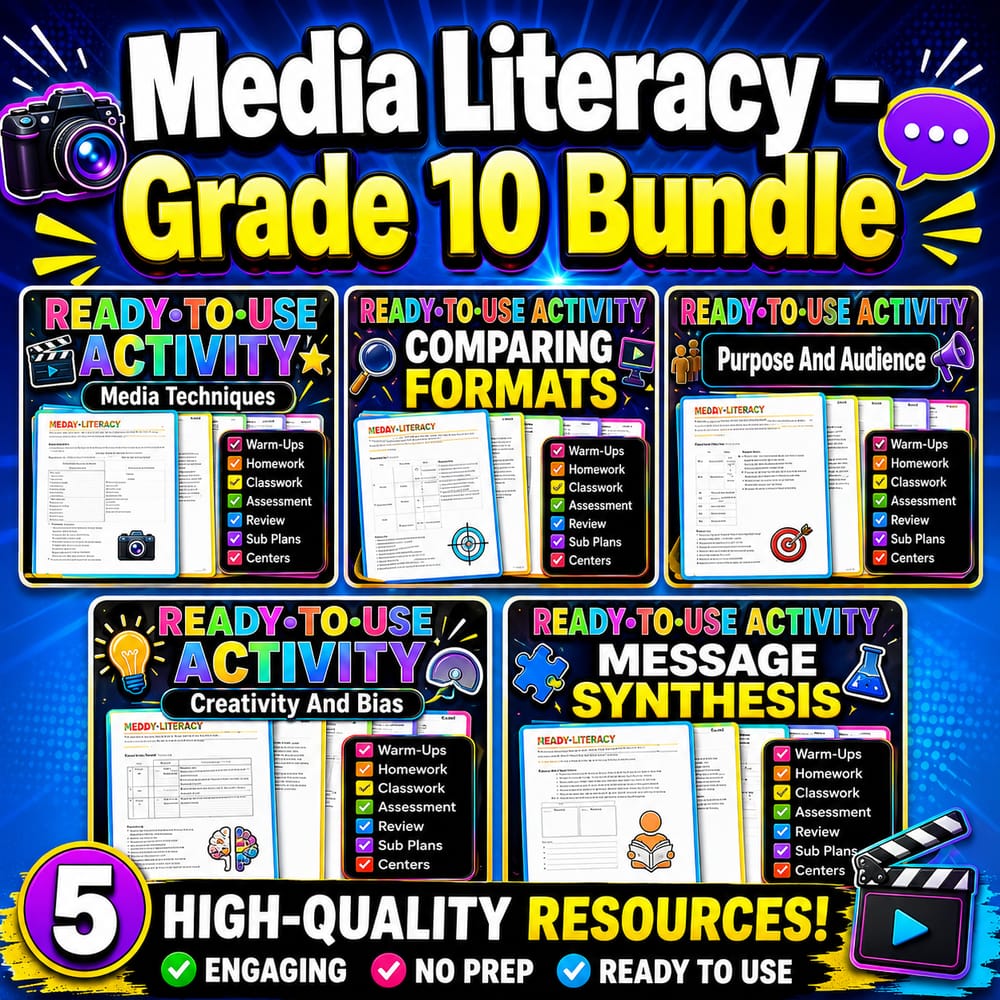
Media Literacy Purpose, Audience & Bias Lesson Bundle | Grade 10 ELA | BC
$12.00$15.00Save $3.00
Sunny Desk Resources
·2 followers·18 sales
SubjectELAGradeGrade 10Pages55 Pages
What’s included
5 worksheets · 55 pages · Save $3.00 (20%) · prices shown inside the bundle
 Media Techniques Worksheet Pack | Grade 10 ELA Practice
- Analyze how framing, imagery, pacing, color, captions, and music shape a media message
- Evaluate how changes in media techniques can shift meaning and emotional impact
- Use media-vocabulary terms to explain how authors guide audiences toward interpretation
$2.40$3.00 Comparing Formats Worksheet | Grade 10 ELA Practice
- Compare how the same idea is represented across different formats (news article, podcast, and video).
- Identify what stays consistent across formats (core claim) and what changes (support, framing, and interpretive guidance).
- Analyze how timing, visuals, and audio narration influence audience understanding.
$2.40$3.00 Purpose And Audience Worksheet Pack | Grade 10 ELA Practice
- Explain how purpose (inform vs persuade) shapes the content and tone of media.
- Identify how audience needs affect word choice, visuals, and the amount of background information.
- Compare two versions of a message to determine which choices fit each target audience and goal.
$2.40$3.00 Credibility And Bias Worksheet Practice | Grade 10 ELA Activities
- Explain how evidence quality, sourcing, and perspective affect credibility in media messages.
- Identify bias signals such as omission, selective quoting, and loaded wording.
- Evaluate whether support matches a claim and whether language shows certainty or exaggeration.
$2.40$3.00 Message Synthesis Worksheet Pack | Grade 10 ELA Practice
- Explain how framing, persuasive design, credibility, and audience goals work together to shape meaning across media formats.
- Compare evidence selection, tone, and context when the same topic appears in different sources or platforms.
- Synthesize information from multiple formats to predict likely audience reactions and influence.
$2.40$3.00
Reviews & Feedback
Loading reviews...
Questions & Answers
Loading questions…
About this bundle
Related categories
Frequently asked questions
Who is Media Literacy Purpose, Audience & Bias Lesson Bundle | Grade 10 ELA | BC designed for?
Media Literacy Purpose, Audience & Bias Lesson Bundle | Grade 10 ELA | BC is designed for Grade 10 students and ELA learners and can be used in classrooms, homeschool, or independent practice.
How do I download Media Literacy Purpose, Audience & Bias Lesson Bundle | Grade 10 ELA | BC?
Add it to your cart and complete checkout. After payment, you can download immediately from your account, and you'll also receive a download link by email.
Similar Products

Grade 9 ELA Media Literacy & Audience-Focused Messaging Lesson Bundle | Ontario
$14.40$18.00

Grade 4 Media Literacy Lesson Bundle | Ontario ELA Worksheets
$12.00$15.00

Grade 10 ELA Purposeful Media, Perspective & Bias Lesson Bundle | Alberta
$12.00$15.00

Grade 3 Ontario Media Literacy Messages, Facts & Bias Lesson Bundle | ELA
$12.00$15.00

Grade 10 ELA Media Literacy Worksheets Bundle | Alberta
$20.00$25.00