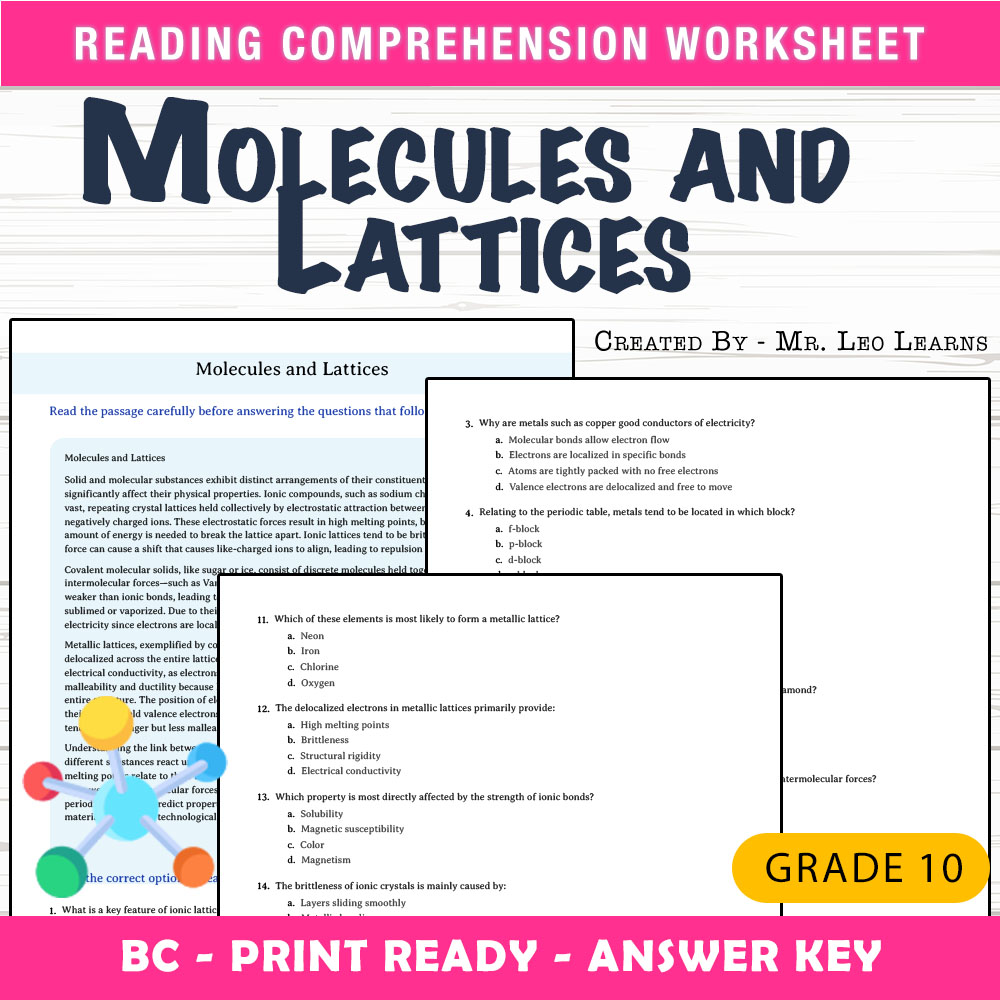
Imagine stepping into a classroom where students are grappling with understanding how different molecular structures influence material properties. Some are unsure why substances with ionic lattices have high melting points, while others find it challenging to distinguish between different types of solids. This worksheet provides a straightforward, print-ready tool that guides students through these concepts with clarity and confidence. Designed specifically for Grade 10 science, it focuses on the arrangement of particles in molecules and lattices, offering targeted practice to reinforce understanding of this fundamental topic in chemistry.
What This Resource Helps Students Do
This worksheet helps students develop a solid grasp of the differences between molecular and lattice structures at the atomic level. It encourages active engagement through a variety of question types that reinforce key ideas, such as particle arrangements and their effect on physical properties. The reading passage introduces core concepts, while the multiple-choice questions challenge students to apply their knowledge to real-world examples. By working through this resource, students build reasoning skills and deepen their understanding of how molecular structure impacts material behavior, preparing them for further study or assessments.
Inside the PDF
• 25 structured questions designed for step-by-step learning
• A print-ready format that requires no preparation
• A clear, organized layout suitable for classroom use or independent practice
• An answer key with rubric included for easy review and assessment
How It Improves Learning
This worksheet supports students in moving beyond memorization to deeper comprehension of molecular and lattice structures. The reading passage offers foundational context, helping students understand the arrangement of particles in solids. The multiple-choice questions prompt critical thinking, encouraging learners to analyze characteristics of ionic and covalent substances. Repetitive practice with these questions builds confidence and helps students recognize patterns in material properties, such as melting points and conductivity. The structured format guides students to reason logically and solidify their knowledge, making it easier to recall concepts during exams or class discussions. Overall, this resource turns challenging topics into accessible, meaningful learning experiences.
Core Skills Students Will Develop
- ➡️ Understanding the structure of molecular and lattice solids
- ➡️ Analyzing the relationship between particle arrangements and physical properties
- ➡️ Applying scientific vocabulary related to molecular structures
- ➡️ Developing critical thinking and reasoning skills
Ways Teachers Use This Worksheet
This worksheet is a flexible resource suitable for multiple instructional purposes. Teachers often assign it as in-class practice following a lesson, or use it as a homework assignment to reinforce key concepts. It can serve as an assessment tool during review sessions or small-group instruction, helping target areas where students need more support. Additionally, it is effective for early finishers who need additional challenge or for setting consistent formative assessments that track student progress over time. Its print-and-go format makes it easy to incorporate into existing lesson plans without extra preparation, ensuring that teachers can focus on engaging students and fostering understanding.
Why This PDF Saves Time
This resource delivers a ready-to-use worksheet in PDF format that requires no additional setup or editing. It’s designed to be printed immediately, saving valuable preparation time during busy teaching schedules. The included answer key with rubric facilitates quick review, enabling teachers to assess student understanding efficiently and provide timely feedback. Its layout ensures easy photocopying and distribution, supporting smooth classroom management. With this worksheet, teachers gain a reliable, consistent tool for lesson reinforcement, formative assessment, or independent practice, making daily instruction more effective and less time-consuming.
End your teaching with confidence knowing this tool supports student success at every stage. It is all set to print and helps ensure your students develop a clear, lasting understanding of molecules and lattices — empowering them with skills that build a strong foundation in chemistry. 😊