
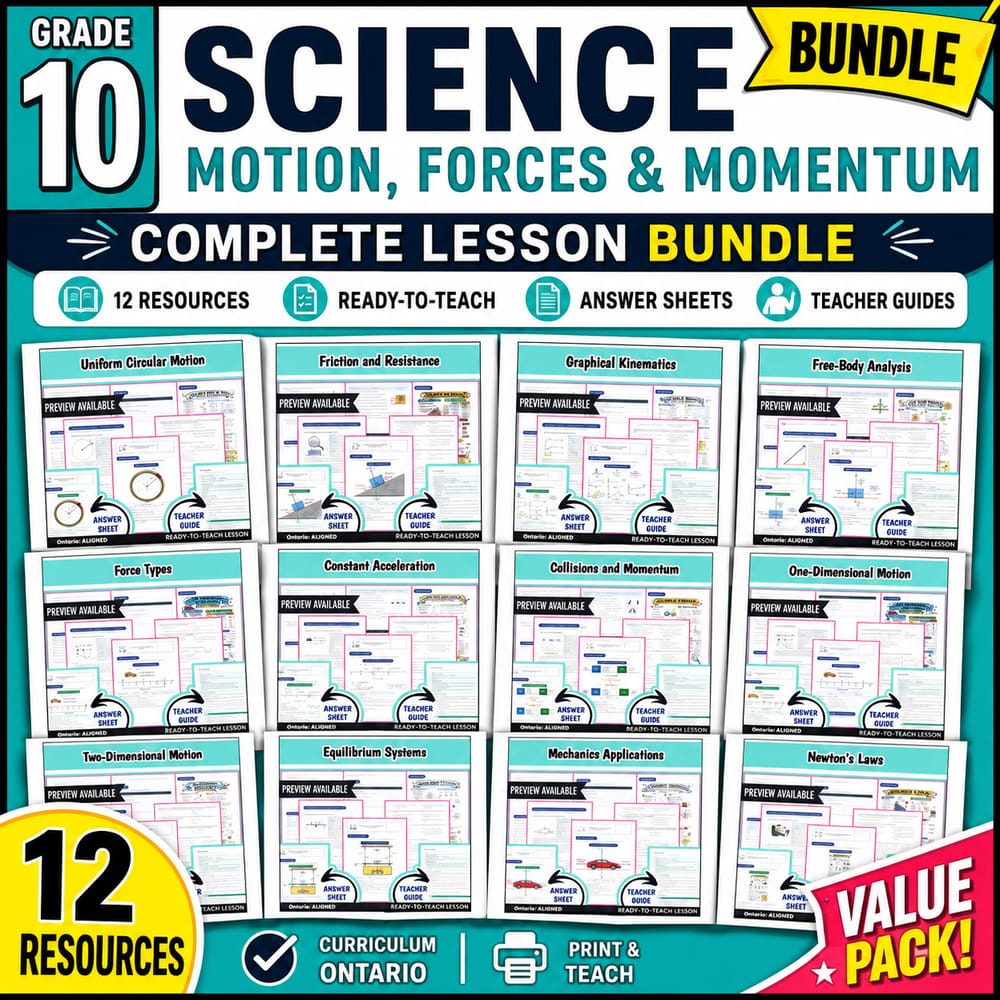


Grade 10 Science Motion, Forces & Momentum Lesson Bundle – Ontario Framework
$48.00$60.00Save $12.00
Chalk and Compass
·5 followers·13 sales
SubjectScienceGradeGrade 10
What’s included
12 worksheets · Save $12.00 (20%) · prices shown inside the bundle
 Grade 10 Uniform Circular Motion Worksheet | Angular & Radial Motion Ontario
- Explain how angular speed relates to linear speed in uniform circular motion using v = rω.
- Determine the centripetal acceleration and required inward net force for motion on a circular path.
- Interpret why a net inward force is necessary to keep an object moving along a curved trajectory.
$4.00$5.00 Grade 10 Friction and Resistance Worksheet | Ontario Physics Forces
- Differentiate static friction from kinetic friction and explain how they relate to motion starting versus sliding.
- Use the ideas of coefficients of friction, normal force, and surface properties to predict friction changes.
- Describe how air resistance and viscous drag depend on velocity and connect this to terminal speed.
$4.00$5.00 Grade 10 Graphical Kinematics Worksheet | Motion Graphs | Ontario Science
- Interpret displacement–time, velocity–time, and acceleration–time graphs in one-dimensional motion
- Connect the slope and area of kinematics graphs to physical quantities
- Compare piecewise motion and uniformly accelerating motion using graph features
$4.00$5.00 Grade 10 Free-Body Analysis Worksheet | Ontario Physics Forces
- Construct a free-body diagram by identifying all forces acting on an isolated object.
- Resolve forces into components using a consistent coordinate axis and sign convention.
- Combine force vectors to determine the resultant force and relate it to acceleration direction.
$4.00$5.00 Grade 10 One-Dimensional Motion Worksheet | Ontario Science Kinematics
- Classify common forces as contact or non-contact interactions.
- Describe how force direction and magnitude affect the motion of an object.
- Distinguish vector forces from scalar effects using everyday examples.
$4.00$5.00 Grade 10 Constant Acceleration & Composite Motion Worksheet | Ontario
- Use kinematic equations to determine displacement and velocity for one-dimensional motion with constant acceleration.
- Apply boundary conditions with consistent sign conventions to interpret negative acceleration and reversed motion.
- Analyze multi-stage motion by matching the correct equation to each stage and connecting initial and final values.
$4.00$5.00 Grade 10 Collisions and Momentum Worksheet | Physics Activity Ontario
- Define linear momentum and impulse and explain how impulse changes momentum.
- Apply conservation of momentum to two-body collisions in isolated systems.
- Distinguish elastic, inelastic, and perfectly inelastic collisions using momentum and kinetic energy ideas.
$4.00$5.00 Grade 10 One-Dimensional Motion Worksheet | Ontario Science Kinematics
- Define displacement, speed, velocity, and acceleration for motion along one axis using clear sign conventions
- Connect average and instantaneous quantities to their mathematical expressions
- Apply constant-acceleration equations to real motion scenarios, including free fall and uniformly accelerated vehicles
$4.00$5.00 Grade 10 Two-Dimensional Motion Worksheet | Projectile Motion Ontario Science
- Decompose an initial velocity into horizontal and vertical components and explain why perpendicular motions are independent.
- Use kinematic equations for projectile motion with uniform gravitational acceleration (ignoring air resistance) to find time of flight, range, and maximum height.
- Interpret projectile motion using vector ideas such as displacement, direction, and trigonometric resolution.
$4.00$5.00 Grade 10 Equilibrium Systems Worksheet | Static Balance of Forces & Moments
- Explain static equilibrium as the absence of net acceleration and relate it to ΣF = 0
- Identify how support reactions and tensions contribute to satisfying equilibrium constraints
- Interpret forces in rigid bodies using component reasoning and qualitative moment considerations
$4.00$5.00
Reviews & Feedback
Loading reviews...
Questions & Answers
Loading questions…
About this bundle
Related categories
Frequently asked questions
Who is Grade 10 Science Motion, Forces & Momentum Lesson Bundle – Ontario Framework designed for?
Grade 10 Science Motion, Forces & Momentum Lesson Bundle – Ontario Framework is designed for Grade 10 students and Science learners and can be used in classrooms, homeschool, or independent practice.
How do I download Grade 10 Science Motion, Forces & Momentum Lesson Bundle – Ontario Framework?
Add it to your cart and complete checkout. After payment, you can download immediately from your account, and you'll also receive a download link by email.
Similar Products

Newtonian Motion, Momentum & Forces Lesson Bundle | Grade 9 Science | ngss
$19.20$24.00

Grade 10 Science Lesson Group: Motion & Forces Ontario Curriculum Bundle
$28.80$36.00

Grade 9 Motion & Forces Science Lesson Bundle | AP Kinematics & Forces
$9.60$12.00

Grade 10 Science Lesson Bundle | Physics and Motion Ontario Framework
$28.80$36.00

Grade 10 Motion & Forces Kinematics Science Lesson Bundle for Ontario
$48.00$60.00