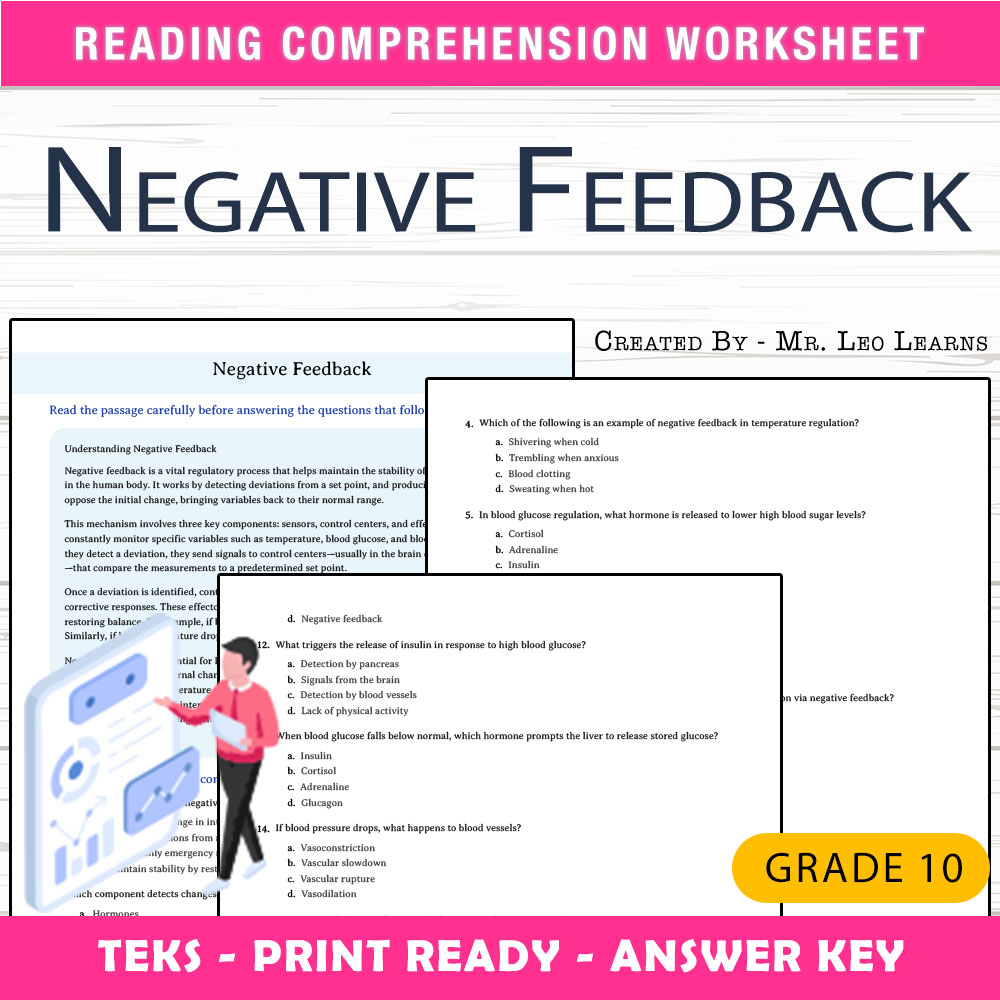
Imagine you're in your classroom, observing students struggling to grasp how the body maintains stability through processes like negative feedback. They might find it challenging to understand how different components detect and respond to changes in internal conditions, such as temperature or hormone levels. This worksheet provides a clear, structured way to help students deepen their understanding of negative feedback mechanisms. It guides them step-by-step through key concepts, with questions designed to reinforce their grasp of physiological regulation and homeostasis, making complex science accessible and manageable in a classroom setting.
What This Resource Helps Students Do
This worksheet is tailored to support students in mastering the concept of negative feedback and its role in maintaining internal stability. It encourages independent thinking and reinforces the connection between theoretical knowledge and real-world biological processes. Through a combination of reading comprehension and multiple-choice questions, students can develop critical thinking skills while building confidence in their understanding of how the body reacts to changes. The structured questions help students identify key parts of feedback loops, interpret diagrams, and apply their knowledge to new situations, fostering a comprehensive grasp of this essential biological concept.
Inside the PDF
• 1 reading passage explaining negative feedback and its importance in biological regulation
• 25 multiple-choice questions focused on identifying components and functions in feedback loops
• A printable, user-friendly format suitable for immediate classroom use
• Clear layout designed for photocopying and easy distribution to students
How It Improves Learning
This worksheet improves student learning by breaking down complex ideas into manageable segments, allowing students to process and understand each step clearly. The reading passage introduces key concepts in an engaging way, setting a strong foundation before moving into questions that reinforce understanding. Multiple-choice questions challenge students to recall and apply their knowledge, turning passive reading into active learning. The structure helps students identify important details, analyze biological processes, and develop reasoning skills. Teachers will find that this resource effectively bridges the gap between theoretical content and practical understanding, boosting student confidence and mastery of the topic.
Core Skills Students Will Develop
- ➡️ Comprehension of biological processes
- ➡️ Understanding of feedback mechanisms
- ➡️ Application of scientific concepts
- ➡️ Critical thinking and reasoning skills
Ways Teachers Use This Worksheet
Teachers may assign this worksheet as part of classwork to introduce or review the topic of negative feedback. It works well as a homework assignment to reinforce lesson content after class discussions. It is also an effective tool for assessment review, helping identify student strengths and areas needing additional support. Small-group work can utilize this worksheet for collaborative learning, or it can serve as early finisher work for students who complete regular activities ahead of schedule. Its straightforward, print-ready format makes it easy to incorporate into daily lesson plans without extra preparation time.
Why This PDF Saves Time
This resource is designed to be ready to print and use immediately, saving teachers valuable prep time. The layout is clean and simple, requiring no additional formatting. The included answer key with rubric offers an objective way to assess student responses efficiently, ensuring consistency in grading. With its print-and-go format, teachers can quickly distribute the worksheet during lessons or as an independent activity, allowing more time for classroom instruction and student support.
Teachers can confidently incorporate this worksheet into their lessons, knowing it is student-centered, teacher-friendly, and aligned with key biological principles of homeostasis and regulation. Its straightforward design ensures that students engage actively with the content, helping them build the foundational knowledge needed to succeed in higher-level science. 😊